Research Theme
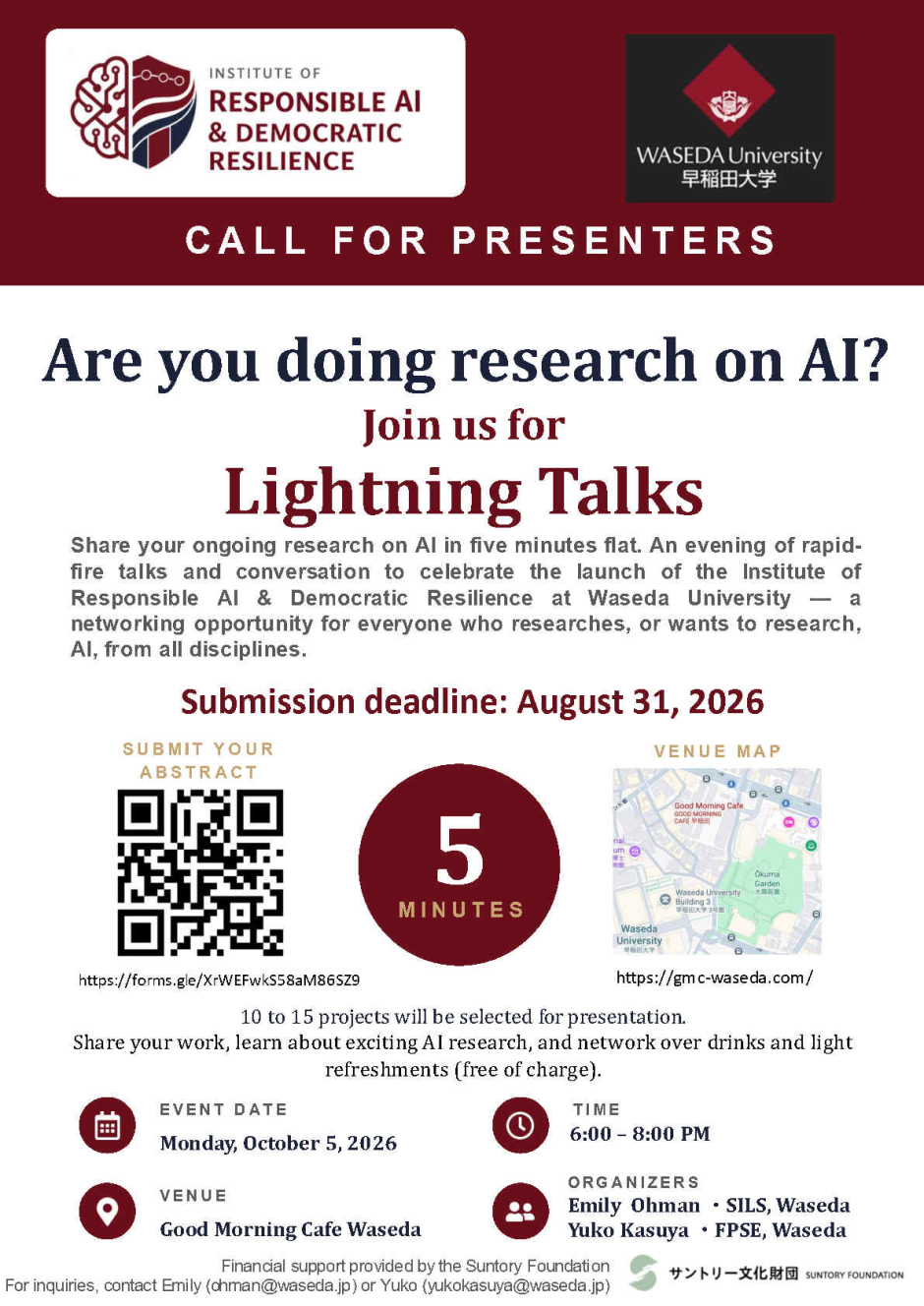
The institute focuses on how generative AI and platform dynamics scale persuasive messaging and affect polarization and democratic resilience.
Research Director
OHMAN, Emily
Faculty of International Research and Education, School of International Liberal Studies
Project Members
- KASUYA, Yuko Professor, School of Political Science and Economics, Faculty of Political Science and Economics
- KOBAYASHI, Tetsuro Professor, School of Political Science and Economics, Faculty of Political Science and Economics
- OHMAN, Emily Associate Professor, School of International Liberal Studies, Faculty of International Research and Education
- Wang, Jinfang Professor, School of International Liberal Studies, Faculty of International Research and Education
Research Keywords
Democratic Resilience, Responsible AI, Large Language Models (LLMs), Information Integrity, Computational Social Science, Political Communication, Polarization Dynamics
Research Summary
The rapid adoption of generative AI and large language models (LLMs) is transforming core societal domains, including information access, journalism, political communication, and public services. At the same time, platform incentives and AI-enabled content production are reshaping the public information environment—lowering the cost of persuasive messaging, amplifying emotionally charged and moralized rhetoric, and accelerating polarization. This institute brings together political science, political psychology/communication, and computational social science with multilingual NLP/ML to investigate how these dynamics work: how exposure to persuasive and affective content changes attitudes and behavior, when and why publics become polarized, and how shared realities fragment across groups. Our outputs emphasize cross-national comparative evidence, shared datasets and coding protocols, and empirical studies (including surveys and experiments) that connect content features to public opinion and political outcomes.