Research Theme
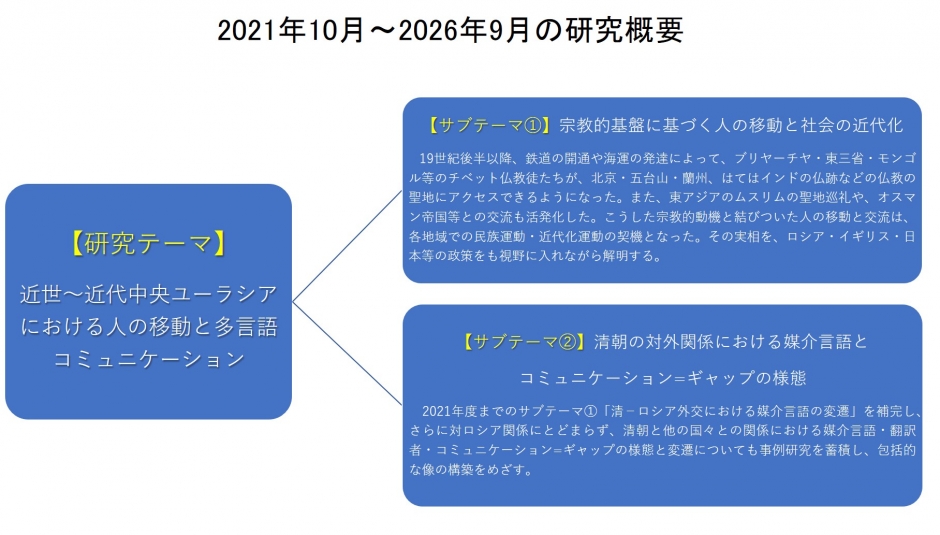
Human Migration and Social/Cultural reorganization in Early Modern to Modern Central Eurasia
Research Director
YANAGISAWA, Akira
Faculty of Letters, Arts and Sciences, School of Culture, Media and Society
Project Members
- IIYAMA, Tomoyasu Professor, School of Humanities and Social Sciences, Faculty of Letters, Arts and Sciences
- ISHIHAMA, Yumiko Professor, School of Education, Faculty of Education and Integrated Arts and Sciences
- NISHIDA, Fuminobu Professor, School of Education, Faculty of Education and Integrated Arts and Sciences
- YANAGISAWA, Akira Professor, School of Culture, Media and Society, Faculty of Letters, Arts and Sciences
- AKASAKA, Tsuneaki
- AOKI, Masahiro
- BATTSENGEL, Natsagdorj
- BORJIGIN, Burensain
- Chaoketu
- DA, Gula
- FUNADA, Yoshiyuki
- Geriletu
- HAMAMOTO, Mami
- HAMANAKA, Saya
- INOUE, Osamu
- INOUE, Takehiko
- KOBAYASHI, Ryosuke
- KOMATSUBARA, Yuri
- MENG, Dalai
- NAGASHIMA, Iku
- NAMSARAEVA, Sayana
- QI, Jinxin
- SUZUKI, Nirei
- TACHIBANA, Makoto
- TAKAGI, Sanae
- TANITA, Nobuharu
- TODORIKI, Masahiko
- Tsengel
- UNNO, Noriko
- UNO, Nobuhiro
- WU Nier
Research Keywords
Central Eurasia Tibet Mongolia Buddhism
Research Summary
Our research theme from 2026 on, “Human Migration and Social/Cultural reorganization in Early Modern to Modern Central Eurasia,” is essentially positioned as a continuation and development of the research theme from 2021 to 2026, “Human Migration and Multilingual Communication in Early Modern to Modern Central Eurasia.” The reason for replacing “multilingual communication” with “social and cultural restructuring” is to encompass a
broader range of social and cultural transformations that go beyond mere linguistic contact and change.
We will set the following two specific research topics.
① To clarify the formation and development process of the Buddhist network originated in Central Eurasia and expended to other Asian regions (including Japan) and even to Europe andAmerica. The approach focuses on the activities of Buddhists across Asia (including Japan), Europe and America, and aims to reinterpret them as a process of formation and development of a Buddhist network centered on the “Tibetan Buddhist sphere,” which encompasses the Himalayas, Tibet, Mongolia, and Manchuria.
② To examine what kinds of changes has been brought about to local societies, cultures and economics in various parts of Central Eurasia by the immigration from mainland China, the Korean Peninsula and Japan. In the workshop “Agricultural Development in Modern Northeast China and Inner Mongolia,” held in March 2026, topics included paddy field development by immigrants from the Korean Peninsula, upland farming by immigrants from mainland China, and industrial restructuring by Japan from the 1930s onward. However, the commentator pointed out that many aspects of the social order changes resulting from these population movements remain unclear. The approach aims to directly address this point.
Taking the above two approaches into account, ① represents a movement originating in Central Eurasia and extending outward, while ② represents a movement from surrounding regions toward Central Eurasia. At first glance, the two might seem to be completely different in phase, but in reality, it is expected that there are many connecting points and interactions between the two movements.
Approach ① will be carried out under the leadership of Yumiko Ishihama, assisted by Fuminobu Nishida, and with the cooperation of approximately 10 visiting researchers.
Approach ② will be carried out under the leadership of Akira Yanagisawa,, assisted by Tomoyasu Iiyama, and with the cooperation of approximately 10 visiting researchers.
In carrying out these research projects, academic cooperation with various regions of Central Eurasia is critically important. that make up Central Eurasia are important, given the limitations on research exchanges with Russia and China, we would like to make every effort to build relationships with Mongolia, Central Asian countries, and regions outside of Central Eurasia.
Since the current research theme essentially inherits the theme from 2021 to 2026, and the name of the institute has already gained a certain level of recognition in academic circles both domestically and internationally, it is considered appropriate to re-establish the institute under the same name.