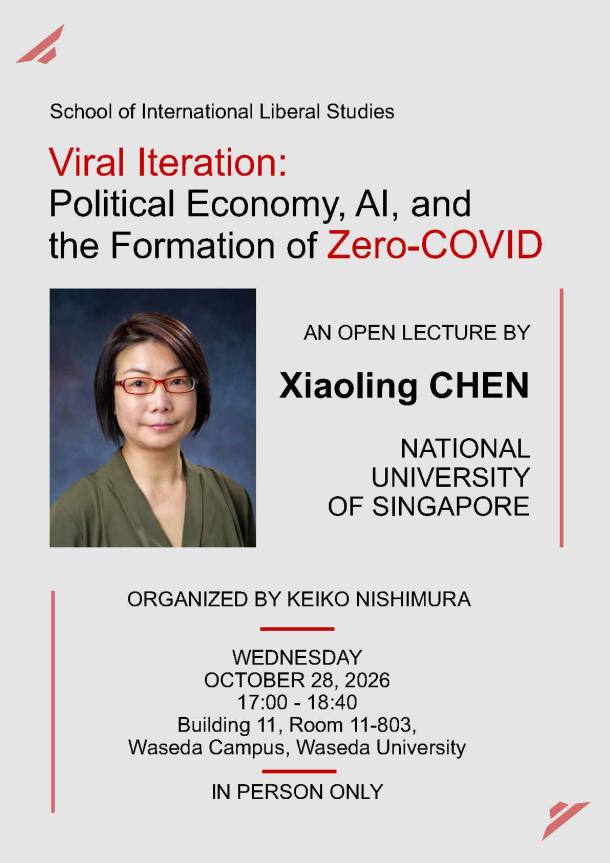
【Open Lecture】Viral Iteration: Political Economy, AI, and the formation of Zero-COVID through the Lens of China’s Health Code System

Dates
Add to calendar1028
WED 2026- Place
- 早稲田キャンパス11号館803号室/Bldg.11, Room803, Waseda Campus
- Time
- 17:00-18:40
- Posted
- Mon, 12 Oct 2026
Open Lecture Information
タイトル/Title:
Viral Iteration: Political Economy, AI, and the formation of Zero-COVID through the Lens of China’s Health Code System
講師/Lecturer:
CHEN, Xiaoling
Postdoctoral Fellow, Asia Research Institute, National University of Singapore;
Visiting Scholar, the German Institute for Japanese Studies in Tokyo
日時/Day and Time:
Wednesday, 28th October, 2026, 17:00-18:40
場所/Venue:
Bldg.11, Room803, Waseda Campus (in-person only)
言語/Language:
Presented in English (No translation)
入場/Admission:
Free and open to everyone
Abstract:
While many countries adopted digital surveillance for COVID-19 contact tracing, none implemented it as pervasively or invasively as China through its health code system. The health code exemplified a color-coded mechanism to categorize individuals, populations, spaces, and entire regions or countries—where green, yellow, and red codes meant low, medium, and high risk of COVID-19 exposure or outbreak, respectively. Throughout 2022, long after much of the world had lifted COVID restrictions, these apps continued to dictate mobility and access to public spaces and services for millions of Chinese citizens, leaving many quarantined in centralized facilities or locked down in their communities.
Contrary to the common perception of the health code as a single app, this paper conceptualizes it as an interconnected technopolitical apparatus comprising four big-data-based, algorithm-driven projects: the health code (健康码), travel card (行程卡), time-space companion (时空伴随者), and venue code (场所码). As SARS-CoV-2 mutated, these projects were iteratively developed, promoted, and integrated into the health code system, constituting what I term “viral iteration.” Drawing on ethnographic fieldwork across police stations, public hospitals, public health facilities, and communities, this paper highlights the technological and institutional logics underlying viral iteration. It demonstrates how technology corporations, public security systems, legal entities, and grassroots organizations—which collectively constitute China’s political, economic, and sociocultural infrastructures—were co-opted into contact tracing and the broader zero-COVID apparatus. Building on literature regarding Chinese authoritarianism, this paper advances the concept of “infrastructural power” to explain the party-state’s ability to mobilize infrastructures for social control.
Xiaoling Chen is an interdisciplinary scholar with training in human geography and medical anthropology. Xiaoling is currently an in-residence Postdoctoral Fellow at the Asia Research Institute, National University of Singapore (NUS), and a visiting scholar at the German Institute for Japanese Studies in Tokyo.
This talk is organized by Keiko Nishimura (Assistant Professor, School of International Liberal Studies, Waseda University).