
Event Report:Public Lecture by Rachel Saunders, Assistant Professor at Princeton University
Dates
カレンダーに追加0116
FRI 2026- Time
- 17:00~18:30
- Posted
- Fri, 13 Mar 2026
Public Lecture by Rachel Saunders, Assistant Professor at Princeton University
Kachōga: Picturing Other-than-Human Being in Japanese Painting
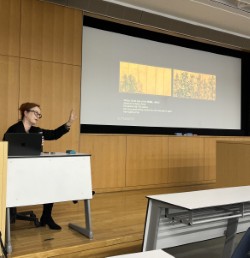
Despite being one of the major genres of East Asian painting, kachōga (bird-and-flower painting) has historically been undervalued in Asia, in part because its verisimilar depictions by professional painters were regarded as merely technical. Meanwhile, it has also been trivialized in the West, reduced somewhat myopically to a repertoire of symbols. Today, how many of the birds and plants depicted in premodern kachōga can we accurately identify by name? These questions emerged through Professor Rachel Saunders’s work while she was curating Painting Edo: Japanese Art from the Feinberg Collection at the Harvard Art Museums (February 14, 2020–June 6, 2021). This exhibition, the largest of its kind since the museum’s founding, was forced to close just three weeks after opening due to the global pandemic. Searching for alternative ways to bring the exhibition to viewers, Professor Saunders began sharing works online. These included many kachōga paintings, Sakai Hōitsu’s Birds and Flowers of the Twelve Months among them, which were accompanied by descriptions and analyses from botanists. This initiative led to an unexpected result—by identifying the depicted flora and fauna with biological precision, the paintings’ cultural contexts emerged in strikingly multidimensional ways, enabling richer readings than even art historians had anticipated. The online exhibition was met with great enthusiasm, and for Professor Saunders, it became the starting point for a new line of inquiry.
In his recent book Elderflora, geohumanist Jared Farmer highlights how megaflora, such as ancient trees, can, like ancient scriptures, serve as bridges between human and geological time. While humans may be adept at looking back, Farmer argues that we have much work to do to improve our foresight and connections to the distant future. Unless we radically alter our patterns of attentional engagement, he writes, we will continue to fail catastrophically.
Yet many of us are plagued by “plant blindness,” a cognitive bias that prevents us from noticing or recognizing plants in our everyday lives. Art historians come face to face with this when challenged to name the flora and fauna depicted in paintings, labelling them simply as “tree,” “flower,” or “small bird” instead of camellia, fleabane, or flycatcher. Without sufficient attention to the language we use to describe these motifs, we fail to fully comprehend pictured, written, and living other-than-human beings, to our own detriment but even more so to theirs.
In shining a new light on kachōga, Professor Saunders’s presentation revealed the rich possibilities for future art historical research. She not only guided us toward new methodologies for grappling with questions concerning humans/other-than-human beings but also demonstrated new avenues for expanding and renewing the classical art historical methodology of iconography as we seek to “read” paintings more deeply.
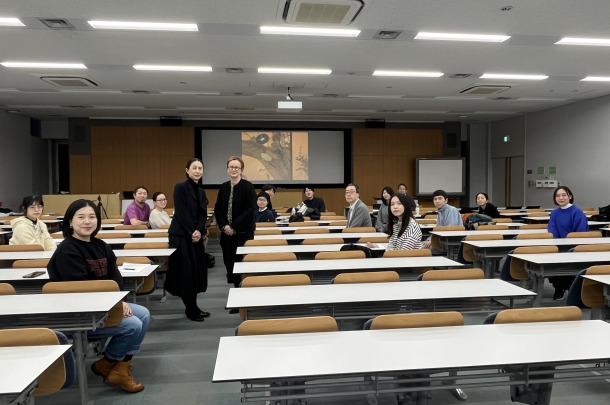
The event was attended by graduate students and faculty from Waseda University, Columbia University, and the University of Tokyo. Following the lecture, the event was extended to allow for a vibrant question-and-answer session with the roughly twenty participants.
Event Details:
- Date/Time: Friday, January 16, 2026, 17:00–18:30
- Location: Classroom 382, Building 36, Waseda University Toyama Campus
Time Schedule:
- 17:00 Speaker Introduction (Yamamoto Satomi)
- 17:05–18:20 Public Lecture
Rachel Saunders “Kachōga: Picturing Other-than-Human Being in Japanese Painting” - 18:20–19:00 Q&A Session
Organizer: Ryusaku Tsunoda Center of Japanese Culture, Research Institute for Letters, Arts, and Sciences, Waseda University