Event Report: Public Lecture by Jennifer Guest, Associate Professor at the University of Oxford
Dates
カレンダーに追加1202
TUE 2025- Place
- Meeting Room 1, Floor 3, Building 33, Toyama Campus, Waseda University
- Posted
- Fri, 13 Mar 2026
Public Lecture by Jennifer Guest, Associate Professor at the University of Oxford
‘The sign of the newt: chastity and illicit romance in the language of Toshiyori zuinō‘
「ゐもりのしるし-「俊頼髄脳」に見える貞節と密通の歌ことば」
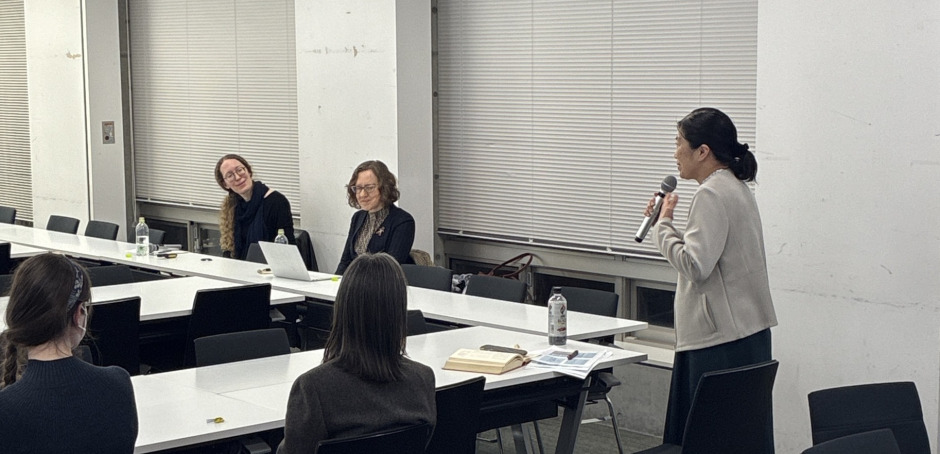
On December 2, 2025, Jennifer Guest, Associate Professor at the University of Oxford, delivered a lecture titled “The Sign of the Newt: Chastity and Illicit Romance in the Language of Toshiyoru zuinō” in Meeting Room 1, Building 33, Waseda University’s Toyama Campus.
Professor Jennifer Guest specializes in classical Japanese literature, with particular focus on the reception of Chinese texts in Japan from the tenth to the thirteenth centuries, as well as on education, translation practices, and the dissemination of literary language (bungo). On this occasion, she presented a portion of the research she conducted during her seven-month tenure as a visiting scholar at Waseda University.
In her lecture, Professor Guest examined episodes and poems concerning the “sign of the newt” (imori no shirushi) in Toshiyori zuinō, a treatise on waka poetics written by Minamoto no Toshiyori in the early twelfth century for Fujiwara no Kunshi. It was believed that if the “sign” (blood) of a “newt” (imori) were painted onto a woman’s arm, the mark would last eternally—unless she committed adultery, in which case the mark would disappear and her misconduct would be exposed. This belief derives from ancient Chinese literature, including Yan Shigu’s commentary on the biography of Dongfang Shuo in the Book of Han, as well as the Hokke genzan. The lecture explored how this story entered the discourse of waka poetry and came to be discussed in poetic treatises, while also considering how the “sign of the newt” functions within Toshiyori zuinō as a potentially didactic discourse directed at women. Drawing on a wide range of related materials, Professor Guest’s analysis
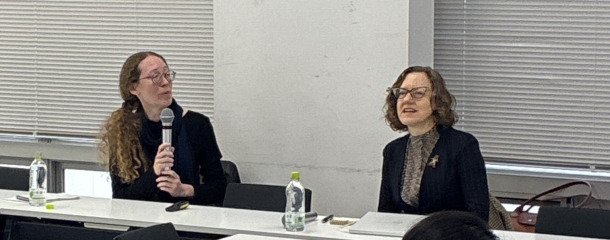
Following the lecture, Christina Laffin, Associate Professor at the University of British Columbia, offered comments, first praising Professor Guest’s meticulous close reading and extensive engagement with relevant sources, and noting her multidimensional, systematic analysis of the discourse under consideration. She also commented on the relative dearth of scholarship on Toshiyori zuinō in Japan and internationally and raised further questions regarding the extent to which the text’s discourse was connected to and contributed to the education of imperial women during the Heian period. She additionally addressed the difficulty of translating words such as imori and mushi, identifying new directions for future research.
The event concluded with a rich discussion featuring questions and comments from the audience.
Event Details
- Date/Time: Tuesday, December 2, 2025, 15:30–17:00
- Format: In-person (Meeting Room 1, Floor 3, Building 33)
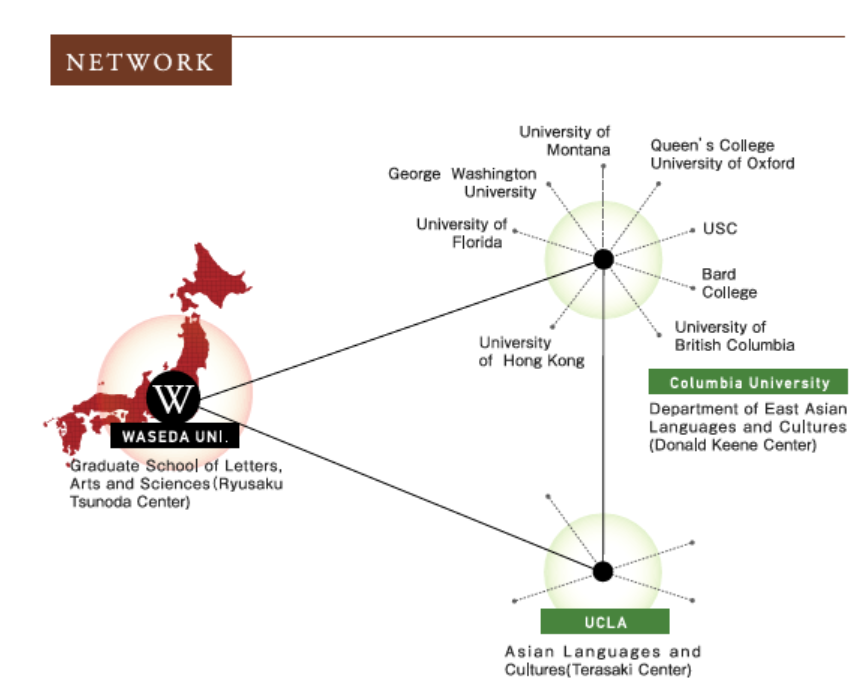
- Organizer: Ryusaku Tsunoda Center of Japanese Culture, Research Institute for Letters, Arts, and Sciences, Waseda University