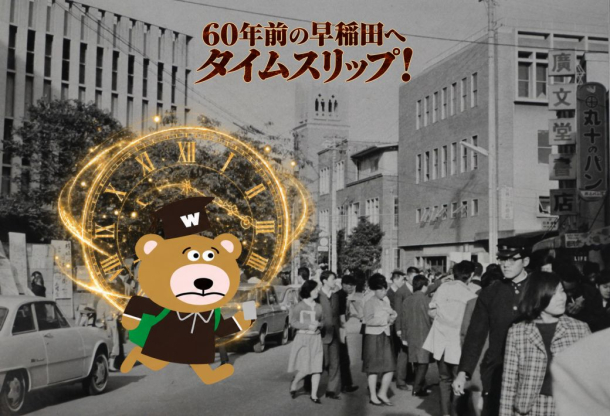
A scene from Okuma Street around 60 years ago (from the 1966 "Waseda People: Graduation Commemorative Album School of Commerce")
In 2026, "Waseda Weekly", the official web magazine of Waseda University, celebrated its 60th anniversary. Its history began with its predecessor, "Waseda", which was founded in 1966 (Showa 41). So, in this anniversary special issue, Waseda Bear travels back in time to Waseda 60 years ago! What did the students of that time wear, what did they eat, and what was their daily life like? Let's discover the differences and surprising similarities with Waseda Bear.
INDEX
▼ 【Morning Routine】Where do you live, and what do you wear to university?
▼ 【Commuting to school】Walking, bus, streetcar, subway - what are your means of getting to the university?
▼ 【Once you arrive at university】What will learning be like in classrooms and the library?
▼ 【Lunch】Where and what do you eat? What is your monthly living expense?
▼ 【After school】 student club, cafes, time spent with friends
[Morning Routine] Where do you live, and what do you wear to university?
What were mornings like for Waseda University students 60 years ago?
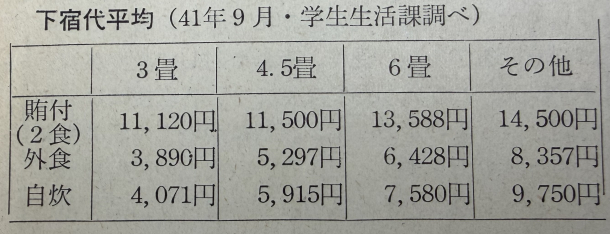
Average lodging costs in 1966 (from "Waseda" magazine, "Parents' Issue, January 1, 1967")
At that time, many students commuted from home, accounting for about 60% of the student population (1967). On the other hand, about 30% lived in boarding houses. The rent for a typical 4.5 tatami mat one-room boarding house was around 5,000 to 6,000 yen per month, or 10,000 to 13,000 yen with two meals included (*1). There were also university-run dormitories in Tanashi and Higashi-Fushimi, but even combined they could only accommodate a little over 120 people, and it is said that the competition rate in 1967 was about 20 times.
*1 From "Waseda" "Parents' Issue, January 1, 1967"
Looking at the rooms of these students, you can find items that tell the story of life at that time. In 1966 (Showa 41), an advertisement for new students from a consumer cooperative (hereinafter referred to as "co-op") featured tape recorders, along with toasters, electric rice cookers, kettles, hair dryers, and electric razors, all accompanied by the catchphrase "For boarding house and dormitory life." It was around this time that convenient home appliances for cooking for oneself were beginning to become widespread.
After breakfast, students would get ready and head to university. At this time, many male students wore the so-called "gakuran" style, consisting of a mortarboard cap, black collar, and gold buttons, and they made up about 70% of the group photos in graduation albums (*2). On the other hand, around 1965, the number of students wearing blazers and slacks increased. Uniforms such as suits, blazers, and slacks appeared alongside caps and school uniforms in advertisements for the university cooperative, giving a glimpse into the gradual spread of new lifestyles. Among female students, outfits such as blouses or sweaters paired with skirts, or dresses, were also seen.
*2 From "Waseda Weekly" and "Northwest of City: Centennial of the Founding of the University," Waseda University History Editorial Office (Waseda University).
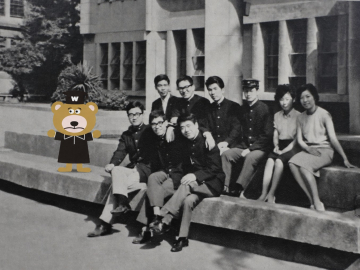
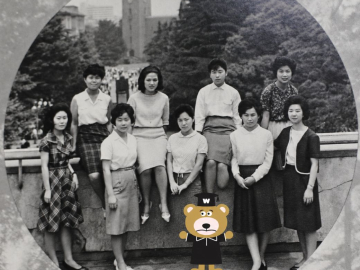
A Waseda University student in the 1960s. This photo offers a glimpse into the campus fashion of the time (from the 1965 "School of Political Science and Economics Graduation Album"). In 1966, the percentage of female students was only 10.2% (calculated from the "National School Directory, 1967 Edition" [Tokyo Educational Research Institute]), and is projected to reach 39.1% by 2025 (from Waseda University Office for Promotion of Equality and Diversity" Trends in Figures Against Vision 150 Numerical Targets").
Back then, about 60% of students commuted from home! Now, students come from both within Japan and internationally, making it a truly international school. Apparently, the competition for dormitory rooms continues to this day. It's surprising to think that 60 years ago, there were so many university students in school uniforms!
【Commuting to school】Walking, bus, streetcar, subway - what are your means of getting to the university?
Aside from walking, the main modes of transportation for Waseda University students were the Japanese National Railways (hereinafter referred to as JNR, now JR), the Tokyo Metropolitan Tramway (hereinafter referred to as Toden), and buses.
Many students walked to the university from Takadanobaba Station on the Japanese National Railways line, likely passing by an increasing number of used bookstores as they approached the campus. Meanwhile, students who got off at Iidabashi Station took the Toden streetcar and alighted at Waseda Shako-mae Station. They would then pass through "Okuma Yokocho," a street located between the Waseda Depot and Okuma Garden, and emerge in front of the Okuma Memorial Auditorium. Those who took the bus would get off at baba and head towards the south gate or main gate of Waseda Campus via Minamimon-dori, or towards the main gate of School of Humanities and Social Sciences (now Toyama Campus).
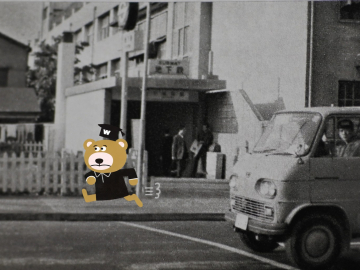
The Waseda Station on the Teito Rapid Transit Authority's (now Tokyo Metro) Tozai Line, which opened in 1964, dramatically changed that landscape. Initially, it began operations with three stations—Waseda, Kagurazaka, and Iidabashi—between Takadanobaba and Kudanshita stations. In 1966, the section between Nakano and Takadanobaba stations opened, and through service with the Japanese National Railways also began. With the addition of the subway as a new mode of transportation to a town already served by streetcars and buses, commuting to Waseda became even more convenient.
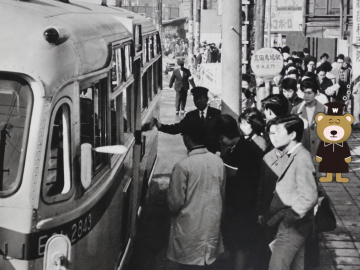
Left: Students waiting to board a bus in front of Takadanobaba Station (from the 1966 "Waseda People: Graduation Commemorative Album School of Commerce")
Right: In front of Waseda Station on the Tozai Subway Line at the time (from the 1966 "Waseda People: Graduation Commemorative Album School of Commerce")
The Tozai Line was a new mode of transportation added around that time! Nowadays, with the development of public transport, it's possible to take classes across different faculties.
【Once you arrive at university】What will learning be like in classrooms and the library?
In 1966, the number of students at Waseda University reached approximately 40,000, roughly double the number in 1950, and at one point, the university was unable to keep up with the demand for classrooms. Although the environment gradually improved through the expansion and renovation of classrooms, some large lecture halls that were full required the use of loudspeakers and overhead projectors (OHPs) to enlarge and project text and diagrams onto screens.
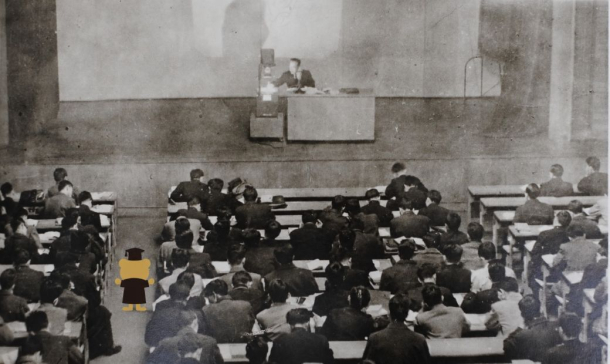
A scene from a lecture in a large classroom during the 1960s, when the number of students rapidly increased (from the 1966 "School of Law Graduation Album").
The first class of students in the newly established School of Social Sciences was incredibly energetic. They nodded along to Faculty' lectures, laughed heartily when something was funny, and applauded at the end of the final lecture of the academic year, filling the classroom with enthusiasm (*3).
*3 From "School of Social Sciences Bulletin" No. 31
Outside of classes, the library is also a place of learning. However, with the rapid increase in students, it seems to have become quite crowded. A 1966 survey included requests for more reading seats, improved lighting, and air conditioning. In 1965, only 16.3% of visitors used the library's collection, with many students spending their time studying with books they brought with them, reading newspapers, or using the lounge. Some pointed out that this decline in the book-using rate was essentially due to students "disengaging" from libraries.
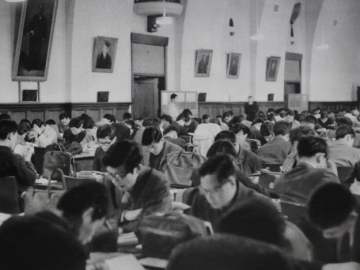
Left: A scene of a packed library (from the 1965 "Waseda People: Graduation Commemorative Album School of Commerce")
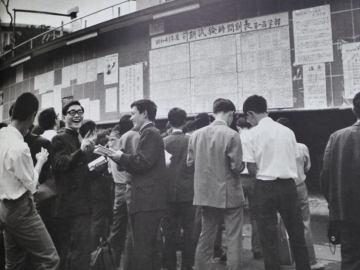
Right: At the time, the exam schedule was posted on a bulletin board (from the 1967 "Waseda People: Graduation Album School of Commerce").
Large classrooms packed with students! These days, many classes use projectors, and taking notes on laptops and tablets is the norm. But libraries are still just as crowded.
【Lunch】Where and what do you eat? What is your monthly living expense?
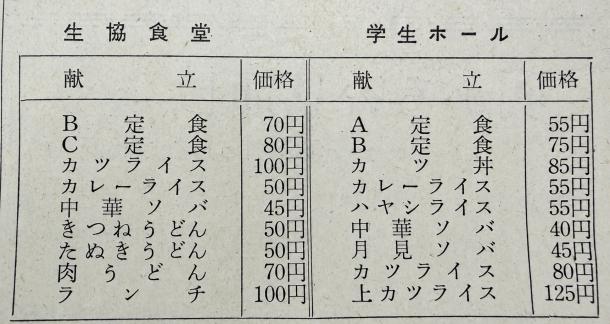
Menus from Co-op Cafeteria and student hall (from the "Parents' Issue, January 1, 1967" of Waseda University)
During lunchtime, students would head to the student hall, Co-op Cafeteria, or restaurants around the university. In 1965, the "Sanpin Shokudo," which still exists today, opened on Nishimon Street, and at that time, there were about 30 student-oriented restaurants in the Waseda area, including Chinese noodle shops and casual eateries. The main menus included set meals with miso soup, as well as katsu rice, curry rice, katsudon, ramen, tanmen, udon, and soba. Many of these restaurants offered meals for under 100 yen, satisfying the students' appetites.
Even so, it wasn't enough for the hungry students, so around 3 PM they would sneak in ramen or soba between classes, and sometimes go to a coffee shop with friends. Many students would return to their lodgings and awkwardly make instant ramen (*4).
*4 From "Waseda" "Parents' Issue, January 1, 1967"
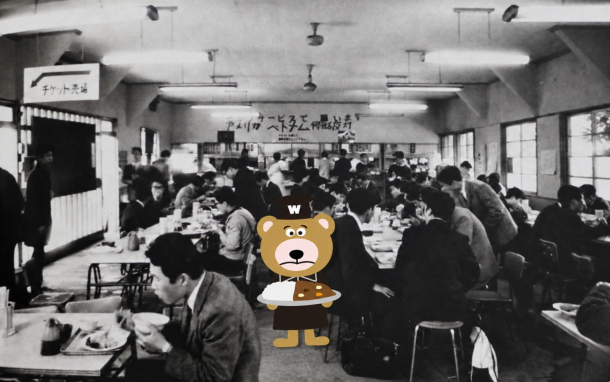
The student cafeteria at the time, bustling with many students (from the 1967 "Waseda People: Graduation Commemorative Album School of Commerce")
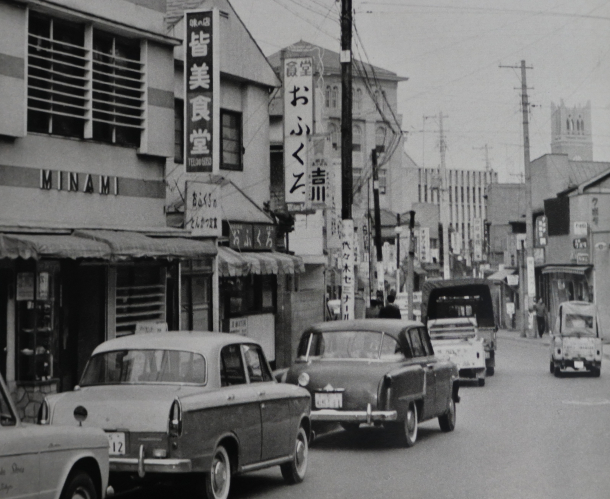
A view of Nanmon Street (from the 1966 "Waseda People: Graduation Commemorative Album School of Commerce")
Before the subway opened, the area around Waseda Junior and Senior High School was dotted with a few establishments, such as the long-established soba noodle shop "Sancho-an," the confectionery shop "Musashino," lumberyards, restaurants, and candy shops. However, with the opening of Waseda Station on the Tozai Subway Line, the number of shops catering to students increased around the station. Coffee shops and stand-up soba noodle shops appeared, and the town became much more lively.
However, food expenses were a significant burden for students. While the economy was growing rapidly, prices also rose, and living expenses, including tuition, books, and lodging costs, increased year after year. In particular, students who lived away from home, such as those living in dormitories, spent around 40% of their living expenses on food, and about 25% on housing. At a time when prices at typical restaurants near their dormitories were rising, the student district restaurants where you could fill your stomach for around 100 yen were a welcome sight for Waseda students, providing a comforting and satisfying meal.
Even back then, there were plenty of restaurants to satisfy students' hunger! "Waseda cuisine" is still very popular today. Due to rising prices, the cost of food and drink is gradually increasing, and lunch often costs over 1,000 yen... Students are finding ways to enjoy their daily meals.
【After school】 student club, cafes, time spent with friends
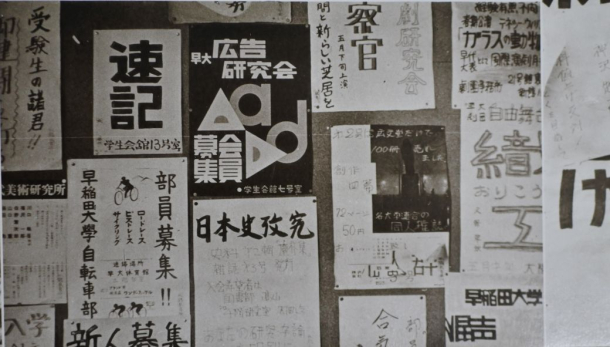
A university bulletin board from that time, filled with recruitment notices and advertisements for student club and research groups (from the 1966 "School of Law Graduation Commemorative Album").
Even after classes ended, a Waseda student's day continued. In 1960, there were 134 officially recognized student clubs, totaling over 10,000 members. Furthermore, student club operating independently, without being bound by existing organizations, increased, reaching approximately 100 by the end of 1965 and into the following year. In student club student club where members gathered across faculties and year levels, each pursued their own interests.
The activities were incredibly diverse. Musical activities were thriving, including a symphony orchestra (now an officially recognized student club), and the male choir, the Glee Club (now an officially recognized student club), practiced in Okuma Garden and Kansen-en Garden. Before competitions, singing could be heard late into the night in the earthen-walled warehouse next to the Okuma Memorial Auditorium. In addition, unique activities were spreading, such as the Waseda Spirit Promotion Society (now an officially recognized student club), which created the "100km Hike" from Honjo to Waseda, and the Shii no Mori no Kai (now an officially recognized student club), which has the concept of nurturing people through tree planting.
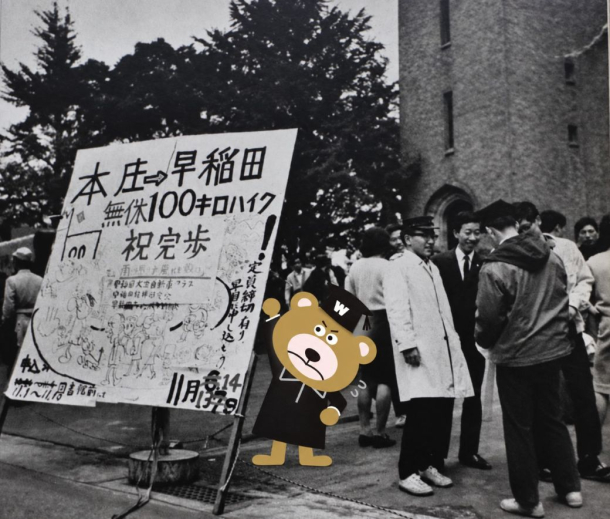
Students gathered in front of a sign for the "100km Hike" (from the 1967 "Waseda People: Graduation Commemorative Album School of Commerce")
Chatting with friends after Extracurricular activity was another after-school pleasure. We deepened our friendships with classmates from seminars and student club at nearby cafes and bars, and sometimes Professor and students even engaged in discussions. Even after leaving the classroom, the Waseda area was filled with students learning and conversing.
The sight of students ending the day with their friends is still seen on campus and in the city today.
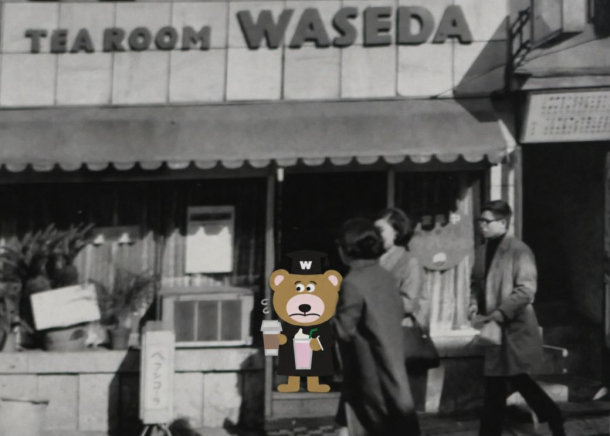
In front of a coffee shop near Waseda Campus (from the 1966 "School of Political Science and Economics Graduation Album")
There were so many student club 60 years ago! Even now, many students belong to multiple student club or work part-time jobs. The sight of students chatting with friends at restaurants around campus or near Takadanobaba Station after classes or student club remains a wonderful scene, just as it was then.
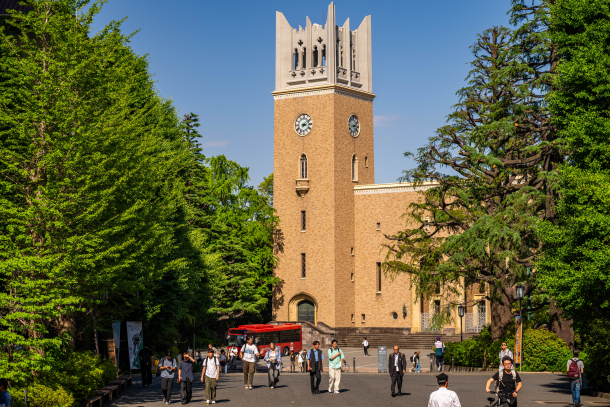
This is the area in front of the current Okuma Memorial Hall. Even though times have changed, the bustling scene of people coming and going at Waseda University remains unchanged.
What we've introduced here is just a small part of student life at Waseda University 60 years ago. You can trace the history of Waseda, as it is etched into the campus, even further at the Waseda Waseda University History Museum (1st floor Building 1 Waseda Campus), so please be sure to stop by.
[References] A Hundred-year History of Waseda University
Interview and text by: Yuta Aizawa (graduated from School of Letters, Arts and Sciences I in 2010)
Cooperation: Waseda University History Museum, Maho Asaba (Student staff member of 'Waseda Weekly')
[Next Focus Preview] "Diversity Special" airing October 26th (Monday)