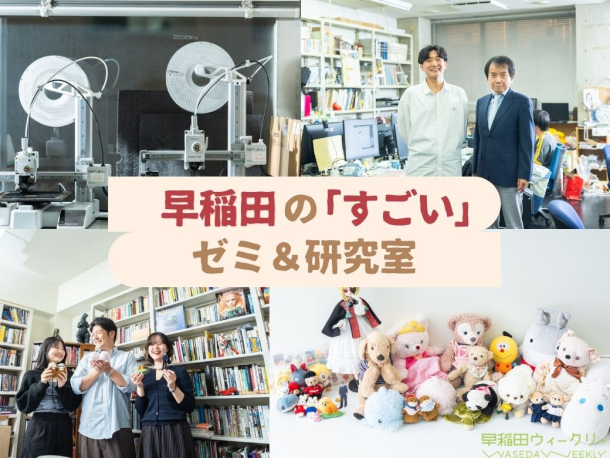
Seminars and research labs are where students deepen their learning at university. Waseda University has many seminars and research labs that engage in unique activities and research that will surprise you with their unexpected approaches. This time, we visited distinctive seminars and research labs in two faculties to introduce the professors' research content and the appeal of their activities as told by Waseda students! And the important question is, "How do you choose the right seminar or research lab for you?" We asked Waseda University student reader monitors of "Waseda Weekly" for advice on the information sources they actually used and how to choose based on their real-life experiences!
INDEX
▼A "doll viewing" where participants bring their own dolls!? "Artificial Body Theory (Kikuchi) Seminar"
▼Soft robots!? The Sawada Laboratory does anything interesting in physics.
▼The reality of choosing a seminar: How do upperclassmen choose their seminars and research labs?
A "doll viewing" where everyone brings their own dolls!? "Artificial Body Theory (Kikuchi) Seminar"
This new 2025 fiscal year program aims to clarify why we are attracted, feared, deceived, and healed by artificial bodies. School of Culture, Media and SocietyRepresentation and Media Theory Section"Artificial Body Theory (Kikuchi) Seminar." Under Associate Professor, Kohei Kikuchi who specializes in doll culture theory, each seminar student brings their own doll and shares related episodes through unique activities such as "Doll Viewing." We spoke with Associate Professor Kikuchi and the seminar students about how they deepen their "love" into research!
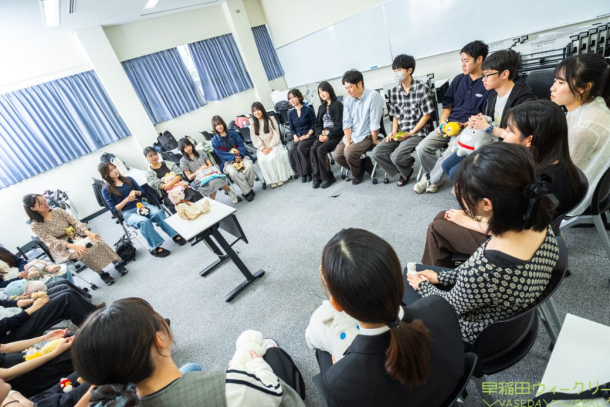
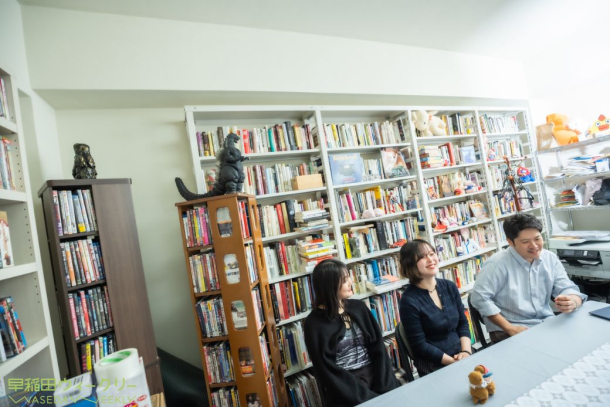
A scene from the doll viewing event. Surrounded by dolls that held special memories, participants shared stories such as, "I've kept this carefully at home until now, but this is the first time I've brought it outside!", "When I was little, I really wanted this doll, so my parents bought it for me at an auction," and "I don't remember where I bought it..." This took place in Room 451, Building 34, Toyama Campus.
Kohei Kikuchi, Associate Professor (Faculty of Letters, Arts and Sciences)
Kokoro Otarube, 3rd year student, School of Culture, Media and Society
Tomoka Saito ,3rd year student, School of Culture, Media and Society
Everything involved is perceived as a "doll."
--Could you tell us about Associate Professor Kikuchi's research?
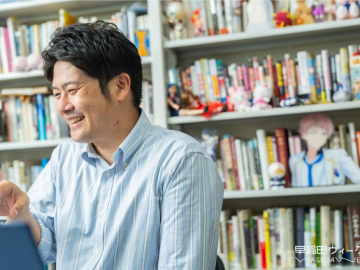
Associate Professor Kikuchi. His laboratory is filled with stuffed animals, acrylic stands, figurines, and other collectibles.
Associate Professor Kikuchi: My research focuses on television puppet shows broadcast on NHK from the 1950s to the early 1970s, aiming to shed light on a part of Japanese television history, including their history and the background behind the creation of these works. However, the research that often gets media attention is my work on the relationship between people and stuffed animals, including the concept of "stuffed animal activities." Personally, I think there's also the opposite concept to "stuffed animal deaths." There are quite a few people who are troubled about how to dispose of their beloved stuffed animals, so I'm currently interested in how modern people's worries fit within the historical and cultural context of doll memorial services and other such practices.
—What kind of topics do you cover in your seminar?
Associate Professor Kikuchi: The students are doing what they want to do, regardless of my research (laughs). But I take the word "doll" in a broad sense, so even if it's just a tool like a pen, if a person has a strong attachment to it, I think it's similar to the feeling they have towards a doll. I keep in mind that everything we interact with might be considered a doll, so there's no contradiction in doing things like doll viewings or discussing the somewhat grotesque film "Substance" (*).
* A film depicting a woman who, in her pursuit of youth and beauty, creates a "younger doppelganger" of herself.
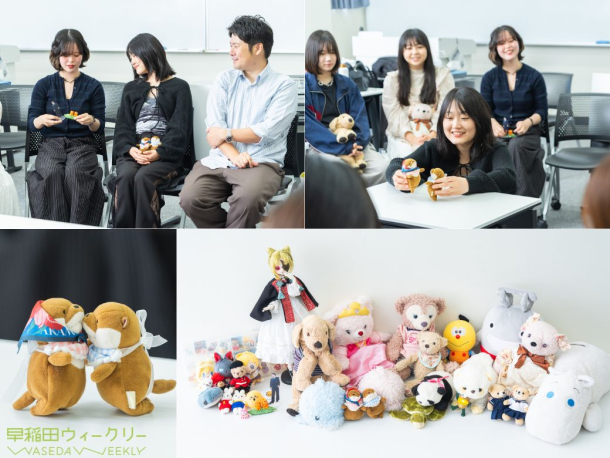
(Top left) Otarube introduces an acrylic stand and a Shisa figurine. (Top right and bottom left) Saito always carries an otter plush toy with her. When she was in high school, she made eye contact with the plush toy that was on the bottom shelf of a local general store and bought it. (Bottom right) A collection of plush toys and figurines brought by the seminar students!
You can freely explore what you "like".
—From a student's perspective, what are the distinctive features of Associate Professor Kikuchi's seminar?
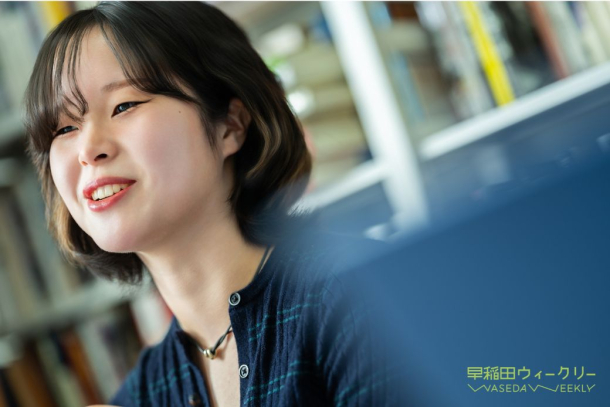
Otarube said that what she remembers most from the seminar retreat is when she and her fellow students searched for "artificial bodies," such as shop objects and miscellaneous goods, during their free time.
Otarube: I was surprised that we were allowed to freely decide on the activities. When I thought of a seminar, I imagined everyone sitting at their desks reading literature, but the format of students discussing and deciding on a work to discuss, such as "This work might have an artificial body aspect," and then analyzing it together, was very refreshing. In addition, I suggested to the professor that we share feedback on presentations using a spreadsheet, and we have actually implemented that. Since we are the second year students, I feel that there is also the interesting aspect of being able to help build the foundation of this seminar.
—Could you tell us why you chose Associate Professor Kikuchi's seminar?
Otarube: Originally, I was thinking of taking a seminar related to theater, so I was drawn to the word "theater" and enrolled in Associate Professor Kikuchi's on-demand course, "Theater Culture Theory 2" (taken in 2025). But in the first class, they explained that it wouldn't be about theater, but rather "horror and haunted houses." Since I happen to love scary stories, I was completely hooked.
Saito: I took Associate Professor Kikuchi's "Introduction to Doll Media Studies" (scheduled for 2025) and thought that I could do anything in Associate Professor Kikuchi's seminar. I have a lot of interests, so I thought it would be great to broaden my range of interests in the seminar.
—What do you want to learn in depth in Associate Professor Kikuchi's seminar?
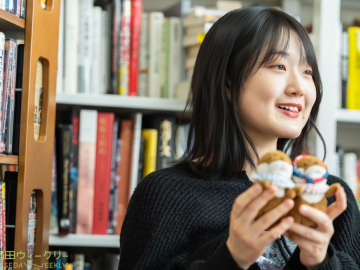
Saito says, "Taking pictures with stuffed animals helps to create memories of ordinary days, like 'I went here' or 'I ate this.'"
Saito: Some of my seminar students are into supporting their favorite idols, and others like anime and movies, so I'm inspired and now my interests have broadened too much (laughs). It could be about the relationship between people and stuffed animals, or it could be interesting to connect it to anime and manga that feature artificial bodies...it's hard to decide.
Otarube: I like "School Ghost Stories," so I'd like to do research related to that. "School Ghost Stories" features a lot of artificial bodies, such as anatomical models and statues of Ninomiya Kinjiro, so I think it would be interesting to Focus on that, but I'm still undecided.
—Finally, what kind of students would you like to see join Associate Professor Kikuchi's seminar?
Saito: I might recommend this to people who want to love the things they already love even more.
Otarube: That's true. Because it allows you to delve deeper into what you "like."
Associate Professor Kikuchi: It's important to have things you love, but sometimes, for example, by listening to other people's opinions or studying history, you realize that even things you love have aspects that deserve criticism. At that point, instead of shutting yourself off, I hope that people who can see it as an opportunity to learn more about the work and flexibly explore possibilities will come and join us.
Artificial Body Theory Seminar (Kikuchi Seminar) Official Instagram: @kikuchi_zemi_2025
Soft robots!? The Sawada Laboratory does anything interesting in physics.
Covers a wide range of themes, including soft robots, chemical reactions, and the generation of tactile sensations School of Advanced Science and EngineeringDepartment of Applied Physics The "Sawada Laboratory." Under Hideyuki Sawada's Professor of "doing anything interesting" in physics, each student works on a different theme and conducts research with free thinking. This time, attention is also focused on a unique research on a "disposable silkworm-shaped robot" aimed at disaster relief. How are the students deepening their "wants to do" into research? We spoke with Professor Sawada and the lab students!
Professor Hideyuki Sawada (Faculty of Science and Engineering)
Yutaro Okawa ,4th year student, School of Advanced Science and Engineering
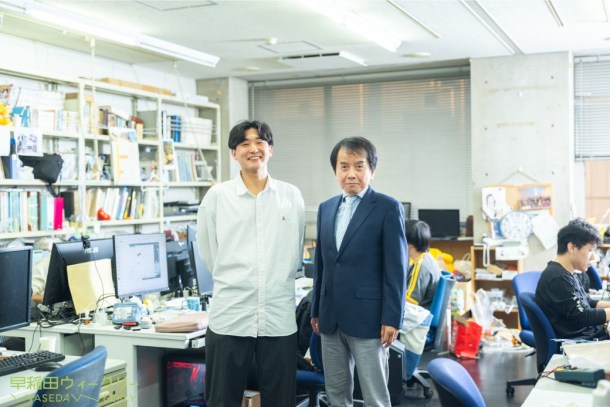
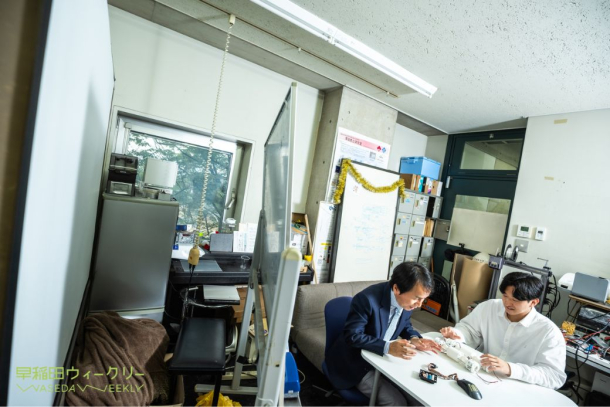
At the Sawada Laboratory in Building 55, Nishi-Waseda Nishi-Waseda Campus. From left: Okawa, Professor Sawada.
From soft robots to tactile sensations, the world of research is expanding.
--Professor Sawada's research topics are quite broad, aren't they?
Professor Sawada: I'm doing everything I'm interested in regarding physics and engineering (laughs). Currently, I'm mainly researching a field called physical AI, which involves controlling robots with AI.
The laboratory has three main research groups. The first deals with "soft robots" that have a softness similar to that of living organisms. The second studies moving objects in solutions using chemical reactions. The third studies the recognition and generation of tactile sensations.
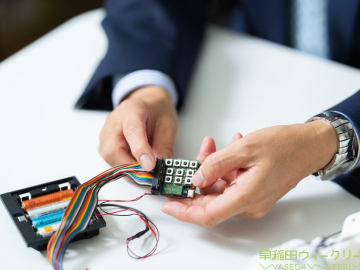
A haptic display. When attached to a device and covered with the palm of your hand, it conveys the sensation of an object moving through your hand. Because it can generate the sensation of touching an object, in the future it may be possible to reproduce the texture of products viewed online.
—What are the unique characteristics of your research lab?
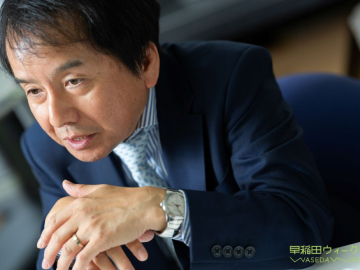
"The most enjoyable part for me is seeing students' research come together well and witnessing their growth," says Professor Sawada.
Professor Sawada: "If something is interesting or intriguing, just try it." If a student has something they want to do, and it's not scientifically incorrect, I encourage them to pursue it.
Okawa: The best thing about Professor Sawada is that he really lets us do things our own way! I also feel that it's liberating that each of us works on one independent theme.
Professor Sawada: For large-scale themes, we work on them in groups, but as a rule, each person works on their own research topic. When multiple people work on a project, there can be differences in progress and things don't always go smoothly (laughs). If each person has one theme, they can approach the issue as their own and think about it, and since everyone is doing different research, they can exchange knowledge and cooperate with each other, which I think has great advantages.
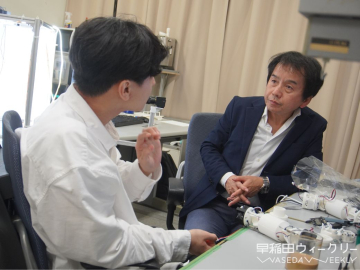
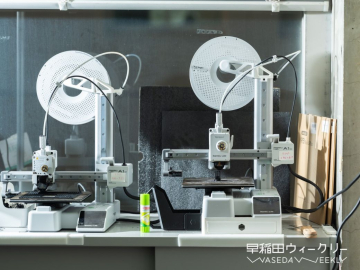
Left: A scene of instruction. Okawa usually conducts his research in the laboratory located in Building 120-5.
Right: It seems that the Sawada Laboratory has about 10 3D printers.
Starting with "problems," we create robots that are useful to society.
--Could you tell us about your research topic, Okawa?
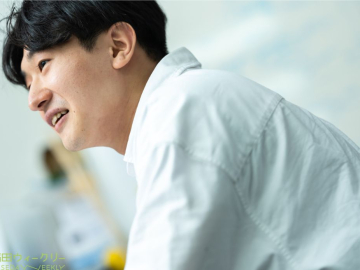
When choosing a research lab, Okawa says, "It's important to ask about the research topics of senior students when you visit the lab and see if it suits you."
Okawa: We are developing a silkworm-shaped continuous robot that will enter rubble and search for people for disaster relief. In actual disaster sites and inside collapsed buildings, there is often not enough space for drones to fly, and wheels cannot move, so we are aiming to achieve flexible movements that mimic the movements of snakes and insects. Another feature is that the parts are made with a 3D printer, so they are disposable. In disaster sites, we believe that what is needed is a robot that can be used in large numbers and can reliably find people, rather than an expensive and sophisticated robot.
Professor Sawada: If we add an infrared sensor in addition to the camera, we can sense a person's body temperature, and if we add a tactile sensor, we can even recognize a person's skin that's buried. It's fascinating, isn't it?
—Why did you choose Professor Sawada's lab, Okawa?
Okawa: I've loved robots since I was a child. I chose the physics department at university because I wanted to explore theoretical aspects, but when I learned that there was a research lab in the physics department that dealt with robots, I chose the Sawada Lab.
Professor Sawada: There are few research labs in the physics department that deal with robots, but in the Department of Physics, students thoroughly study condensed matter physics, quantum mechanics, and mathematics, so it is well-suited for research not only on conventional rigid robots, but also on chemical robots that move by extracting energy from chemical reactions of materials, and soft robots that can perform flexible movements with a soft body.
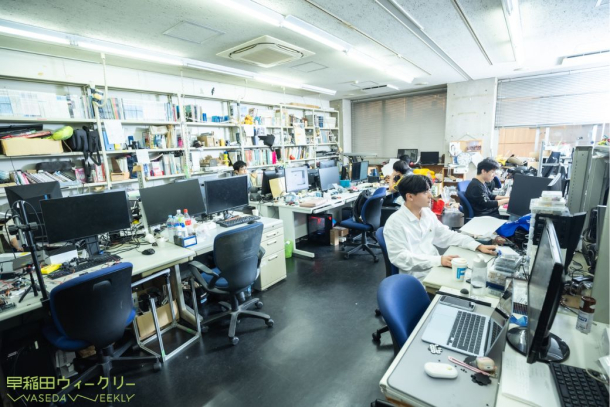
The students in the lab work on their research every day. Once a week, everyone gathers to report on the progress of their research.
—What kind of path do you envision taking in the future, Okawa?
Okawa: I hope to pursue a career in robotics research and development. The biggest takeaway from my time in the lab was learning how to develop a sense for thinking about what the world needs. Instead of thinking, "I'll do it because it's technically possible," I learned to think, "I'll use this technology to solve a problem." I realized that if you don't first consider what problems people are facing, you'll end up being self-centered.
—What kind of students do you hope they will become through their research activities in the Sawada Laboratory?
Professor Sawada: I hope that people will be able to fully utilize their abilities and enjoy life. Being able to enjoy work while imagining things is a uniquely human activity that AI cannot do, so I hope that people will think for themselves in an enjoyable way and acquire the skills that will lead to their abilities.
The reality of choosing a seminar: How do upperclassmen choose their seminars and research labs?
'Waseda Weekly' conducted a survey with Waseda student readers about choosing seminars and research labs! It's a must-read for how upperclassmen pick their seminars and things you should do in advance. Be sure to check it out and use it as a reference!
How did you gather information about the seminar?
The results showed that many people refer to word-of-mouth from seniors and friends, as well as the social media accounts of seminars and research labs. In addition, many people actually visited and attended information sessions. Furthermore, when asked what they considered important when choosing a seminar, approximately 80% of people chose "research content" and "supervising Faculty."
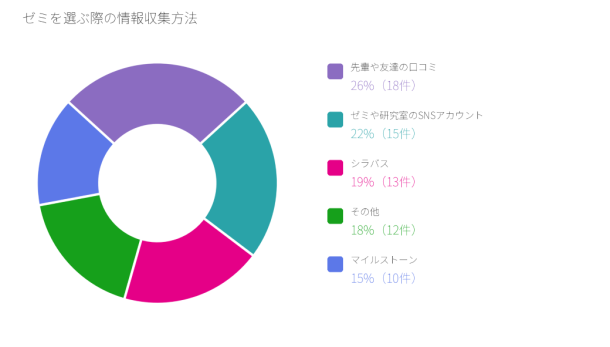
Of the reader monitors, 38 who belong to a seminar responded (multiple answers allowed).
What were the benefits of joining the seminar?
3rd year, School of Culture, Media and Society
One of the best things about seminars, unlike other classes, is that you can feel that others are also interested in the same things you are. Even topics that would be difficult to tackle on my own become easier to approach because others are working on them, which motivates me to try!
3rd year student School of Human Sciences
I've become very close with the members of my seminar. We hang out together, of course, but we also meet up frequently to work on projects and help each other out, so I've gained a lot of emotional support.
4th year student School of Advanced Science and Engineering
I've come to appreciate the fascinating aspects of physics, and I feel like I'm gradually becoming more capable of thinking logically and critically, not just in science.
What advice would you give on choosing a seminar?
4th year student School of Sport Sciences
While the research topic is certainly important, even if it aligns with your interests, whether you can actually research what you love depends on Faculty. Therefore, it's crucial to observe seminars, talk to Faculty, and speak with senior graduate students.
2nd year student School of Social Sciences
It's a good idea to take various lectures to get a sense of your interests and how well you match with Faculty.
Interview and text: Kyoko Suemitsu (1998 Graduate of the School of Science and Engineering)
Photo by Kota Nunokawa
[Next Focus Preview] "Harassment Special" airing November 30th (Monday)