
- NEWS
- 概日リズムが骨格筋由来細胞外小胞のマイクロRNAプロファイルを規定する:高脂肪食肥満マウスにおける運動による状況依存的修飾/Circadian Phase Shapes Muscle-Derived Extracellular Vesicle microRNA Profiles with Context-Dependent Modulation by Exercise in High-Fat-Diet-Fed Mice
概日リズムが骨格筋由来細胞外小胞のマイクロRNAプロファイルを規定する:高脂肪食肥満マウスにおける運動による状況依存的修飾/Circadian Phase Shapes Muscle-Derived Extracellular Vesicle microRNA Profiles with Context-Dependent Modulation by Exercise in High-Fat-Diet-Fed Mice
- Posted
- Wed, 29 Jul 2026
概要/Abstract
本研究は、高脂肪食肥満マウスの骨格筋由来細胞外小胞(EV)※1のマイクロRNA(miRNA)※に対する概日リズム※3と運動の影響を検討し、運動よりも概日位相の方が強く寄与することを明らかにしました。
This study examined how circadian phase and exercise affect the microRNA (miRNA) composition of skeletal muscle-derived extracellular vesicles (EVs) in high-fat-diet obese mice, demonstrating that circadian phase contributed more to EVs’ miRNA variance than exercise itself.
これまでの研究で分かっていたこと/Research Background
骨格筋は、様々な生理活性物質や細胞外小胞(EV)の分泌を通じて、他の臓器と情報伝達を行っています。運動はEVのmiRNA組成を変化させることが知られていますが、その多くは急性運動の影響に着目したものであり、長期的なトレーニングや、特に「いつ運動するか」という時間帯(概日リズム)がEV miRNAの慢性的な適応に及ぼす影響については、これまでほとんど分かっていませんでした。また、概日時計は骨格筋代謝を含む多くの生理機能を制御していますが、EVの分泌やmiRNA組成における概日リズムの役割は十分に解明されていませんでした。
Skeletal muscle communicates with other organs by secreting various bioactive substances and extracellular vesicles (EVs). While exercise is known to alter the miRNA composition of EVs, most prior work has focused on the effects of acute exercise, and little was known about how long-term training—and particularly the time of day at which exercise is performed—chronically shapes the EV miRNA profile. Although the circadian clock regulates many physiological processes including skeletal muscle metabolism, its role in EV secretion and miRNA cargo composition remained poorly understood.
今回の研究で新たに実現しようとしたこと、明らかになったこと/Findings
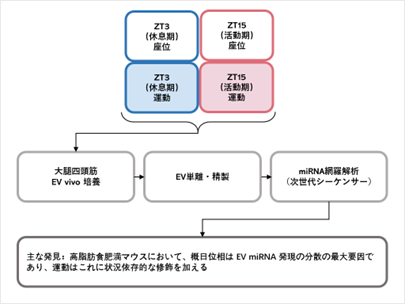
本研究では、休息期(ZT3)と活動期(ZT15)、座位と運動という2×2要因デザインを用い、高脂肪食で肥育したマウスの大腿四頭筋由来EVのmiRNAプロファイルを網羅的に解析しました。主成分分析(PCA)※4により、概日位相がEV miRNA発現の全体的なばらつきの最大の要因であることが判明しました(第1主成分の33.47%)。座位条件下では、筋分化に関わるmiR-1ファミリー※5およびインスリン抵抗性に関連するmiR-29ファミリーが活動期(ZT15)で有意に上昇しましたが、この変化は運動条件下では認められませんでした。さらに、運動によるmiRNA変化は位相依存的であることも明らかになりました。
Using a 2×2 factorial design (rest phase ZT3 vs. active phase ZT15; sedentary vs. exercise), we comprehensively profiled the miRNA cargo of quadriceps muscle-derived EVs in high-fat-diet obese mice. Principal component analysis showed that circadian phase was the largest contributor to overall variance in EV miRNA expression (33.47% of PC1). Under sedentary conditions, the myogenesis-related miR-1 family and the insulin-resistance-related miR-29 family were significantly elevated during the active phase (ZT15), but this pattern was not observed under exercise conditions. Exercise-induced miRNA changes were also found to be phase-dependent.
そのために新しく開発した手法/Methods developed
大腿四頭筋の摘出組織を無血清培地で培養し、その培養上清からEVを回収するex vivo培養法を用いました。回収したEVから小分子RNAを抽出し、次世代シーケンサーによる網羅的miRNAプロファイリングを実施しました。統計解析では、複合効果(概日位相全体・運動全体)と条件別の比較を組み合わせた解析デザインを採用し、さらに実験的に検証されたmiRNA標的遺伝子データベース(miRTarBase)を用いた標的遺伝子の機能解析(GO・KEGG解析※6)を行いました。
We employed an ex vivo culture method in which excised quadriceps muscle tissue was cultured in serum-free medium and EVs were recovered from the conditioned medium. Small RNA was extracted from the isolated EVs and comprehensively profiled using next-generation sequencing. Differential expression was assessed using both composite (overall phase/exercise) and condition-specific comparisons, and functional enrichment analysis (GO and KEGG) of experimentally validated target genes was performed using the miRTarBase database.
研究の波及効果や社会的影響/Research implications to the society
本研究は、「いつ運動するか」という時間軸が、骨格筋から分泌されるEV miRNAを介した臓器間コミュニケーションに影響を与える可能性を示す基礎的知見を提供します。将来的には、運動のタイミングを考慮した運動処方が、肥満やインスリン抵抗性など代謝性疾患の予防・改善に向けた新たな戦略となる可能性があります。
This study provides foundational evidence that the timing of exercise may influence interorgan communication mediated by muscle-derived EV miRNAs. In the future, exercise timing could become an important variable in exercise prescription strategies aimed at preventing or improving metabolic conditions such as obesity and insulin resistance.
今後の課題/Future issues
本研究はサンプルサイズが少なく(各群3反復)、探索的な位置づけであるため、今後はより大規模な独立コホートでの定量PCR※7による検証が必要です。また、雄マウスのみを対象としているため、系統・年齢・性差を考慮した検討や、標準食との比較、EVの機能的な検証(受容組織における実際の作用)も今後の課題です。
Because this study used a small sample size (n = 3 per group) and was exploratory in nature, future work should validate these findings by qRT-PCR in larger, independent cohorts. As only male mice were used, further studies considering strain, age, and sex differences, comparisons with a standard diet, and functional validation of EV effects in recipient tissues are also needed.
研究者のコメント/Researcher’s Comment
本研究に取り組む中で、「いつ運動するか」が「どう運動するか」と同じくらい重要かもしれないという知見に強く惹かれました。骨格筋由来のEVがこの時間情報を全身に伝える”メッセンジャー”である可能性を示せたことは、大きなやりがいでした。まだ基礎的な段階ですが、将来的にはこうした知見が、より効果的で個別化された運動・栄養指導へとつながることを期待しています。
While working on this project, I became deeply drawn to the idea that “when” you exercise may matter just as much as “how” you exercise. Being able to show that muscle-derived EVs may act as messengers carrying this timing information throughout the body was genuinely rewarding. Although this remains an exploratory, foundational study, I hope these findings will eventually contribute to more effective, personalized exercise and nutrition guidance.
用語解説/Terminology
※1 概日リズム
体内時計によって約24時間周期で調節される生理的なリズムのことです。
※2 細胞外小胞(EV)
細胞から分泌される膜で覆われた微小な粒子で、タンパク質やmiRNAなどを含み、細胞間の情報伝達を担っています。
※3 マイクロRNA(miRNA)
遺伝子の働きを調節する小さなRNA分子で、標的となるmRNAに結合してタンパク質合成を抑制します。
※4 主成分分析(PCA)
大量のデータが持つ複雑な特徴を、いくつかの代表的な”軸”にまとめて分かりやすく可視化する統計手法です。
※5 miRNAファミリー
塩基配列や機能が似ている複数のmiRNAをまとめたグループのことです。
※6 GO・KEGG解析
多数の遺伝子が関わる生物学的な機能(GO)や、代謝・シグナル伝達の経路(KEGG)を分類・整理するための解析手法です。
※7 定量PCR
遺伝子の発現量を正確に測定するための実験技術です。
論文情報/Journal Information
雑誌名/Journal:Nutrients 2026, 18(7), 1076
論文名/Title:Circadian Phase Shapes Muscle-Derived Extracellular Vesicle microRNA Profiles with Context-Dependent Modulation by Exercise in High-Fat-Diet-Fed Mice
執筆者名・所属機関名/Authors and Affiliated Organisation:Shuo Wang(早稲田大学/Waseda University)、Noriaki Kawanishi(千葉工業大学/Chiba Institute of Technology)、Cong Wu(早稲田大学/Waseda University)、Haruki Kobori(早稲田大学/Waseda University)、Katsuhiko Suzuki(早稲田大学/Waseda University)
Publishment Date(Local Time):27th March, 2026
Publishment Date(Japan Time):27th March, 2026
(オンライン掲載の場合/For online publication)
URL:https://www.mdpi.com/article/10.3390/nu18071076
DOI:https://doi.org/10.3390/nu18071076
研究助成/Research Grant
研究費名/Research Fund:
日本学術振興会(JSPS)科学研究費助成事業 基盤研究(A) 20H00574;基盤研究(B) 23H03274
研究課題名/Research Subject:
- 基盤研究(A) 20H00574「骨格筋由来の生理活性因子による運動効果の機序究明とバイオマーカーの開発」
- 基盤研究(B) 23H03274「細胞間コミュニケーション因子であるエクソソームによるサルコペニアの発症機序の解明」
研究代表者名・所属機関名/Research Representative and Affiliated Organisation:
- 鈴木克彦(早稲田大学)/基盤研究(A) 20H00574
- 川西範明(千葉工業大学)/基盤研究(B) 23H03274