
- NEWS
- 損失を利益に変える:苦境にあるブランドの慈善的な企業の社会的責任が顧客の市民行動を促進する方法
損失を利益に変える:苦境にあるブランドの慈善的な企業の社会的責任が顧客の市民行動を促進する方法
- Posted
- Mon, 22 Jun 2026
概要/Abstract
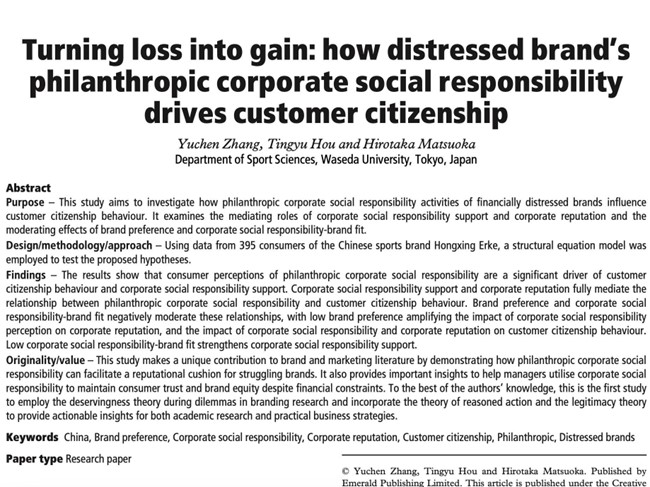
本研究では、財政的に困難な状況にあるブランドによる慈善的な企業の社会的責任(CSR)活動が、顧客の市民的行動にどのような影響を与えるかを明らかにすることを目的としています。CSR支援と企業評判の媒介効果、ブランド嗜好およびCSR-ブランド適合性の調整効果を検証します。中国のスポーツブランド「鴻星爾克」の消費者395名のデータを用いて、構造方程式モデリングによって仮説を検証しました。その結果、慈善的CSRに対する消費者の認識は、顧客の市民的行動とCSR支援の重要な推進要因であることが明らかになりました。CSR支援と企業評判は、慈善的CSRと顧客市民的行動との関係を完全に媒介します。ブランド嗜好とCSR-ブランド適合性はこの関係を負に調整し、低いブランド嗜好や適合性はCSRの影響力を高めます。本研究は、財政的困難下におけるブランド評価の維持に向けた実務的示唆も提供します。
これまでの研究で分かっていたこと(科学史的・歴史的な背景など)/Research Background
Corporate social responsibility (CSR) has become increasingly prevalent in recent decades, as companies have realised that alongside profit-making, contributing to the betterment of society is essential for long-term success. Existing research has analysed the impact of CSR on corporate image and customer loyalty, whereas few scholars have investigated the effect of philanthropic CSR adoption on consumer behaviour in the marketplace, particularly volunteerism. Previous studies have proposed that CSR practices engender positive consumer behaviours and attitudes towards a brand. However, the underlying psychological mechanisms and boundary conditions shaping these outcomes remain poorly understood, particularly for philanthropic CSR. Most importantly, there is a gap in the literature on financially troubled firms, because most companies that engage in CSR are well managed. Few attempts explore how financially distressed firms engage in CSR as a strategy to enhance brand reputation and consumer support.
今回の研究で新たに実現しようとしたこと、明らかになったこと/Findings
findings demonstrate that consumers’ perceptions of philanthropic CSR significantly influence customer citizenship behaviour, both directly and indirectly, through CSR support and corporate reputation. Mediation analyses show that brands can boost consumer support and reputation through their involvement in philanthropic CSR initiatives, which in turn encourages enhanced consumer citizenship. The moderating effects reveal that brand preference and CSR-brand fit play nuanced roles in moderating the impact of CSR initiatives. Although brand preference weakens the relationship between CSR perceptions and corporate reputation, it reduces the impact of CSR support and corporate reputation on customer citizenship behaviour. The negative moderating effect of CSR-brand fit suggests that a disconnect between CSR activities and the brand’s identity may bolster the relationship between CSR perceptions and consumer support rather than weaken it. Brand preference does not significantly moderate the relationship between consumers’ perceptions of philanthropic CSR and their support for CSR initiatives.
そのために新しく開発した手法/Methods developed
The methodology used in this study was a survey. Using consecutive sampling techniques, the questionnaire used the sports brand Hongxing Erke as the brand context. Those who had experience buying sports products were eligible for inclusion in this study. To guarantee the reliability and validity of the research outcomes, all surveys were translated into Chinese, and the items were used as feasible. All participants provided informed consent prior to beginning the survey, and participation was entirely voluntary and anonymous. In total, 395 valid survey responses were remained.
研究の波及効果や社会的影響/Research implications to the society
This study makes a substantive contribution to the crisis management field that has been insufficiently examined by assessing the importance of CSR during operational distress. Most previous works analysed the benefits of CSR to strong firms regarding reputation, but this study illustrates that CSR is a distressed brand’s “crisis catalyst”. Brands that take CSR outside of the context of a benevolent activity can tap into a state of financial desperation and equate it with a moral flag-waving exercise. For instance, Hongxing Erke’s “bankruptcy donation” story allowed the company to leverage sympathy as a negative publicity coin and consequently turned its financial collapse into victory. Managers may develop more effective CSR strategies by focusing on the social and consumer marketing aspects of corporate philanthropy. For financially distressed brands, CSR is more than just a means to enhance their reputation; it is also a tool to mobilise consumers. Managers can transform CSR into a strategic tool for long-term recovery and growth by emphasising low-fit initiatives and sacrificial narratives while engaging consumers directly. These findings fundamentally restructure the role of CSR within the context of brand management and provide a pathway for turning a firm’s weaknesses into positive consumer engagement.
今後の課題/Future issues
First, this study use a single sports brand, which skews a particular cultural context, further research should include multiple cases within different cultures and industries.
The second limitation stems from the fact that the current study used a cross-sectional design. Longitudinal research may provide better insight into the impact of philanthropic CSR initiatives on consumer behaviour over time. This study focuses solely on philanthropic CSR. Therefore, the different impacts of various CSR initiatives should be explored. Ultimately, other potential moderators of the relationship between the consumers’ understanding of CSR and purchasing behaviour may include certain consumer values, psychological variables (e.g. personality), and competitive context. With these additional dimensions, a more holistic understanding of consumers’ responses to CSR initiatives can be achieved.
研究者のコメント/Researcher’s Comment
This study provides important insights to help managers utilise corporate social responsibility to maintain consumer trust and brand equity despite financial constraints. By examining the unique dynamics of philanthropic CSR in the context of a financially distressed brand, this study not only confirms but also broadens the application of previous theories.
用語解説/Terminology
※1 Philanthropic Corporate Social Responsibility (PCSR)
Philanthropic CSR is the voluntary provision of cash or other resources assets to the community through private firms for public benefit.
※2 Customer citizenship behaviour (CCB)
Voluntary and discretionary behaviors that help the service organization overall but are not necessary for the successful production or delivery of the service.
※3 Brand preference (PRE)
The tendency to select a product or service over similar ones that are priced and featured as rich.
※4 Corporate social responsibility-brand fit (FIT)
The synergy between a brand’s CSR activities and its core brand attributes, such as values, products, or services.
論文情報(掲載された場合)/Journal Information (if published)
雑誌名/Journal:Journal of Product & Brand Management
論文名/Title:Turning loss into gain: how distressed brand’s philanthropic corporate social responsibility drives customer citizenship
執筆者名・所属機関名/Authors and Affiliated Organisation:Yuchen Zhang (Graduate School of Sport Sciences, Waseda University), Tingyu Hou (Graduate School of Sport Sciences, Waseda University), and Hirotaka Matsuoka (Faculty of Sport Sciences, Waseda University)
Department of Sport Sciences, Waseda University, Tokyo, Japan
Publishment Date(Local Time):3 June 2025
Publishment Date(Japan Time):3 June 2025
(オンライン掲載の場合/For online publication)
URL:https://www.emerald.com/insight/content/doi/10.1108/jpbm-11-2024-5587/full/html
DOI:https://doi.org/10.1108/JPBM-11-2024-5587
松岡 宏高