
- ニュース
- 階層的統合モデルによる努力知覚のメカニズム:血流制限下における末梢・中枢・認知・時間的・応用的相互作用/A Hierarchical Integration Model of Effort Perception: Peripheral, Central, Cognitive, Temporal, and Applied Mechanisms Revealed Through Blood Flow Restriction
階層的統合モデルによる努力知覚のメカニズム:血流制限下における末梢・中枢・認知・時間的・応用的相互作用/A Hierarchical Integration Model of Effort Perception: Peripheral, Central, Cognitive, Temporal, and Applied Mechanisms Revealed Through Blood Flow Restriction
- Posted
- Thu, 01 Oct 2026
概要/Abstract
血流制限下の努力知覚モデル
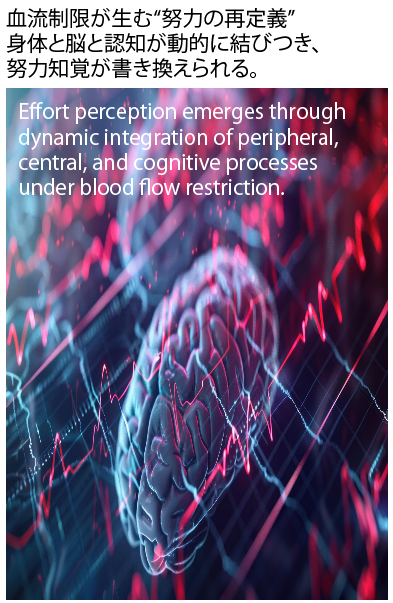
本研究は、血流制限下における努力知覚の階層的統合モデルを提案する。末梢入力から中枢抑制、認知再校正、時間適応、応用成果まで六層の相互作用を整理し、努力知覚が多層的統合によって再構築されることを示した。
Hierarchical effort perception model under BFR
This study introduces a hierarchical integration model explaining how effort perception is reconstructed under blood flow restriction (BFR). The model organizes evidence across six dynamically interacting levels, beginning with peripheral afferent signals and progressing through central inhibitory processes, cognitive recalibration mechanisms, temporal adaptation, and ultimately applied performance outcomes. By synthesizing these layers, the framework demonstrates that effort perception does not arise from any single physiological factor. Instead, it emerges as a dynamic construct shaped through continuous multilevel integration. This perspective highlights the importance of considering peripheral, central, and cognitive domains together when interpreting perceived effort under BFR and provides a structured foundation for future research and applied practice.
これまでの研究で分かっていたこと/Research Background
Effort perception research history: 努力知覚は、末梢の信号や脳のコピー信号を使った単層モデルで説明されてきました。
Blood flow restriction context: 血流制限(BFR)では軽い負荷でも強い努力感が生じるため、体の反応と感じ方のずれを調べる条件として重視されてきました。
今回の研究で新たに実現しようとしたこと、明らかになったこと/Findings
努力知覚は末梢入力に強く影響されますが、それだけで決まるわけではありません。
中枢の抑制や高次の運動補償によって、努力感と行動の関係が再構成されます。
認知・動機づけレベルでの再校正が努力評価の基準枠を変化させます。
そのために新しく開発した手法/Methods developed
神経生理学・心理学・運動科学をまとめる 階層的統合フレームワーク を作成しました。
血流制限(BFR)を使い、努力知覚の多層的な相互作用を検証する実験条件を整えました。
研究の波及効果や社会的影響/Research implications to the society
リハビリテーションや高齢者運動における安全な筋力増強法の理論的基盤になります。
努力知覚の客観的モニタリング技術(AI・ウェアラブル)への応用が期待できます。
今後の課題/Future issues
神経内分泌・自律神経・認知再校正の過程を統合的に検証する必要があります。
大規模な神経画像研究によって、階層的な再構成の因果関係を明らかにすることが求められます。
研究者のコメント/Researcher’s Comment
努力知覚は単なる「きつさ」ではなく、人間の行動制御を支える多層的な知覚構造です。本研究はその複雑さを整理し、リハビリやスポーツ現場での応用を見据えた理論的枠組みを提示しました。
Effort perception is not merely a sense of exertion but a multilayered construct shaping human performance and self-regulation. This framework aims to bridge neurophysiological mechanisms with practical applications in rehabilitation and sport.
用語解説/Terminology
※1 Group III/IV afferents
筋肉の代謝・機械的状態を伝える末梢感覚線維群。努力知覚の主要な生理的基盤。
※2 Motor inhibition
血流制限下で一次運動野(M1)の興奮性が低下し、運動出力が抑制される現象。
※3 Cognitive recalibration
認知的・動機づけ的要因によって努力評価の基準が再設定される過程。
論文情報/Journal Information
雑誌名/Journal:Frontiers in Neuroergonomics
論文名/Title:A Hierarchical Integration Model of Effort Perception: Peripheral, Central, Cognitive, Temporal, and Applied Mechanisms Revealed Through Blood Flow Restriction
執筆者名・所属機関名/Authors and Affiliated Organisation:Yudai Takarada, Faculty of Sports Sciences, Waseda University, Japan
Publishment Date(Local Time):July 23, 2026
Publishment Date(Japan Time):July 23, 2026
(オンライン掲載の場合/For online publication)
URL:https://www.frontiersin.org/journals/neuroergonomics/articles/10.3389/fnrgo.2026.1811504/full
DOI:10.3389/fnrgo.2026.1811504
研究助成/Research Grant
研究費名/Research Fund:JSPS KAKENHI Grant Number JP25K14752
研究課題名/Research Subject:局所的な血流制限下の筋収縮中の運動システムの活動状態とは何か
研究代表者名・所属機関名/Research Representative and Affiliated Organisation:Yudai Takarada, Waseda University