
- NEWS
- ハムストリングス等尺性および伸張性収縮中における筋内・筋間の力学的特性の分布-Intra- and intermuscular shear wave speed distributions in the human hamstrings during isometric and eccentric contractions
ハムストリングス等尺性および伸張性収縮中における筋内・筋間の力学的特性の分布-Intra- and intermuscular shear wave speed distributions in the human hamstrings during isometric and eccentric contractions
- Posted
- Sat, 09 May 2026
ハムストリングス等尺性および伸張性収縮中における筋内・筋間の力学的特性の分布
Intra- and intermuscular shear wave speed distributions in the human hamstrings during isometric and eccentric contractions
概要
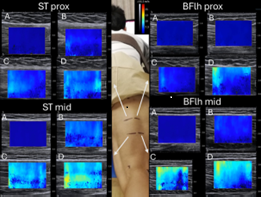
ハムストリングス※1の肉離れは大腿二頭筋長頭の近位部(上部)で好発することが知られていますが、その要因は明らかではありません。本研究では、15名の健常成人男性を対象に、超音波剪断波エラストグラフィを用いて剪断波伝播速度(shear wave speed, m/s)を計測し、ハムストリングス(大腿二頭筋長頭、半腱様筋)の各部位が最大下強度の等尺性収縮※2および伸張性収縮※3中にどのような力学的応答を示すかを検討しました。その結果、大腿二頭筋長頭の近位部は中間部に比べて応答が小さく(=筋内で伸長への抵抗性が不均一)、隣接する半腱様筋は筋長に沿って均一な応答(=筋内で伸長への抵抗性が均一)を示しました。このような差異はハムストリングスの受動的な力学的特性の影響を反映していると考えられ、特定の部位で肉離れが生じやすい要因を解明する上で有用な知見となると考えられます。
Professor Yasuo Kawakami (Faculty of Sport Sciences, Waseda University, Japan), along with Dr. Pavlos E. Evangelidis (University of Exeter, UK) and other coauthors, has published new research findings in the European Journal of Applied Physiology. The article, titled “Intra- and intermuscular shear wave speed distributions in the human hamstrings during isometric and eccentric contractions,” was published on September 18, 2025.
早稲田大学スポーツ科学学術院の川上泰雄教授、University of Exeter (エクセター大学)のPavlos E. Evangelidis(パブロス・エヴァンジェリディス)研究員らの研究グループによる研究成果が、『European Journal of Applied Physiology』に掲載されました。(論文タイトル:Intra- and intermuscular shear wave speed distributions in the human hamstrings during isometric and eccentric contractions 、掲載日:2025年9月18日)
Hamstring strain injuries often occur near the upper biceps femoris long head muscle, but the reasons remain unclear. This study examined how different regions of the hamstrings respond to force during static (isometric) and lengthening (eccentric) submaximal voluntary contractions using ultrasound shear wave elastography in 15 young, healthy men. Researchers found that the upper biceps femoris showed weaker responses than the middle region, while the neighboring semitendinosus muscle maintained a more balanced response along its length. These differences, which appear to be influenced by the passive mechanical properties of the hamstring muscles, may help explain why certain areas of the hamstrings are more prone to injury.
これまでの研究で分かっていたこと(科学史的・歴史的な背景など)
ハムストリングスの肉離れは、スポーツ傷害の中でも最も頻発する傷害の一つであり、特に大腿二頭筋長頭の近位部で好発することが知られています。先行研究では、筋内および筋間における力学的特性の不均一性が局所的な力学的負荷の発生に関与することが示唆されています。しかし、損傷発生と最も関連の強い収縮様式である伸張性収縮中に、そうした力学的特性の不均一性を体系的に検討した研究はこれまで行われていませんでした。
Hamstring strain injuries are among the most common sports injuries, often occurring in the upper biceps femoris long head muscle. Previous studies have suggested that unequal mechanical properties within and between muscles may contribute to localized strain, but this had not been systematically studied under eccentric (lengthening) loading, which is most relevant to injury occurrence.
今回の研究で新たに実現しようとしたこと、明らかになったこと
- 大腿二頭筋長頭は、等尺性および伸張性収縮のいずれの収縮様式においても、一貫して不均一な力学的応答(剪断波伝播速度:近位部<遠位部)を示しました。
- 半腱様筋は、等尺性収縮中にのみ力学的応答の不均一性を示しました。
- 安静時の受動的な力学的特性を考慮すると、伸張性収縮中には筋内の力学的応答の不均一性は消失しましたが、低強度の等尺性収縮中には依然として不均一性がみられました。
- 大腿二頭筋長頭と半腱様筋の間での相対的な応答は、安静時および低強度での収縮中には近位部で小さくなりましたが、収縮強度の増加に伴いより均衡したため、力発揮の努力水準の上昇に伴って両筋間の負荷バランスが均等化することが示唆されました。
- 筋構造は、伸張性収縮中にのみ大腿二頭筋長頭近位部の力学的特性との関連を示しました。
- The upper biceps femoris long head muscle consistently showed lower response to load bearing than its mid-region during both static (isometric) and lengthening (eccentric) contractions.
- The semitendinosus showed regional differences only during isometric contractions.
- When passive mechanical properties at rest were accounted for, intramuscular differences disappeared during eccentric loading but remained during low-intensity isometric contractions.
- The relative response between the two hamstring muscles (biceps femoris long head vs. semitendinosus) was lower in the upper region at rest and during low-intensity contractions, but became more balanced at higher intensities, suggesting more even load sharing between the muscles as effort increases.
- Muscle architecture correlated with upper biceps femoris long head mechanical properties only during eccentric contractions.
そのために新しく開発した手法
我々の研究グループは、超音波剪断波エラストグラフィを用いて異なる強度での随意的な等尺性および伸張性収縮中における筋の局所的な力学的特性を評価する方法を確立しており、本研究ではハムストリングスの力学的特性を空間的・機能的側面から詳細に解析しました。
The study applied ultrasound shear wave elastography to assess local muscle mechanical properties in humans during controlled isometric and eccentric voluntary contractions at varying intensities, enabling a detailed spatial and functional analysis of hamstring mechanics.
研究の波及効果や社会的影響
本研究は、ハムストリングスの肉離れが特定部位で好発する要因の理解を深めるものです。ハムストリングスの中でより大きな機械的ストレスを受ける部位を特定することで、アスリートの傷害予防プログラムやリハビリテーション方略の立案、さらにはスポーツ傷害の発生率低減に寄与する可能性が示唆されます。
This research advances the understanding of why hamstring injuries frequently occur at specific sites. By identifying regions of the hamstring muscles that are under greater stress, the findings could inform evidence-based prevention programs for athletes, reduce sports-related injury rates, and improve rehabilitation strategies.
今後の課題
今後の研究では、今回観察された低・中強度での力学的応答の不均一性が、スプリント動作あるいは競技特異的な動作においても生じるかを検証する必要があります。また、これらの不均一性に対して、筋活動パターン、筋構造、筋疲労などの要因がどのように関与しているか、さらにトレーニングによってより均一な力学的応答を促すことが可能かを明らかにすることも重要です。加えて、性別・年齢・運動歴などの異なる集団を対象に検討を拡大することで、これらのパターンが普遍的なものか、また傷害予防との関連を明らかにすることが必要です。
Future studies should investigate whether the regional imbalances observed at low to moderate intensities also occur during high-speed or sport-specific movements such as sprinting. It will also be important to examine how factors like muscle activation patterns, architecture, and fatigue contribute to these imbalances, and whether targeted training can promote more uniform mechanical responses across the hamstrings. Expanding to larger and more diverse populations will clarify whether these patterns are consistent across sex, age, and athletic background, and how they relate to injury prevention.
研究者のコメント
ハムストリングスの肉離れは、スプリント動作を伴うスポーツに取り組むアスリートや一般人にとって長期的な影響を及ぼす可能性がある傷害です。本研究では、ハムストリングスにおける部位特異的な力学的応答を明らかにし、特定の部位が損傷しやすい要因を説明し得る「力学的な弱点(mechanical weak spots)」の存在を示しました。本研究の成果が、傷害予防を目的としたトレーニング方略の立案や実践に資することで、受傷リスクの低減につながることを期待しています。
Pavlos E. Evangelidis: Hamstring strain injuries can have lasting effects on athletes and physically active individuals involved in high-speed running sports. By showing that certain regions of the hamstrings respond differently under load, our study highlights ‘mechanical weak spots’ that may explain why some areas are more prone to injury. I hope these findings will help inform training and prevention strategies and contribute to lowering the risk of such injuries.
用語解説
※1 ハムストリングス
大腿後面に位置する大腿二頭筋(長頭・短頭)、半腱様筋、半膜様筋の3つの筋の総称。主に膝関節を曲げる際に貢献し、スプリント走動作などで肉離れが好発する部位である。
※2 等尺性収縮
筋長が変化しない状態で力を発揮する収縮様式。
※3 伸張性収縮
筋が伸されながら力を発揮する収縮様式。関節運動を伴い、筋肉痛や肉離れを引き起こしやすい。
論文情報
雑誌名/Journal:European Journal of Applied Physiology
論文名/Title:Intra- and intermuscular shear wave speed distributions in the human hamstrings during isometric and eccentric contractions
執筆者名・所属機関名/Authors and Affiliated Organization:
Authors: Pavlos E. Evangelidis1,2,3, Chi Yang4, Hoshizora Ichinose4,5, Paul Newell3, Yasuo Kawakami1,6
Affiliations:
1 Faculty of Sport Sciences, Waseda University, Japan
2 Japan Society for the Promotion of Science, Japan
3 Public Health and Sport Science, Medical School, Faculty of Health and Life Sciences, University of Exeter, Exeter, United Kingdom
4 Graduate School of Sport Sciences, Waseda University, Japan
5 Faculty of Sport & Health Science, Ritsumeikan University, Japan
6 Human Performance Laboratory, Waseda University, Japan
Publishing Date(Local Time):18 September 2025
Publishing Date(Japan Time):18 September 2025
(オンライン掲載の場合/For online publication)
URL:https://link.springer.com/article/10.1007/s00421-025-05968-y#citeas
DOI:https://doi.org/10.1007/s00421-025-05968-y
研究助成
研究費名:日本学術振興会 科学研究費助成事業 特別研究員奨励費 [7F17412]
研究課題名:ハムストリングスの収縮中ストレス分布の解析:スポーツにおける肉離れとの関連性
研究代表者(受入研究者)・所属機関名:川上泰雄(早稲田大学)
研究分担者(外国人特別研究員)・所属機関名:Pavlos E. Evangelidis(University of Exeter)
研究費名:日本学術振興会 科学研究費助成事業 基盤研究(A) [16H01870]
研究課題名:骨格筋を形・質・機能で捉える:一般人~アスリートの身体運動能力躍進を目指して
研究代表者名・所属機関名:川上泰雄(早稲田大学)
研究費名:日本学術振興会 科学研究費助成事業 国際共同研究強化(B)[21KK0175]
研究課題名:Unravelling the Mechanisms of Muscle Strain Injuries: Toward Injury Prevention, Rehabilitation, and Athletic Performance
研究代表者名・所属機関名:川上泰雄(早稲田大学)
PE‘s role in this study was supported by a Grant-in-Aid for Japan Society for the Promotion of Science Research Fellows [JP 17F17412]. YK was supported by a Grant-in-Aid for Scientific Research (A) [No. 16H01870]. Both were supported by a Grant-in-Aid for Scientific Research (Fostering Joint International Research B; 21KK0175). PE and PN are currently supported by the National Institute for Health Research (NIHR) Exeter Biomedical Research Centre (BRC). The views expressed are those of the authors and not necessarily those of the NIHR or the Department of Health and Social Care.