Miyake Lab
- Posted
- Wed, 07 Jan 2026
The future of bioelectronics
Name:Gatus, Daniella Marie B.
Program & Year : Doctoral program, 3rd-year
✓日本語版はこちら/Click here for the Japanese version
Research Vision and Environment of the Miyake Lab
The research goal of Miyake Lab is to bridge the gap that exists at the interface between hard semiconductor devices and soft, wet biological materials. We hold weekly seminars to share interesting cutting-edge papers and exchange ideas for any possible research directions. With the kind and valuable guidance from our professors, we can work on our research with little to no anxiety. One of the fascinating initiatives of Miyake Lab is the development of smart contact lenses that detect changes in intraocular pressure for glaucoma patients.

Members of Miyake Lab
International Collaboration and Academic Exchange
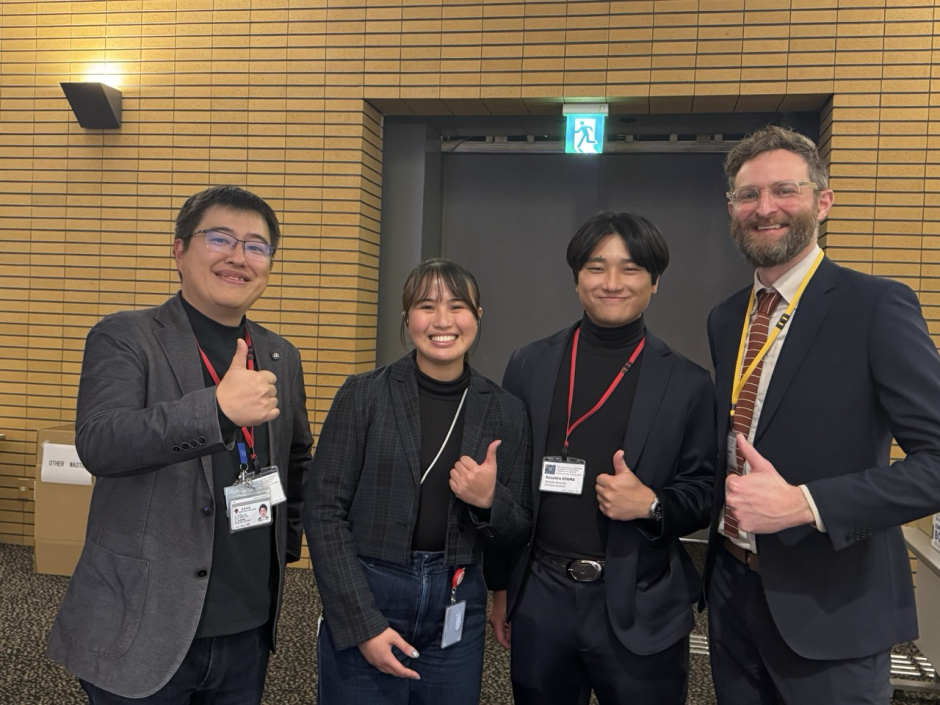
Meanwhile, at The 19th International Collaboration Symposium on Information, Production and Systems (ISIPS 2025), Prof. Miyake invited Prof. Daniel Simon of Linköping University (LiU) to inspiring talk on organic bioelectronics. Kazuhiro Oyama, a PhD student in Miyake Lab, is currently a designated participant in the MIRAI program, in which he is set to conduct joint research with Prof. Simon at LiU next fiscal year.
(from left to right) Prof. Miyake, myself, Kazuhiro Oyama (PhD students of Miyake Lab) and Prof. Daniel Simon (LiU)
My Research and Interdisciplinary Learning Experience
As for my own research, I am currently working on a collaboration project with Prof. William Bentley of the University of Maryland, combining the Miyake Lab’s gold nanotube technology with the Bentley Lab’s gene editing technology. Here, I not only learn the basics of molecular biology, such as microbial cultivation, plasmid introduction, and gene editing, but also acquire the knowledge and skills necessary for interdisciplinary research, such as mastering semiconductor microfabrication techniques to manufacture gold nanotubes. Through these research projects, I have become particularly interested in the fact that bacteria are not simply harmful, but can be modified to benefit human health. This is a powerful example of how science can dramatically change our existing concepts, and I feel joy in the realization that by applying the new method of nanotechnology to a different field (biology), I am able to make new discoveries and have the opportunity to come into contact with cutting-edge technology that will change the world.

Research contents