Waseda Podcasts: Rigorous Research, Real Impact– “Can Doing Good Make Good Business?”
Wed, Nov 25, 2026-
Tags
Waseda University released the fifth episode, “Can Doing Good Make Good Business?”, of Season 3 of its English language podcast series “Rigorous Research, Real Impact” on November 25, 2026. All podcast episodes are available for free on Spotify, Apple Podcasts, Amazon Music, and YouTube.
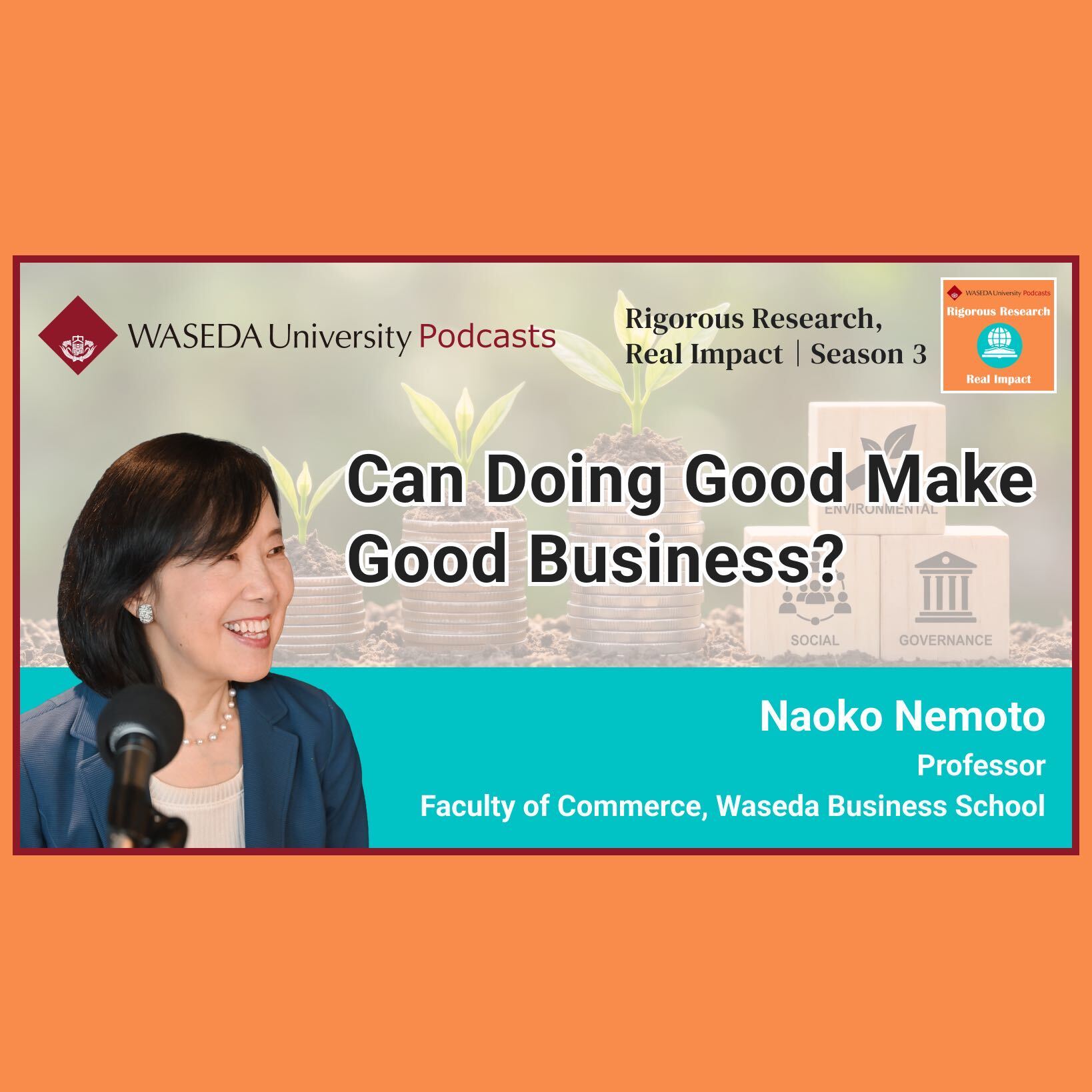
Episode 5: “Can Doing Good Make Good Business?”
In this episode of Waseda University’s Rigorous Research, Real Impact, Professor Naoko Nemoto and MC Hyunseo explore sustainable finance and Environmental, Social and Governance (ESG) investment in Japan. Drawing on her research during the COVID-19 pandemic, she examines how ESG practices contribute to corporate resilience and financial stability. She also discusses Japan’s traditional Sanpo-yoshi philosophy and the potential of impact investment to address social challenges, including regional revitalization. At Waseda University, Professor Nemoto encourages students to think independently and explore practical solutions to global sustainability challenges through research and real-world case studies.
About Season 3
This season, eight Waseda researchers will join three charismatic Waseda students, who will take on the role of MCs and guide the conversations. In relaxed, approximately 15-minute episodes, the researchers will introduce their areas of expertise, discuss how their research intersects with current social debates and trending news, and talk about their experiences teaching in Waseda’s English-based degree programs. Topics explored throughout the season include Japan’s economy, labor and migration in Japan, business in Japan, Japanese culture, and AI. By bringing academic expertise into accessible conversations about contemporary issues, the podcast offers international audiences a fresh perspective on Japan and the research taking place at Waseda. It is especially aimed at prospective international students, those considering further study or research in Japan, and anyone interested in discovering new perspectives on the issues shaping Japanese society and beyond.

About the Guest
Naoko Nemoto is a Professor in the School of Commerce at Waseda University. She holds a Ph.D. in Finance from Hitotsubashi University, an MBA from the University of Chicago, and a B.A. in Law from Waseda University. Before joining Waseda University, she worked as an economist and analyst at the Bank of Japan, served as Managing Director at Standard & Poor’s Ratings Services, and later as a financial economist at the Asian Development Bank Institute. Her research focuses on financial institutions management, monetary policy, financial inclusion, and sustainable finance.
Transcript
Introduction
MC Hyunseo Jung (00:06):
Hello and welcome to Waseda University’s English podcast series titled Rigorous Research, Real Impact. In this series, we dive into interesting conversations and stories from Waseda’s vibrant academic and cultural community. I’m your host, Hyunseo Jung, a fourth-year undergraduate student in the School of Culture, Media and Society here at Waseda.
Have you ever wondered if a company’s efforts to help the society and the environment actually pay off when times get tough? When an unexpected global crisis hits, does being a responsible business really protect companies and the broader economy from financial turmoil? Today, we’re exploring a field that bridges business strategy, social responsibility, and economic resilience: this is sustainable finance. We’ll discuss how ESG, or environmental, social, and governance practices, can build trust and stability in uncertain times, and what it really takes to shape a sustainable future for us all. Let’s dive further into this topic with an expert in this area.
To guide us, we are honored to have Professor Naoko Nemoto from the Faculty of Commerce, Waseda Business School.
Welcome to the show, Professor.
Professor Naoko Nemoto (01:25):
Thank you for having me. It’s a pleasure to be here.
Core Research Areas and Professional Background
MC Hyunseo (01:29):
To start off, could you briefly introduce the core areas you’ve specialized in throughout your career and the specific themes you are focusing on right now?
Prof. Nemoto (01:37):
Thank you very much. Let me begin by explaining my main research areas: ESG investment. When making investment decisions, investors usually look at a company’s profits, growth potential, and financial health. ESG investment goes beyond these traditional financial factors. It also considers how a company performs in three areas, namely: environmental responsibility, social responsibility, and corporate governance. The basic idea is that companies with strong ESG practice are more likely to avoid serious risks, earn the trust of customers, and reduce their financing costs. As a result, they may also perform better financially, and my research uses data to examine whether this is true or not.
And let me explain my background. Before joining the university, I worked at the central bank, Bank of Japan, a credit rating agency, and international organizations. For example, at the Asian Development Bank Institute, or ADBI, I was involved in the development of green bonds to support decarbonization in Asian countries. I also worked on gender bonds, which aim to support women and promote gender equality. This practical experience has been very, very useful in my academic research.
ESG Performance and Market Stability During COVID-19
MC Hyunseo (03:13):
One of your recent papers focuses on how ESG performance affected the Japanese stock market during the COVID-19 pandemic. Could you give us a quick overview of this research?
Prof. Nemoto (03:24):
Thank you for asking. This report explores how the financial conditions of Japanese firms affected by COVID, and the results show that their performance, or stock return or stock market volatilities, very stable. They have a very good ESG scoring, which shows the company’s behaviors or ESG promotions has a positive impact on their financial returns and stock market stability.
Shareholder Value vs. Stakeholder Capitalism
MC Hyunseo (03:54):
Let’s now move on to a topic we often see in the news these days. There is a growing debate about ESG. Many people believe that ESG is essential for responsible business. However, critics argue that investing in sustainability may reduce corporate profits.
Prof. Nemoto (04:11):
Thank you, that’s a very good question. Traditionally, there have been two main views about the purpose of a company. And the first view is that companies should focus on maximizing returns for its shareholders. The second is that a company should balance the interest of wider range of stakeholders. These stakeholders include customers, employees, suppliers, local communities, and shareholders. And ESG investment is based mainly on the second view. But I think the first and second views are not trade-off. Considering the long-term interest of stakeholders does not mean ignoring shareholders’ values. For instance, companies that properly manage environmental pollutions or human rights abuses in the supply chain can avoid serious risk. It can also build trust and strengthen its long-term corporate value. This will ultimately benefit its shareholders as well. And many company CEOs or investors now share this view, I believe. However, we don’t have enough empirical evidence showing that ESG improves financial performance. We also need to explain more clearly how ESG activities lead to better financial results. This is one of the important questions addressed by my research.
The Uniqueness of the Japanese Market in ESG
MC Hyunseo (05:37):
Regarding current trends, we hear a lot about green recovery in the post-pandemic era. How can we tell if a company is genuinely committed to sustainability rather than just following a temporary trend?
Prof. Nemoto (05:50):
I don’t think it’s a temporary trend, because currently, in many countries, they have already set up the disclosure rules, and it’s mandatory for listed companies. And also, many companies set the purpose of the companies and that includes sustainability. So I think it’s quite difficult to really change that purpose or company’s values.
MC Hyunseo (06:15):
Now, a lot of existing research on ESG has focused on the US and Europe, but your work specifically targets Japan. So what makes the Japanese market such an interesting context for studying ESG performance?
Prof. Nemoto (06:29):
I think Europe, they are probably more advanced in ESG areas. However, I believe Japan has three distinctive characteristics that support the development of ESG investment. The first is a traditional business philosophy known as Sanpo-yoshi. This idea dates back to the 17th century Edo period. It means that business should benefit three parties: the seller, the buyer, and society. In other words, a good business should create shared prosperity. The second characteristic is the steady role played by the Japanese government. Japanese government has introduced sustainability disclosure requirements and has promoted various green growth projects. And the third is the positive attitude of Japanese companies. For instance, Japan has had one of the largest number of corporate supporters of international frameworks such as TCFD for climate-related risk and the TNFD for nature-related financial disclosure. Many Japanese companies also hope to turn sustainability into a competitive advantage. They want to develop technologies for carbon neutrality and energy efficiency, and expand these technologies in international markets.
MC Hyunseo (07:57):
Would you say there are any Japanese companies or industries that you think are particularly interesting in—from an ESG perspective?
Prof. Nemoto (08:06):
It’s so difficult to nominate a few industries. I think most of the industries are very keen to develop ESG initiatives, I mean. But the auto industry, for instance, a quite strong industry in Japan, and they are very, very keen to address these issues, I think.
MC Hyunseo (08:23):
What type of influence do you hope your findings might have on business leaders and investors here in Japan?
Prof. Nemoto (08:30):
Most of the business leaders probably share the view that they should really focus on the benefit of stakeholders, not just only shareholders. However, various opinions, I think, among the companies or industries. So I think my research, I mean, will really support, or support the evidence that it is quite beneficial for the corporate leaders to promote ESG.
Teaching Sustainable Investment and Advice for Future Students
MC Hyunseo (08:54):
Thank you, Professor, for this immensely eye-opening conversation. Before we wrap up, let’s talk a little bit about your classroom. You teach courses on corporate governance, financial institutions, and sustainable investment here at Waseda. So what can students expect to experience and learn in your classes?
Prof. Nemoto (09:13):
Sustainability is still relatively new field. Only a few years ago, very few people expected international sustainability disclosure standards to be created and gradually made mandatory. At the same time, technologies such as AI and blockchain are changing the financial world in dynamic ways. And this field may be particularly interesting for people who enjoy developing their own hypotheses and searching for answers in areas where established theories do not yet exist. In my classes, I introduce the basic framework of sustainable and impact finance. I also use recent news stories and real corporate cases for students, and that will help them think independently. In addition, students have opportunities to discuss these issues directly with business leaders and professional investors.
MC Hyunseo (10:18):
Do students need a strong background in finance before taking your classes, and if not, where would you recommend they start?
Prof. Nemoto (10:26):
Common sense is sufficient. However, when you enter, for instance, MSc Finance school, there are some core courses for finance and statistics and other corporate finance, some projects, and so you can learn from this.
MC Hyunseo (10:43):
What kind of mindset do you hope to see from students who are interested in your research field and want to study sustainable finance?
Prof. Nemoto (10:51):
I think, as I said, that it’s quite new areas and there is not established theories, so I really encourage students to really confront with the reality and think about independently what would be the good measures to resolve the issues.
Regional Revitalization, Social Challenges, and Closing Remarks
MC Hyunseo (11:07):
Professor Nemoto, this has been an incredibly insightful conversation. Do you have a final message for students around the world who might be thinking about studying at Waseda or even researchers who might be considering taking up a position in Japan?
Prof. Nemoto (11:21):
Focus on one thing. Japan faces serious social challenges, including a shrinking workforce and aging populations. And one area that particularly interests me is the connection between regional revitalization and impact investment. Across Japan, many startups, innovative companies are trying to solve social problems while also earning profits. Examples include shared bus services in rural areas and online medical services for communities with limited access to healthcare. I believe this Japanese initiative can also offer useful lessons for other countries. And students in my zemi also enjoy many aspects of life in Japan, including Japanese hospitality, culture, and relatively affordable living costs.
MC Hyunseo (12:17):
Thank you so much for your time and for sharing your expertise with us, Professor Naoko Nemoto.
Prof. Nemoto (12:22):
Thank you for having me. It was a pleasure. I hope international students will bring their own experiences and perspectives to our discussions. Sustainability challenges are global, but the solutions may differ across countries and communities. By learning from one another, we can develop better ideas for the future.
MC Hyunseo (12:54):
And thanks to all our listeners for tuning in. For more conversations from the corridors of Waseda University, don’t forget to subscribe and tune in to the next episode on Rigorous Research, Real Impact. Until then, take care and stay curious.