Outside the Classroom, Learning Comes Alive
Thu, Nov 12, 2026-
Tags
Outside the Classroom, Learning Comes Alive
– Professor Miki Ikoma and the Leipzig Program: Fostering International Learning –
As soon as students arrive in the city of Leipzig, Germany, they are immediately immersed in the German-speaking world. From everyday interactions with locals to exchanges with students and life with homestay families – the language they have learned in a classroom setting is put to the test as their own in the real world. Professor Miki Ikoma of the School of Political Science and Economics has been providing her students with such experiences for over ten years through the Leipzig Program.
In addition to promoting study abroad programs that send Waseda students to study at international partner universities as exchange students, Waseda University also offers the Faculty-Led Education Abroad Program Grant to support student participation in overseas programs planned and conducted by Waseda faculty members. These programs can encompass a wide range of educational activities, including language programs, seminar participation, and fieldwork, providing students with opportunities to put the knowledge and language skills they have cultivated in the classroom to the test in real-world settings while encountering different perspectives and ways of thinking.
The exchange program with Leipzig University is one such example. Here, sustained teaching efforts by a Waseda professor have combined with students’ own initiative, allowing them to gain learning experiences that would be hard to come by in the classroom. We interviewed Professor Miki Ikoma about her motivations for starting the program and the value it has offered students over the years.
*Check out the following article to read the perspectives of the students who took part in the Leipzig Program accompanied by Professor Ikoma
Learning That Starts by Going Abroad
The Leipzig Program grew out of a history of exchange between Waseda and Leipzig University. Now run jointly by the School of Political Science and Economics and the School of Law, it has become firmly established as a learning experience encompassing presentations, discussions, and daily life. During the program, students are tasked with giving presentations in German and taking part in discussions held in a mix of Japanese and German. Additionally, through language and culture tandem sessions and homestays, they gain sustained experience using the language in everyday situations.
“From the moment you step outside in the morning, you can’t get by without using German. The participants truly spend the entire program, from start to finish, surrounded by the language.”
Thus, what students have learned in the classroom connects with the real world from the very first moments of the program.
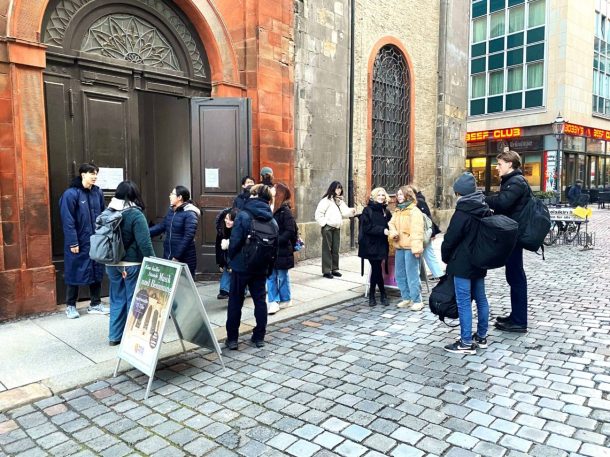
Visiting St. Nicholas Church during a tour of the city with Leipzig University students
How Being Understood Transforms Learning
At the heart of the program is providing students with the experience of being understood in another language.
“Speaking and finding that you’re understood – that experience really makes a big difference. That’s when students realize that what they’ve been learning hasn’t been for nothing.”
As opportunities to use German in Japan are limited, these moments of success leave a particularly strong impression. More than providing a simple sense of accomplishment, these moments renew students’ faith in the learning process itself.
“It’s a different kind of feeling from speaking English. Being understood in German is, I think, a truly special experience.”
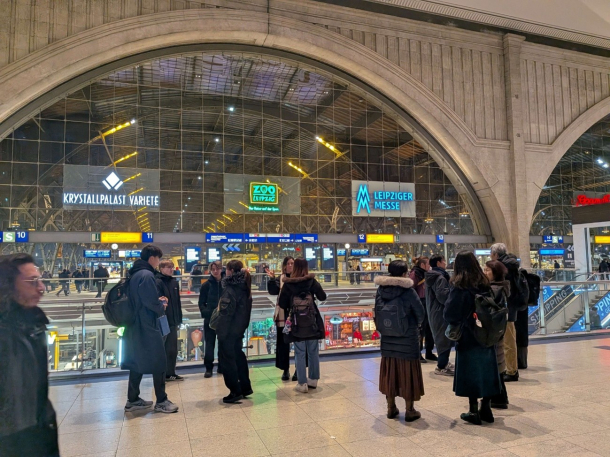
Participants regroup at Leipzig Central Station
Short-Term Experiences, Long-Term Change
Even a stay of just a few days to a week can have a considerable impact.
“Many students start to become more motivated even before they embark on the trip, thinking, ‘If I’m going to go abroad, I want to make it count.’ And the changes after they come back are significant as well.”
Some students, frustrated at not being able to speak as well as they had hoped, use that experience as motivation to recommit to their studies, taking more German courses to build their skills. For many others, it broadens their interest in studying abroad, something they had not seriously considered before.
In this way, a short-term experience can become a turning point that shapes students’ future paths.
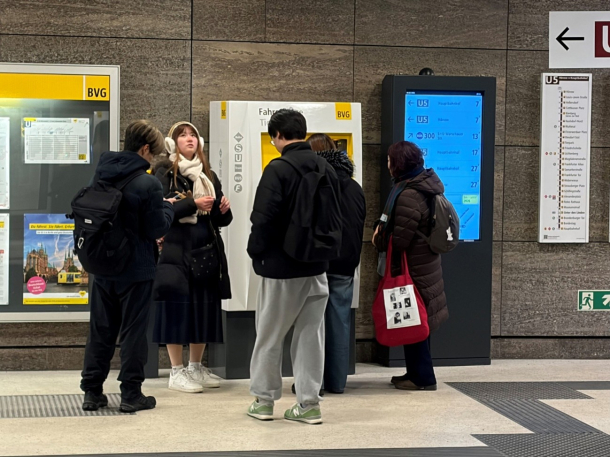
On the Berlin subway
A Program Designed to Encourage Student Initiative
The program is built on the premise that students will act autonomously.
“Once we arrive, I basically leave things up to the students. Interactions with locals start naturally from the very first day.”
Exchanges between students grow and develop on their own, without excessive professor intervention. This environment is what turns the passive learning of a classroom-based curriculum into an active, self-driven experience.
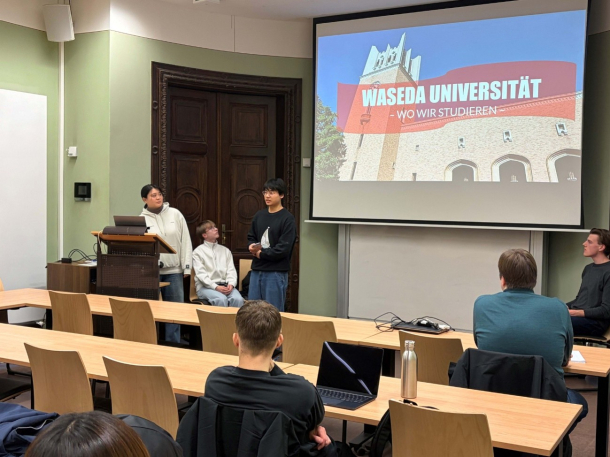
Students giving a presentation introducing Waseda University
New Possibilities for Faculty
This approach also challenges the idea that leading students abroad is necessarily a heavy burden.
“It’s not as if you have to keep a close eye on every little thing. The students take the initiative, so you can leave a lot to them.”
While respecting students’ independence, faculty members can focus on ensuring their safety and supporting their learning from the sidelines. In addition, speaking with professors and colleagues at the partner university can provide the Waseda faculty with new insights they can apply to future teaching and educational programs.
“Interacting with the faculty there has been extremely valuable.”
The relationships of trust built through ongoing exchange may also lead to future student exchanges and educational partnerships. Over time, these accumulated efforts ultimately produce more learning opportunities for students.
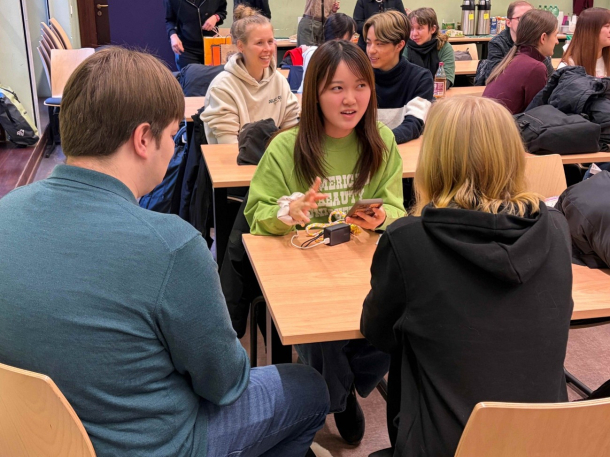
Exchange with Leipzig University students
Why There Is No Substitute for Going Abroad
Professor Ikoma describes why learning on location matters.
“There’s a lot you really can’t understand without going abroad yourself.”
Students come to see the setting in which a language is used, the customs and traditions behind it, and the way people relate to one another. Through homestays and everyday conversations, they encounter perspectives and ways of thinking that textbooks cannot fully capture.
“Casual conversations reveal the ways in which people from a certain country think. Noticing those things is a key part of learning, too.”
Changing one’s environment even for a short time can have a large impact on what students can pick up about a language. In this respect, the program offers an exceptionally high return on educational investment.
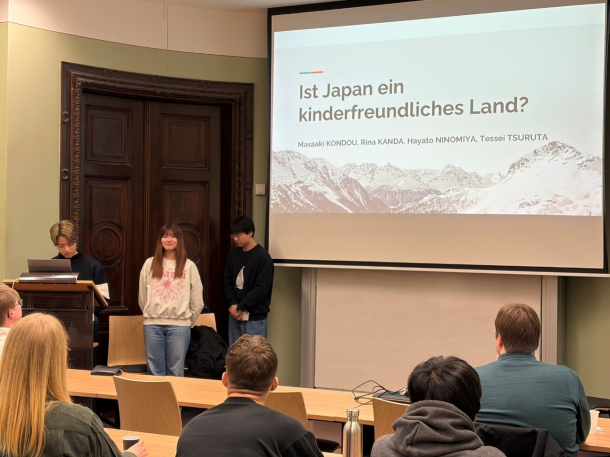
Waseda students presenting on Japan’s declining birthrate and aging population
Helping Students Take the First Step
These opportunities are made possible by the Faculty-Led Education Abroad Program Grant.
“Even a subsidy of 50,000 yen makes it much easier for students to take that first step.”
Financial support thus helps to turn students’ motivation into concrete action.
Even relatively modest support can have a significant impact in creating turning points in each student’s learning journey.
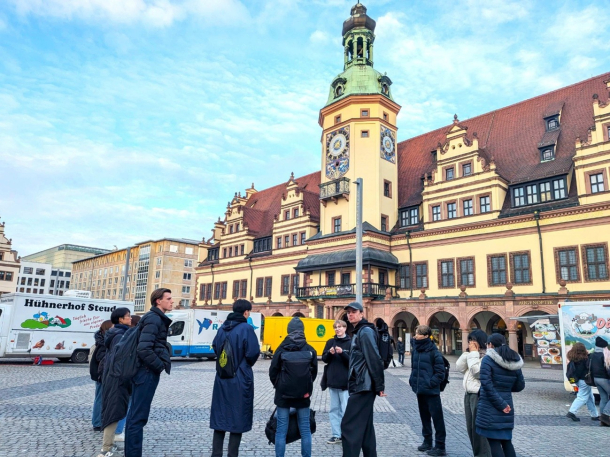
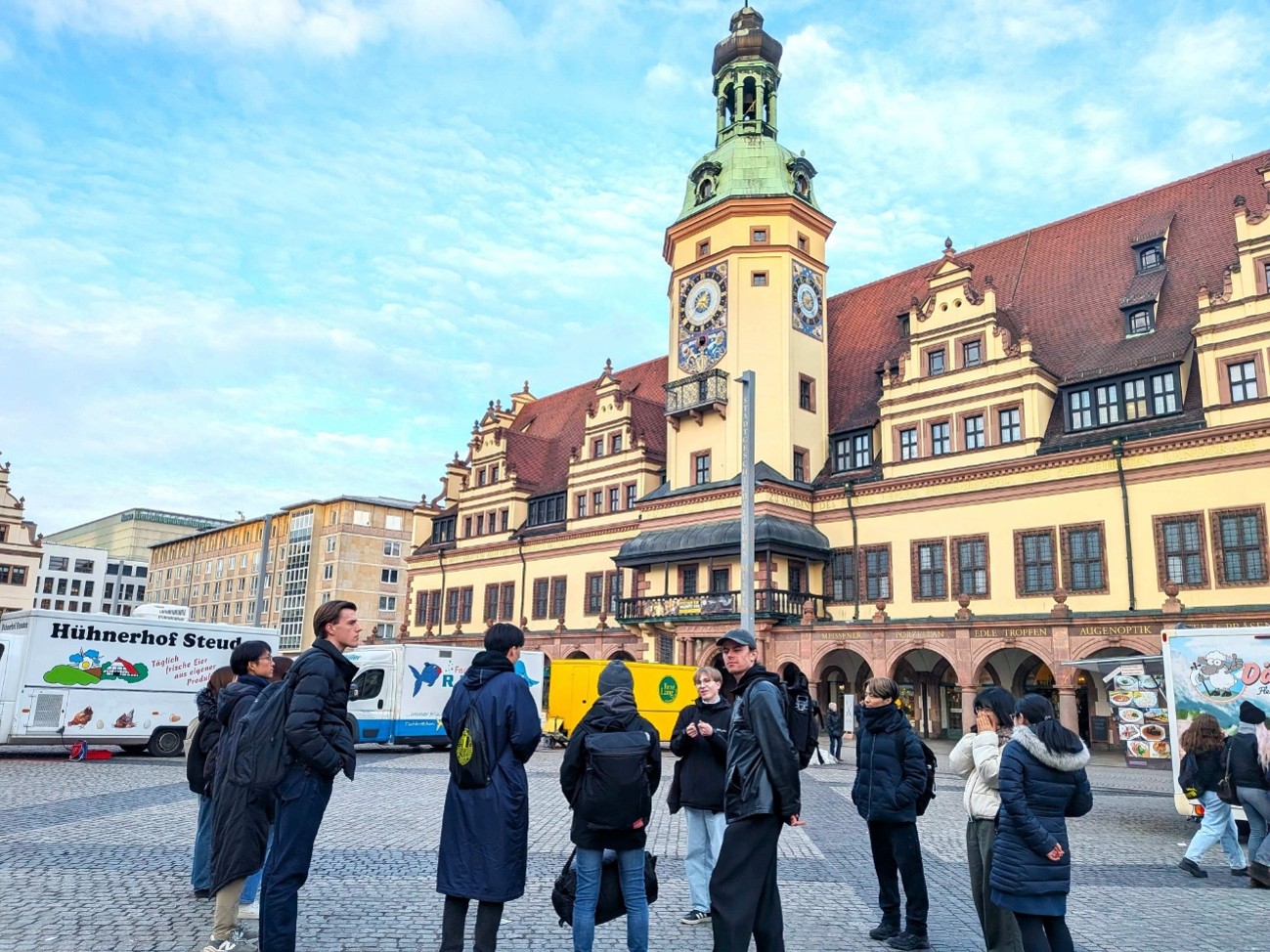
Visiting Market Square during a tour of the city with Leipzig University students
Sustaining and Expanding the Program
At the same time, initiatives like this are limited by funding.
“A lot of students are interested, so I’d like to see the program expand a little more.”
Despite growing demand, the number of opportunities that can currently be offered is limited. Yet the changes this program brings about, such as increasing motivation to learn and connecting to future study abroad experiences, extend beyond individual students.
Small-scale support can become a catalyst that shapes students’ futures, and over time, these efforts help raise the level of international education across the university as a whole.
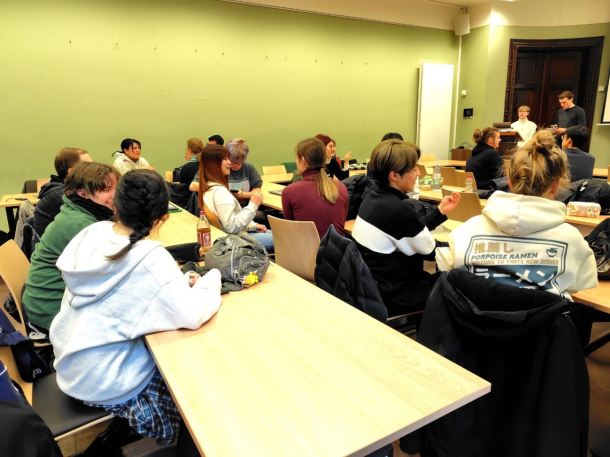
Taking part in a group discussion
Nurturing Students to Connect with the World
“I see it not just as a language program, but as a place for students to experience firsthand the connections between language, culture, and people,” says Professor Ikoma.
Each individual experience may be small, but that single step can change how students learn, broaden their horizons, and eventually grow into the ability to connect Japan with the world.
The challenge now is to make these opportunities available to even more students and to expand the possibilities they offer.
Faculty-Led Education Abroad Program Grant
Waseda University’s Faculty-Led Education Abroad Program Grant supports student participation in overseas programs planned and conducted by faculty members. Not limited to language programs, the grant is used for a wide range of educational activities, such as seminar participation and fieldwork, providing students with opportunities to put the knowledge and language skills they have cultivated in the classroom to the test in real-world settings while encountering different perspectives and ways of thinking. In the exchange program with Leipzig University in Germany, led by Professor Miki Ikoma of the Faculty of Political Science and Economics, sustained teaching efforts by faculty have gone hand in hand with students’ own willingness to take on challenges, opening the door to new learning experiences and future paths.
Instructor Profile
Professor, School of Political Science and Economics, Waseda University. Specializing in German linguistics and German language education, Professor Ikoma has led overseas programs for over ten years. Centered on exchange with Leipzig University, she is committed to hands-on international education.