At the research lab in Graduate School of Letters, Arts and Sciences Building 33, Toyama Campus
What's graduate school like? Waseda University currently has 21 graduate schools. This edition of "Graduate Student's Research!" introduces the campus life of Ms. Yu, who is diligently conducting research in Graduate School of Letters, Arts and Sciences. We'll share not only why she chose sociology, but also the allure of academics and how she spends her days.
I want to leverage my curiosity about human relationships to explore the intimacy of modern society.
Yo Mokuko, 2nd year Master's student, Graduate Graduate School of Letters, Arts and Sciences
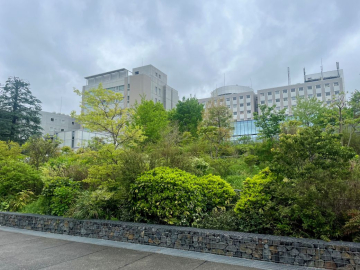
Toyama Campus where Graduate School of Letters, Arts and Sciences is located, after the rain.
I chose to major in sociology because the learning perspective resonated with my own experiences and feelings at the time. Until I went to graduate school, I mostly followed the path laid out for me by my parents, and because I hadn't yet established my own interests or core beliefs, I encountered various problems in my daily life.
At that time, I sometimes doubted myself or hesitated to act, and others thought I was slow to react. Amidst these struggles, I had the opportunity to be introduced to sociology through a senior colleague, which examines the underlying mechanisms behind phenomena that are taken for granted in society. This way of thinking resonated with my state of mind at the time, as I was trying to re-examine conventional wisdom.
For example, during my university years, my parents encouraged me to choose a field of study that would give me an advantage in finding a job, while others asked me, "Why don't you take the shortcut?" These are seemingly different situations, where one is advised to take the "difficult path" and the other the "easy path," but both share the commonality of requiring rationality and efficiency in individual actions. Regarding such everyday situations, sociologist Jürgen Habermas criticized the pervasiveness of the logic that emphasizes efficiency and results in the economic sphere into the lifeworld as the "colonization of the lifeworld." Meanwhile, fellow sociologist Max Weber explained the characteristics of modern society through the concept of "rationalization."
For me, the meaning of studying this field of study, and one of my core principles, is that sociology is "the study of questioning common sense."
Furthermore, sociology fosters an understanding of "people" and provides opportunities to find connections with others. I believe that focusing not only on individuals but also on people living together with others is one of the attractions of sociology. Having witnessed conflicts among those around me since childhood, I have been interested in the mechanisms of connection and division in human relationships, and within sociology, I specialize in the study of social network theory.
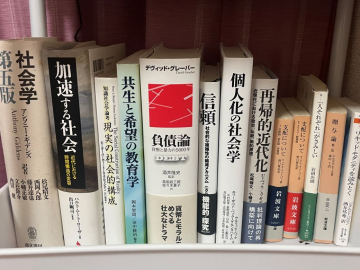
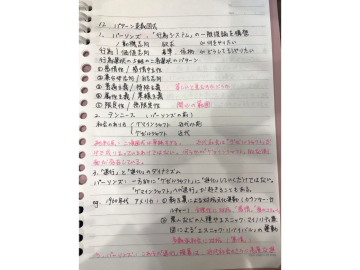
Photo on the left: A corner of a bookshelf at home, filled with numerous books on sociology and education.
Photo on the right: The study notebook I usually use.
During my master's program in sociology, what particularly stood out to me was being assigned to conduct the SSM survey (*) in Maebashi City, Gunma Prefecture, thanks to an introduction from my Faculty, Professor Mitsunori Ishida (Faculty of Letters, Arts and Sciences). I felt anxious before starting, but the actual survey turned out to be unexpectedly interesting.
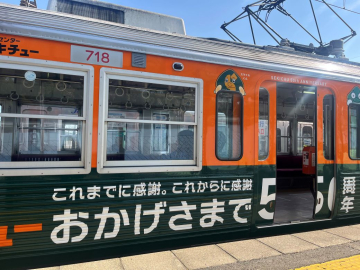
A commemorative photo taken on the Jomo Electric Railway Jomo Line during the SMM survey in Maebashi City.
For example, when we went to a location based on a list of the selected individuals and a map, we sometimes found that there was no building at all. This is because the individuals may have moved or sold their land between the time of selection and the survey.
Furthermore, when we conducted face-to-face interviews with participants at a cafe, we were able to hear detailed information about their work environment and gain insight into the realities of their lives that cannot be fully captured by data alone. From this experience, I learned that in social research, in addition to theory and data analysis, it is important to listen to people's lives and perspectives on the ground.
* "National Survey on Social Stratification and Social Mobility." Conducted every 10 years under the leadership of Japanese sociologists, it investigates how inequality and social stratification in Japanese society are changing.
Currently, I am working on Master's Thesis on the theme of "Exploring the Voices of Young People Who Find It Difficult to Rely on Others," focusing on young people who are facing difficulties but find it hard to talk to others about them. In the future, I would like to leverage my curiosity about human relationships and continue to conduct in-depth research on intimacy in modern society during my doctoral studies.
Daily Schedule
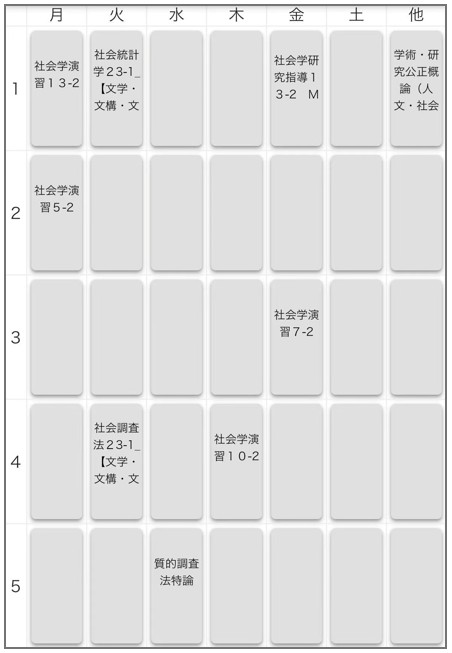
First-year Master's student, Fall semester class schedule
- 08:00 Wake up
- 09:00 Graduate seminar
- 11:00 Teaching Teaching Assistant(TA)for classes (When not working, I read and write papers and study independently)
- 12:30 Lunch
- 13:00 Class
- 15:00 Reading or writing a paper (I tend to concentrate better in the afternoon or evening, so I often study in the afternoon.)
- 17:30 Dinner, break
- 19:00 Gym (I go to the gym because I need physical stamina for my research. The frequency varies slightly depending on my schedule.)
- 20:30 Writing the paper
- 23:30 Bath, go to bed