Waseda Podcasts: Rigorous Research, Real Impact– “University vs. Corporate Startups: A Tale of Two Entrepreneurial Paths”
Tue, Dec 16, 2025-
Tags
Waseda University released episode seven, “University vs. Corporate Startups: A Tale of Two Entrepreneurial Paths”, of season two of its English language podcast series “Rigorous Research, Real Impact” on December 16, 2025. All podcast episodes are available for free on Spotify, Apple Podcasts, Amazon Music, and YouTube.
Episode 7: “University vs. Corporate Startups: A Tale of Two Entrepreneurial Paths”
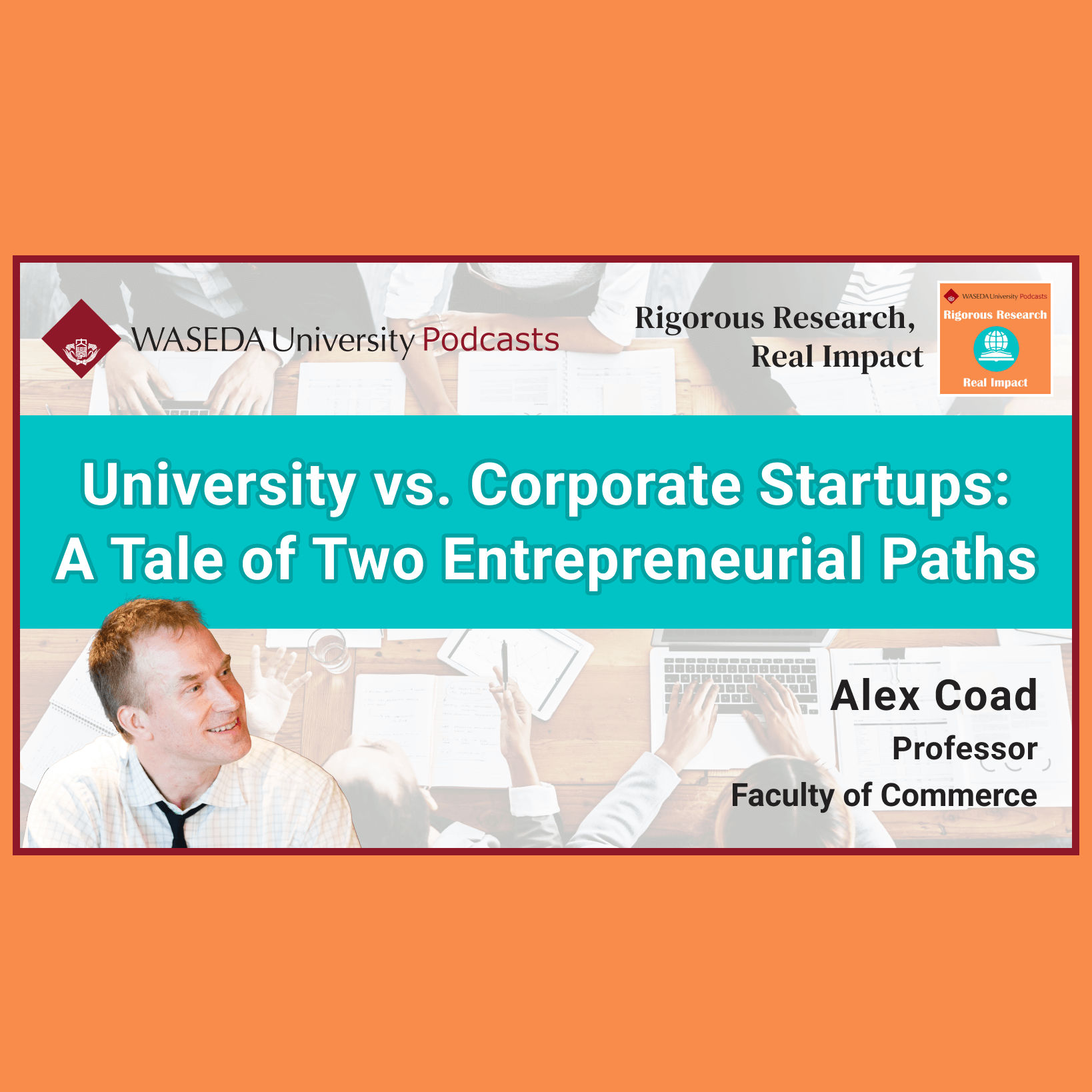
The seventh episode of season two features Professor Alex Coad (Faculty of Commerce), whose new study compares the motivations, cultures, and performance of entrepreneurs emerging from universities versus those from the corporate world. In conversation with host & PhD student Fabian Johannes (Graduate School of Economics), Professor Coad challenges the assumption that cutting-edge academic research naturally leads to high-performing startups, highlighting the cultural hurdles and identity shifts university-based founders often face. The episode also explores global entrepreneurial ecosystems, Japan’s evolving startup landscape, and how the Waseda Business School and Professor Coad’s seminar classes equip aspiring innovators with both theory and practical tools—offering listeners a compelling look into what it takes to turn ideas into real-world impact.
This episode is based on the following research:
Coad, A. “The company I keep is not corporate enough”: exploring the specificities of University startups. J Technol Transf (2025). https://doi.org/10.1007/s10961-025-10228-4
About Season 2
Season two features eight knowledgeable Waseda researchers casually conversing with Waseda PhD students about their recent, rigorously conducted research in the humanities/social sciences, their thoughts on working in Japan at Waseda, and the merits of the English-based degree programs they are a part of. Short 15-minutes episodes will cover a range of themes that include translanguaging in the Japanese sociolinguistic context, legendary game designer Hideo Kojima, and hybrid peacebuilding. It’s the perfect choice for international listeners considering attending university in Japan, current students contemplating further study in graduate school, and researchers looking to make the move to Japan and work for a university that stresses the importance of interdisciplinary approaches.

Professor Coad (left) recording with host Fabian, his former master’s student, at the Haruki Murakami Library
About the Guest
Professor Alex Coad is a highly-cited scholar in the areas of firm growth, entrepreneurship and innovation, and has published over 80 articles in leading international peer-reviewed journals. Prof. Coad is an editor at the journals ‘Research Policy’ (Financial Times Top 50 list of journals for Business Schools) and ‘Small Business Economics.’ Previously he obtained a joint PhD from Université Paris 1 Panthéon-Sorbonne and the Sant’Anna School, Pisa, Italy. In December 2016, Prof. Coad received the 2016 Nelson Prize at University of California Berkeley.
Transcript:
Introduction
MC Fabian Johannes (0:06):
Hello, and welcome to Waseda University’s English podcast series titled “Rigorous Research, Real Impact.” In this series, we dive into interesting conversations and stories from Waseda’s vibrant academic and cultural community. I’m your host, Fabian Johannes, a PhD student in the Graduate School of Economics here at Waseda.
MC Fabian (0:27):
Today, we’re exploring a field that is crucial for innovation and economic growth: entrepreneurship. Specifically, we’ll be looking at the differences between entrepreneurs who emerge from universities and those who come from the corporate world.
MC Fabian (0:41):
I’m thrilled to have a very special guest on the show today, my former master’s thesis supervisor here at Waseda, Professor Alex Coad. His recently published article investigates the specifics of university startups versus corporate startups, examining the motivations, cultures, and performance differences between entrepreneurs from academic and business backgrounds.
University vs. Corporate Startups: Key Differences
MC Fabian (1:09):
Professor, it’s been a while since we last connected, and I’m really excited to talk about your insightful research in the field of entrepreneurship.
Professor Alex Coad (1:16):
Thank you, Fabian, for having me. It’s a pleasure to be here.
MC Fabian (1:19):
Your research provides a very interesting comparison between two distinct types of entrepreneurs: those from universities and those from corporations. Your paper, called “The company I keep is not corporate enough,” suggests that even though universities are centers of cutting-edge research, they don’t necessarily produce the most successful entrepreneurs. Could you perhaps start by walking us through the key differences you’ve identified between university startups and corporate startups?
Prof. Coad (1:48):
Thank you. Yes, so there’s a lot of interest in university startups, university startup entrepreneurs, and how they differ from corporate startup entrepreneurs. For example, government and policymakers are often interested in finding out how can we unlock the innovation potential of university startups. They don’t take into account that there are many differences between university startups and startups coming from elsewhere in the economy, such as corporate startups. So, coming from a university background means that individuals wanting to be entrepreneurs have all kinds of, let’s say, baggage, have all kinds of cultural sensitivities, have all kinds of habits and routines that are very different from what you would find in a corporate workplace. So, all kinds of attitudes towards focusing on work that is interesting rather than profit-making, being willing to do research and work for free rather than trying to do something for financial reward, and also an aversion to routine work, to repetitive work, which is so important for getting a startup to become successful. So, the disadvantages faced by university-based entrepreneurs, to a large degree, they are based on culture, based on working practices. And for many reasons that I’ve explored in the paper, university-based entrepreneurs are not well-positioned initially for the work required for a startup. The choice is theirs whether they invest in the efforts to change their identities and transform from university researchers into entrepreneurs.
The Challenge of Shifting Identities
MC Fabian (3:29):
So, staying with what you said about identities, you mention in the paper that there needs to be a change from a scientific identity to a profit-seeking identity. Can you maybe elaborate on why this identity shift is such a significant challenge for them compared to their corporate counterparts?
Prof. Coad (3:47):
The scientific identity is about things like problem-solving, it’s about slow thinking, it’s about checking all of the details in your reasoning, it’s about things like checking the scientific literature, engaging in mathematical models, doing mathematical proofs, and so on. And it’s a very different type of problem-solving to the kind of tinkering and applied engineering that is done by entrepreneurs. Also, academics, they generally tend to avoid pursuing power in an organization, going for promotion, and so on, and they tend to shy away from repetitive tasks which are so important for managing a startup.
Questioning the Link Between Scientific and Entrepreneurial Success
MC Fabian (4:36):
I see, I see. That’s a very insightful view on the cultural and psychological challenges involved. That makes me wonder about the origins of this research question itself, because there’s a common assumption that because universities produce groundbreaking scientific discoveries, they will also be the source of the most successful high-tech ventures. And your work directly challenges this. What prompted you to question these assumptions and investigate why this gap between scientific success and entrepreneurial success exists?
Prof. Coad (5:02):
Thank you, that’s a great question. So, first of all, there’s the assumption often held by policymakers and economists that because universities often have the world’s best scientific research, that this research should automatically translate into innovative entrepreneurship. So, it makes sense to assume that, but it doesn’t really work out that way in the real world. So, when we look at the data on where are these most innovative startups, where are the innovative entrepreneurs actually coming from, we don’t see that university spinouts perform better; they actually seem to perform a bit worse than spinoffs and startups coming from the private sector. So, the first thing that got me interested in this topic was the kind of disconnect between the policymakers’ and economists’ assumption and what the evidence is saying from the many high-quality studies that have been published looking at large sample evidence in large sample representative data sets. And also, considering all of the support that university-based entrepreneurs get. So, university-based entrepreneurs, they benefit from all kinds of support: financial support from their department, they can take the intellectual property with them in many cases, and if it doesn’t work out, they can come back to their previous job at the university. That is unheard of in the private sector. You can’t leave a company, take their secrets with you, try to set up your own business, and then if that fails, come back to your previous job in the private sector. So university entrepreneurs have all of this support, why don’t they do better? That’s something that led me to investigate this issue.
Entrepreneurial Ecosystems: Japan vs. Europe and the US
MC Fabian (6:43):
That’s an interesting insight. And maybe let’s stay for the financial aspect for a bit longer. You were saying they can go back to their jobs if it doesn’t work out in the university ecosystem, which is, as you put it, unheard of, right, in the corporate world. How does this aspect shape the entire ecosystem of university startups, from the types of projects chosen to the way success is measured?
Prof. Coad (7:07):
Very interesting, yes. So, university entrepreneurs will probably choose different projects, probably choose projects in terms of, is this an interesting puzzle that I can attack, or is this a way that I can contribute to society, rather than thinking in terms of, is this a way that I can make a lot of money? And maybe university-based entrepreneurs have a different set of strategies at their disposal compared to private sector entrepreneurs because they often think in terms of making the world a better place, contributing to society, bringing something new to the world, whereas private sector entrepreneurs are more interested in seeking profits and even engaging in zero-sum games. For example, what’s good for me is good even if it’s bad for someone else, or even in even worse, negative-sum games where you may receive a small benefit but have a large negative impact on society. So maybe university entrepreneurs are using a different set of strategies focusing more on positive-sum games rather than zero-sum games or negative-sum games. That’s one aspect.
Another way in which entrepreneurs may differ coming from universities is that, so in terms of motivations for entrepreneurs, the literature has identified three different types of motivations. So, there’s the classic Darwinian motivation, which is the motivation for profit-seeking, competitive entrepreneurs trying to create lots of money from their startup. In addition to this Darwinian motivation, we can think of a communitarian motivation, which is where entrepreneurs might try to contribute something good to society and good to the community with which they identify. And there’s also a third one, which is the missionary motivation, which is where you think you have a good idea, and you want to spread it throughout society and throughout the world. So probably it makes sense to assume that private sector entrepreneurs are more on the Darwinian side, whereas university-based entrepreneurs are more on the communitarian or missionary side. Of course, it’s difficult to generalize because people are different wherever they come from, but on average, maybe there is a tendency like this. This also answers your question regarding different motivations and different ways in which success is measured.
MC Fabian (9:35):
I see, thank you for your elaborations, Professor. Now I’d like to shift the focus a bit. I know that you have conducted your research in Europe before coming to Japan. As a resident in the land of the rising sun, do you see parallels or stark contrasts between entrepreneurial ecosystems in Japan compared to Europe and the US when it comes to the identity shift from science-centered to commercially minded?
Prof. Coad (10:03):
Thank you. So, in Japan, traditionally, the rate of entrepreneurship has been lower than in other countries such as Europe and the USA, although this has changed recently, for example, in response to Abenomics, the policies of Shinzo Abe and afterwards, which has placed more emphasis on supporting entrepreneurship. So in recent times, there has been a discussion in the USA that entrepreneurship, the startup rates are decreasing. That doesn’t seem to be happening in Japan; in fact, it seems to be increasing slightly, although admittedly from a relatively low base. So Japan is quite entrepreneurial. If we can try to generalize about Japanese society, then entrepreneurship seems to be less common, although obviously, there are all kinds of people in Japan and there are lots of high-ability, highly ambitious entrepreneurs in Japan that are having a big impact.
I think the challenge of moving from a scientific, university-based research environment to a commercially-minded environment, this is a big challenge all over the place, whether we’re in Japan or Europe or the USA, but there are also several policies in Japan to support entrepreneurs coming from universities to set up. And there have been some success stories in Japan.
Learning Entrepreneurship at Waseda
MC Fabian (11:26):
Now I’d like to shift the focus once more to the benefit of potential future Waseda students listening from around the world. Hearing about your research, I’m sure many would be excited to study with you. For students interested in entrepreneurship and innovation, what makes Waseda’s English-based degree programs an ideal place to learn and prepare for their future careers?
Prof. Coad (11:49):
Thank you, Fabian, that’s an important question. What matters for success is, of course, entrepreneurial passion and having the motivation and having the grit to succeed, but there are also many ideas that can be followed from the scientific literature or from studying about the topic in order to improve entrepreneurial outcomes. So, before starting up your business, doing all kinds of activities to better position your business, searching for information, preparing, following recommendations from, for example, the lean startup approach regarding having a minimum viable prototype, finding a niche in the market, connecting to users, getting feedback from users, making sure that users…trying to find a business model that works, and so on. So there are many things that can be taught in a business school regarding how to improve your chances of success for entrepreneurship. And so this is one area in which I think an education at Waseda Business School can help to put entrepreneurs in a stronger situation for their business.
MC Fabian (12:55):
You mentioned the lean startup approach. From your seminar course, “Firm Growth, Innovation, and Industry Dynamics,” it covers topics like high-growth firms, scale-ups, and the aforementioned lean startup approach. How do you connect this cutting-edge theory with practical knowledge that can help students, whether they aim to become entrepreneurs themselves or innovators within large companies?
Prof. Coad (13:20):
Okay, so before starting their business, there are various activities that students can engage in to be better prepared once their business starts. So, these are ideas coming from, for example, research on gestation activities, research on the lean startup approach. So, we can say that there is some kind of a checklist of activities that entrepreneurs can engage in to be better prepared for starting up, which of course can be blended in with practical knowledge to deliver a set of actions that entrepreneurs can engage in. For example, in my seminar course “Firm Growth, Innovation, and Industry Dynamics,” we try to discuss these things and to analyze critically what constitutes good management practice and good advice for entrepreneurs.
Going back to the case of university-based entrepreneurs, so many of the activities that are crucially important for entrepreneurial success are activities that are relatively repetitive, not necessarily scientific breakthroughs. They require a lot of, well, focusing just on one activity rather than being distracted by interesting puzzles and scientific ideas. So perhaps this is one reason why academic entrepreneurs tend to have lower performance on average. It’s because they just are not interested in having the focus on repetitive activities that lead to entrepreneurial success. So maybe it’s a choice made by academic entrepreneurs. So, it’s a lifestyle choice. These are the important activities, whether individuals want to follow these guidelines for the activities leading to entrepreneurial success, that’s another matter and that’s their personal decision. But these are the things that we discuss in my seminar course, “Firm Growth, Innovation, and Industry Dynamics.” So being a successful entrepreneur does mean engaging in all kinds of repetitive activities. If you really want to succeed as an entrepreneur, then you will have to change your identity and be willing to engage in these activities.
A Final Message
MC Fabian (15:33):
Thank you for elaborating on your seminar. That sounds like a must-visit class for anyone who wants to become an entrepreneur, in my opinion.
Professor Coad, thank you very much for your time today and your takes on the captivating field of entrepreneurship. Before we wrap it up, do you have a final message for students around the world who might be thinking about studying at Waseda or becoming an entrepreneur in the future, or even researchers who might be considering taking up a position in Japan?
Prof. Coad (15:58):
Thank you very much. Yes, Waseda Business School, as you know, it is widely seen as the best place in Japan to get an MBA. It is widely recognized on the global landscape. So, why would students want to come to Waseda to study? So, I think there are many reasons. They might want to get or receive an education, a world-class MBA or MSc in finance. They might be interested in learning about Japanese society. They might want to live in Tokyo. They might want to receive an education along the lines that Waseda tries to prioritize, not only academically rigorous research but also actionable insights, actionable knowledge coming from a world-class faculty, not only of academics but also practitioner-based professors as well.
MC Fabian (16:48):
That makes for a strong final statement. Thank you.
Prof. Coad (16:51):
Thank you very much for having me. It was a pleasure.
Conclusion
MC Fabian (16:58):
And thanks to all our listeners for tuning in. For more conversations from the corridors of Waseda University, don’t forget to subscribe and tune into the next episode on “Rigorous Research, Real Impact.” Until then, take care and stay curious.