Waseda Podcasts: Rigorous Research, Real Impact– “Migration, Labor Shortages, and Japan’s Economic Future”
Wed, Oct 14, 2026-
Tags
Waseda University released the third episode, “Migration, Labor Shortages, and Japan’s Economic Future”, of Season 3 of its English language podcast series “Rigorous Research, Real Impact” on October 14, 2026. All podcast episodes are available for free on Spotify, Apple Podcasts, Amazon Music, and YouTube.
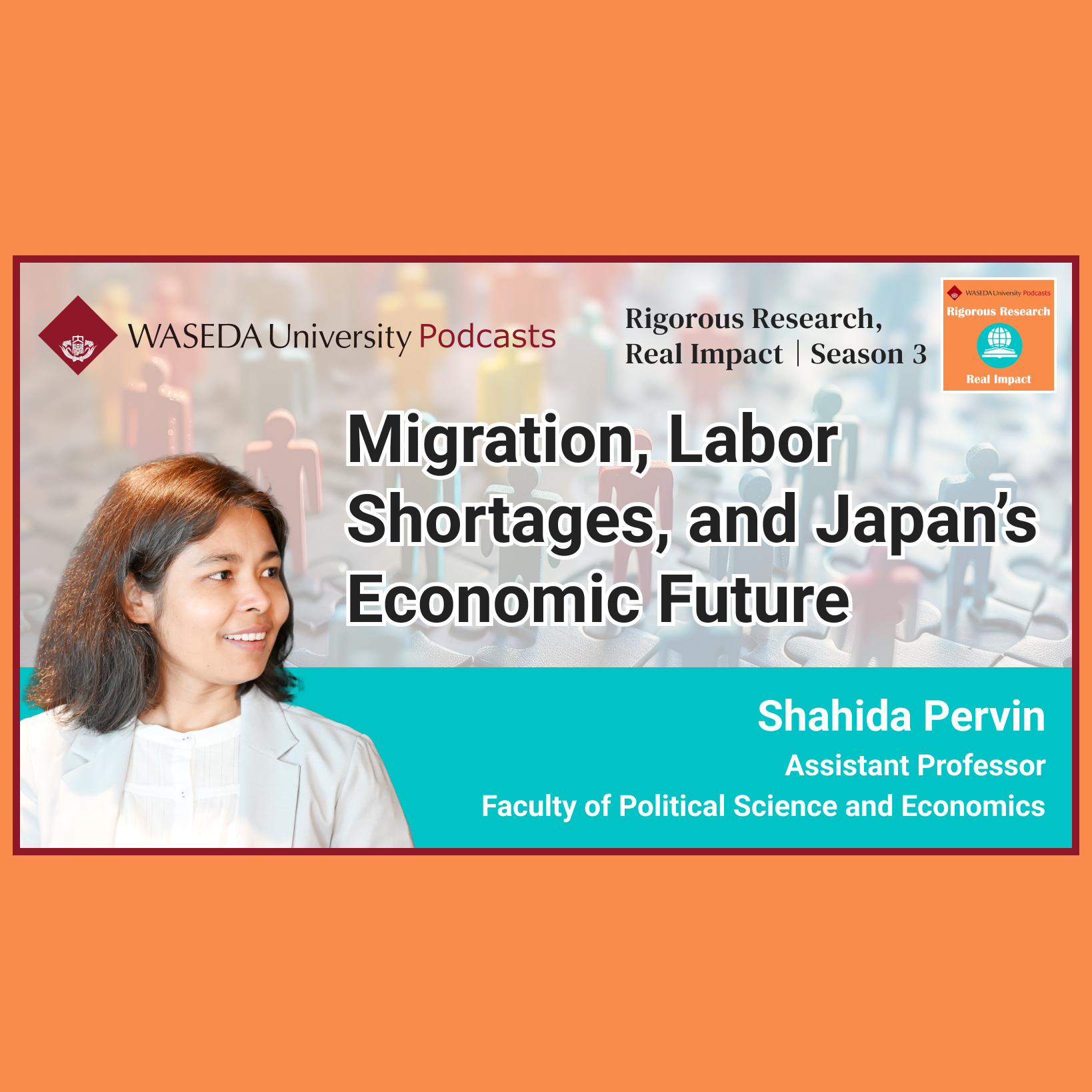
Episode 3: “Migration, Labor Shortages, and Japan’s Economic Future”
In this episode of “Rigorous Research, Real Impact,” Assistant Professor Shahida Pervin of Waseda University’s School of Political Science and Economics discusses Japan’s changing labor and migration landscape and the economic and social questions surrounding the movement of people across borders. Drawing on her research in empirical economics, she shares her thoughts on why people migrate, the challenges Japan faces as it responds to labor shortages, and how research and evidence can contribute to a better understanding of migration. She also introduces her approach to teaching economics at Waseda, where students learn quantitative methods and apply them to real-world data and current economic issues.
About Season 3
This season, eight Waseda researchers will join three charismatic Waseda students, who will take on the role of MCs and guide the conversations. In relaxed, approximately 15-minute episodes, the researchers will introduce their areas of expertise, discuss how their research intersects with current social debates and trending news, and talk about their experiences teaching in Waseda’s English-based degree programs. Topics explored throughout the season include Japan’s economy, labor and migration in Japan, business in Japan, Japanese culture, and AI. By bringing academic expertise into accessible conversations about contemporary issues, the podcast offers international audiences a fresh perspective on Japan and the research taking place at Waseda. It is especially aimed at prospective international students, those considering further study or research in Japan, and anyone interested in discovering new perspectives on the issues shaping Japanese society and beyond.

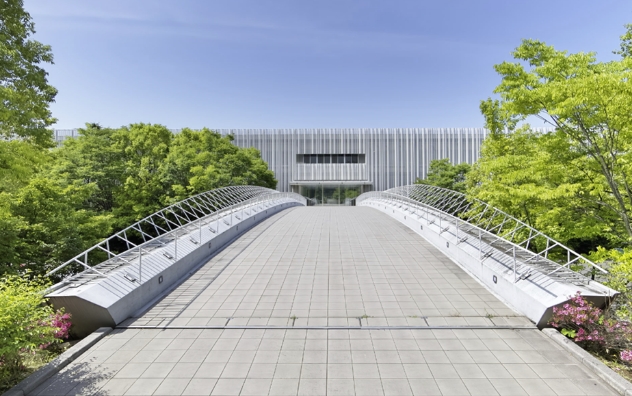
Professor Pervin and MC Jamie recording at the Waseda International House of Literature (Haruki Murakami Library)
About the Guest
Shahida Pervin is an Assistant Professor of Economics in the Faculty of Political Science and Economics at Waseda University. Before joining Waseda University in April 2024, she was an Adjunct Faculty member at Meiji Gakuin University and a researcher at several research organizations, including the Overseas Development Institute (ODI) and Centre for Policy Dialogue (CPD). Her primary research interests include labor economics, development economics, and empirical and experimental economics. She is also interested in macroeconomic issues, food security, and agricultural economics.
Transcript
Introduction
MC Jamie Beatty (00:08):
Hello and welcome to Waseda University’s English podcast series titled Rigorous Research, Real Impact. In this series, we dive into interesting conversations and stories from Waseda’s vibrant academic and cultural community. I’m your host, Jamie Beatty, a first-year master’s student in the Graduate School of Asia-Pacific Studies here at Waseda.
So, when you go to a convenience store or a restaurant in Japan these days, how often is it that you see foreign workers? For many of us, it’s become a part of our daily lives. What does that mean for Japan’s economy and its immigration policies?
Today, we’re exploring a critical issue for Japan’s future: labor shortages and migration. We’ll be discussing how cross-border labor mobility and immigration policies are addressing the challenges of an aging population, and what this means for both migrant-receiving and sending countries. To guide us through the topic, we’re honored to have Assistant Professor Shahida Pervin from the School of Political Science and Economics.
Welcome to the show, Professor.
Asst. Prof. Shahida Pervin (01:13):
Thank you so much for having me. It’s a great pleasure.
MC Jamie (01:16):
So, to start off, could you please introduce yourself and just a bit of the core themes of your research?
Asst. Prof. Pervin (01:23):
Thank you. My name is Shahida Pervin. Currently, I am an assistant professor in the Faculty of Political Science and Economics here at Waseda University. I specialize in empirical economics, and I teach mostly development economics, public economics, and data and econometric methods. I have been working on several issues in economics, including macroeconomic issues in the UK, in China, and Bangladesh. I also worked on development issues, including LDC, SDGs, gender, etc. Currently, I am focused on migration, particularly in Japan. So, today’s episode is a great opportunity for me to talk about migration in Japan. I look forward to today’s conversation.
Drivers of Cross-Border Labor Mobility and Country-Specific Trends
MC Jamie (02:11):
Thank you very much for that introduction. Our research interests actually happen to align very well. For your current research, I understand that you’re exploring the driving factors in both migrant-receiving and sending countries. Please, could you give us a little bit of an overview as to what this involves?
Asst. Prof. Pervin (02:27):
Right. So, Japan has been a recent phenomenon in migration research, particularly foreign population in Japan has spiked in recent times. I was working on Rohingya refugees in Bangladesh, and at some point, I started to look into data on the Japanese labor market, particularly in migration, because a lot of things are happening in Japan right now regarding immigration processes, policies. So, I started to think about Japanese immigration policies, the impact on the labor market, and why people come to Japan. That was the thing, how I started to work on Japan. I wanted to understand the reasons and implications of immigration in Japan. So my interest is to understand why people come to Japan, and when they come to Japan, what happens to Japan in the labor market and overall in the economy.
MC Jamie (03:26):
That’s really interesting. I look forward to learning more about your research. I know that within Japan, it’s a different experience for different people coming from different countries. For example, from countries like Vietnam, Nepal, and Indonesia, they have different experiences in obtaining visas, for instance. For Nepal, they don’t have as clear routes as the other two. So, could you elaborate on why these non-policy factors could be?
Asst. Prof. Pervin (03:54):
That’s an interesting question, and that was one motivation for me to start working on Japan. People come to work for different reasons. One big reason is the labor market: people want to find good jobs, better salaries, and in many cases, it happens from the neighboring countries. So it appears that the distance from the country is a big issue. I started to look into which countries’ people come to Japan more, and it is obvious that the neighboring countries, like China, Vietnam, Korea, and Philippines, Indonesia as well.
But the thing is, from all these countries, people do not come uniformly. For example, from Vietnam, the recent increase in immigration is very high compared to other neighboring countries. But then I started to look into further away, like what happens to South Asia, what happens to other regions. And I found that from South Asia, the people from Nepal are coming a lot to Japan, but not similarly from neighboring countries like Sri Lanka, India, or Bangladesh.
To the best of my knowledge, I realized that there is no bilateral agreement between Japan and Nepal, but there are some policies between Japan and India or even between Japan and Vietnam or Indonesia. So what happens to Nepal, that even if there is no bilateral agreement or bilateral policy, still people are coming? There could be many things. One is, if many people from the past came to Japan, it is easier for people to get more information from Japan. How historically immigration flow was from Nepal to Japan, or from other countries to Japan, that might be a factor.
And other factors are cultural homogeneity, maybe religion, government policies from the country of origin. Like you mentioned Nepal, maybe they are planning to send many people to Japan, so they are planning accordingly, like they may have developed language schools or introducing Japanese culture to the country. There could be many factors.
One important determinant is distance between countries. Other factors could be government policies, cultural homogeneity, languages, and historical flow of people between countries. These could be the big factors, but I am still exploring and trying to understand that.
Researching Japan: Filling the Literature Gap and Policy Impacts
MC Jamie (06:26):
Such a fascinating web of interlinking factors, then. It’s so hard to explain, but that’s why your research is so important. So thank you for going through that. What I understand, you’ve, as you’ve said, worked in the UK previously, you’ve studied there too, you’re from Bangladesh, you’re now in Japan. What makes Japan so interesting to study migration and labor shortages right now?
Asst. Prof. Pervin (06:48):
Thank you for that question. That’s really an interesting question. I have been working in different countries and also on different issues, including the UK, China, Bangladesh, and South Asia, and recently I started to look into Japan. One important thing about Japan is that Japan is a new phenomenon in migration literature. Most of the migration issues have been studied from the perspective of Western countries, and most of the displaced population or refugees are located in developing or poor countries. So Japan has not been into migration issues much, neither into the refugee or displaced literature. Japan is becoming a new issue in migration literature, so I thought this could be something interesting I can add to literature. There is some research gap, so I wanted to work on Japan to contribute to the literature by introducing Japanese migration broadly.
MC Jamie (07:53):
Definitely a gap, what I’ve uncovered myself, too. What kind of impact do you hope your research will have on policymakers and even local communities within Japan?
Asst. Prof. Pervin (08:03):
First of all, I do empirical research, so what I bring is evidence from my research. I want to provide evidence to inform policymaking so that the policy does not rely on only narratives or hype, but also based on proper research, proper information. That is one thing I want to contribute to from the policy perspective. I also want to contribute to the literature, as I mentioned before, and to the people who are concerned about migration.
That is definitely one important issue in Japan, particularly because Japanese people did not have much experience of living in diverse situations. Their experience is more homogeneity. So we also need to understand Japanese people’s perspectives. That is one of my research questions. We are trying to understand, with my collaborators, why people are concerned. Is it only protecting their culture, their history, or are they also affected by the immigrants? Do they face more competition in the market? Is it becoming difficult to find jobs for them when more immigrants are coming? Is it difficult for them to get better wages? Do they feel threatened by the immigrants because of their skill gap, or is there any skill gap between local people and the immigrants?
We are trying to understand people’s perspectives as well, what are the concerns. And if we know better about people’s perspectives, we can inform the policy, and this will also help people to understand their perspective better. For example, sometimes people depend on only the narratives, while they are not well-informed or well aware of the real statistics. If we can share the information with the people, they can sometimes update their beliefs or thoughts, and they can revise their opinion or reaction process. That’s how I think our research and my research will contribute to understand Japanese migration for policymakers and for the people as well.
Addressing Societal Hurdles, Geographic Disparities, and Permanent Residency Policies
MC Jamie (10:25):
Perfect. Thank you for your response. That was really fascinating and very holistic. We often hear about this tension on one hand where Japan desperately needs workers because of its aging population, its declining birth rate, then on the other hand, integrating migrants comes with social and cultural challenges. In your view, what is the biggest hurdle that Japan faces right now in welcoming more foreign workers?
Asst. Prof. Pervin (10:47):
Right. So we are talking about human mobility, not about capital or any object. That means people have their preferences and choices, and that is one big thing in economics, how people make their choices. We need to be careful about that. The economy has difficulties because of labor shortage; on the other hand, people have different choices. How to balance this, that is a big question, definitely.
If the economic performance does not improve, it can create more problems than solving the existing problem. That’s why the problems in the labor market should be addressed, as well as people’s concerns should be addressed. What are the people’s concerns? That is one of my research questions. As I mentioned, people may think that because of the immigrants, we are not getting jobs, we are getting less wages, we are facing more competition, foreigners may be taking more advantage from the government, they may be consuming most of our subsidies, or they may not pay tax properly. If the authority can communicate with the local community, that may mitigate a part of the problem. How the communication of statistics and information takes place, that is a big way how the government can solve the problem.
So I would say that economic problems have to be addressed, labor shortages have to be addressed, as well as people’s concerns have to be addressed. I’m focusing on this holistic issue: addressing why people are concerned and how to address those concerns.
MC Jamie (12:25):
That’s really interesting. Obviously, I’m not as far into my research as you are, but I’m uncovering similar patterns with mine, too. Increasingly within Japan, too, we’re seeing a mismatch geographically in where migrant workers are heading to. This obviously is going to complicate the debate a bit, because Tokyo and Osaka, they’re going to have different experiences to in rural Japan, for instance. How would you say this mismatch complicates the wider debate?
Asst. Prof. Pervin (12:52):
If you look at different countries, you see that about 40% of London’s population is foreign-born. That means people are concentrating in urban areas. The similar thing is happening in Japan. Most people come to Japan and find it convenient to live in Tokyo or Osaka, big cities, while Japan may need more people in the remote areas or in the countryside. I think for people it is easy to live in urban settings because these places are generally less demanding in terms of culture. It’s more convenient to find all the facilities, it’s sometimes more convenient to find their community or diverse community, so people try to locate in an urban setting.
It is a policy issue to address the geographic imbalances. Policymakers may need to address this differently, how to distribute immigrants more evenly in different places. They may need targeted policies to redistribute the population. That could be one thing, but I would say that is a global phenomenon. If you look at Silicon Valley, talented people concentrate there, so Japan is no exception in that regard.
MC Jamie (14:04):
That actually answers the next question I was about to ask you, because I was going to ask if there are any other cases where you could think of which share similar regional imbalances to Japan, but it seems that this is a global phenomenon, then.
Just moving on, within the news, recently there’s been speculation that the Japanese government is going to yet again make it harder to achieve permanent residency for migrants. Do you anticipate that this might have a negative impact upon Japan’s attractiveness, or do you think shorter-term visas for so-called low-skilled labor will continue?
Asst. Prof. Pervin (14:34):
I think there are several issues regarding this question. First of all, what kind of people does Japan need? Does Japan need more skilled people or less-skilled people? Is Japan willing to give residence permits to more skilled people or less-skilled people? If currently the permanent residence is given more to high-skilled populations, and if the government rethinks about making the permanent residence more difficult, then it will distract the inflow of high-skilled populations. One thing is how the government makes the priority about the inflow of foreign people.
Second, it is generally accepted that high-skilled people are more competitive around the world, so they have higher mobility. They can move from one place to another place easily compared to less-skilled people. If the permanent residence affects the high-skilled people, they will find an alternative destination, and this will affect Japan negatively.
It also depends on how other countries respond. For example, if the developed countries or OECD countries are competing for skilled populations, then they will attract more skilled populations and people will go in that direction rather than coming to Japan.
Another is, if Japan thinks that it needs low-skilled people, and after completing short-term jobs they will go back to their country, I think then the policy of discouraging them to come to Japan is a good thing. It is about the priority of Japan. However, one thing I can mention is that to change policy, it’s better to go gradually so that if there is any mistake or any big shock, the country can revert to the previous situation easily.
Studying at Waseda: Quantitative Methods, Econometrics, and Advice for Students
MC Jamie (16:24):
It’s certainly a situation we should keep an active eye on. Thank you very much for explaining what is going on to our listeners. Just now moving to the appeal of studying at Waseda University. Your work demonstrates the importance of using really core methods of econometrics to understand really complicated societal issues such as migration. For potential future Waseda students who are listening, what kind of skills and perspectives can they expect to gain from your data-driven approach in the School of Political Science and Economics?
Asst. Prof. Pervin (16:53):
I’m an empirical economist, and I teach econometrics, as well as development economics, labor economics, and public economics. I try to bring research into my teaching. Students can learn in my lectures quantitative methods, they can apply those methods with real data, they can learn research, and they can also be updated about what is going on in the research field in economics. These are the things students can learn from my lectures. I focus on research and quantitative methods in my teaching.
MC Jamie (17:30):
That sounds very interesting to me. What can I say? For myself, actually, I was once someone who was very nervous to try data-intensive methods because, frankly, I’m not the best at maths. What’s some advice you could give to other people who are beginning their journey into the world of data analysis? Would you recommend just going headfirst into things like Stata, or how would you recommend getting into the world of it?
Asst. Prof. Pervin (17:55):
Well, I do not recommend to think about Stata or R. These are technical tools. First of all, I would say, get over your nervousness. The first thing is to know that economics is getting more math-oriented these days. In the past, economics used to be more philosophical or political economy. Nowadays, the economics subject is becoming more and more mathematics- and statistics-oriented. And I see a clear advantage of this; this is a time of data revolution.
If you start learning data and methods, that would be really useful in the future, because the situation is emerging, technical knowledge is more required than ever. I would say overcoming your nervousness will be the first thing, then you need to get into the subject and learn gradually. One thing I always mention in my class is that there is no wrong question in economics, and you need to study more and more to make good questions.
Similarly, I would say to those students who feel nervous that overcoming your nervousness is important first of all, and then understand that learning is a gradual process. You can learn throughout your life. I’m a teacher, but I still learn. Accept that any learning will be difficult, and you can get through this. That would be my suggestion.
Final Message to Prospective Students and Researchers
MC Jamie (19:27):
Well, it certainly sounds like there’s no place better to learn than in your class and here at Waseda in general, too. Thank you, Professor. This has been such an incredibly insightful conversation. Before we finish, do you have a final message for students around the world who might be thinking about studying here at Waseda, or even researchers who might be considering taking up a position in Japan?
Asst. Prof. Pervin (19:47):
Surely. I encourage all the potential students and researchers to consider Waseda University and broadly Japan. Waseda, to the best of my knowledge, is the largest university to host foreign students, so you can find a diverse environment here. And for researchers, at the Faculty of Political Science and Economics, we are a vibrant academic community of economists and political scientists. I encourage future researchers to consider Waseda University and also Japan. Japan is a unique place, you will enjoy it and you will love it. I encourage all the students and researchers to consider Japan and of course, Waseda University.
MC Jamie (20:29):
I can certainly agree with that sentiment. Thank you so much for your time and for sharing your expertise with us. Thank you, Professor Shahida Pervin.
Asst. Prof. Pervin (20:36):
Thank you. It was a pleasure.
MC Jamie (20:49):
And thanks to all our listeners for tuning in. For more conversations from the corridors of Waseda, don’t forget to subscribe and tune in to the next episode of Rigorous Research, Real Impact. Until then, take care and do stay curious.