Waseda Podcasts: Rigorous Research, Real Impact– “Institutionalized Socialization: How Companies Help Newcomers Belong”
Tue, Jan 13, 2026-
Tags
Waseda University released episode eight, “Institutionalized Socialization: How Companies Help Newcomers Belong”, of season two of its English language podcast series “Rigorous Research, Real Impact” on January 13, 2026. All podcast episodes are available for free on Spotify, Apple Podcasts, Amazon Music, and YouTube.
Episode 8: “Institutionalized Socialization: How Companies Help Newcomers Belong”
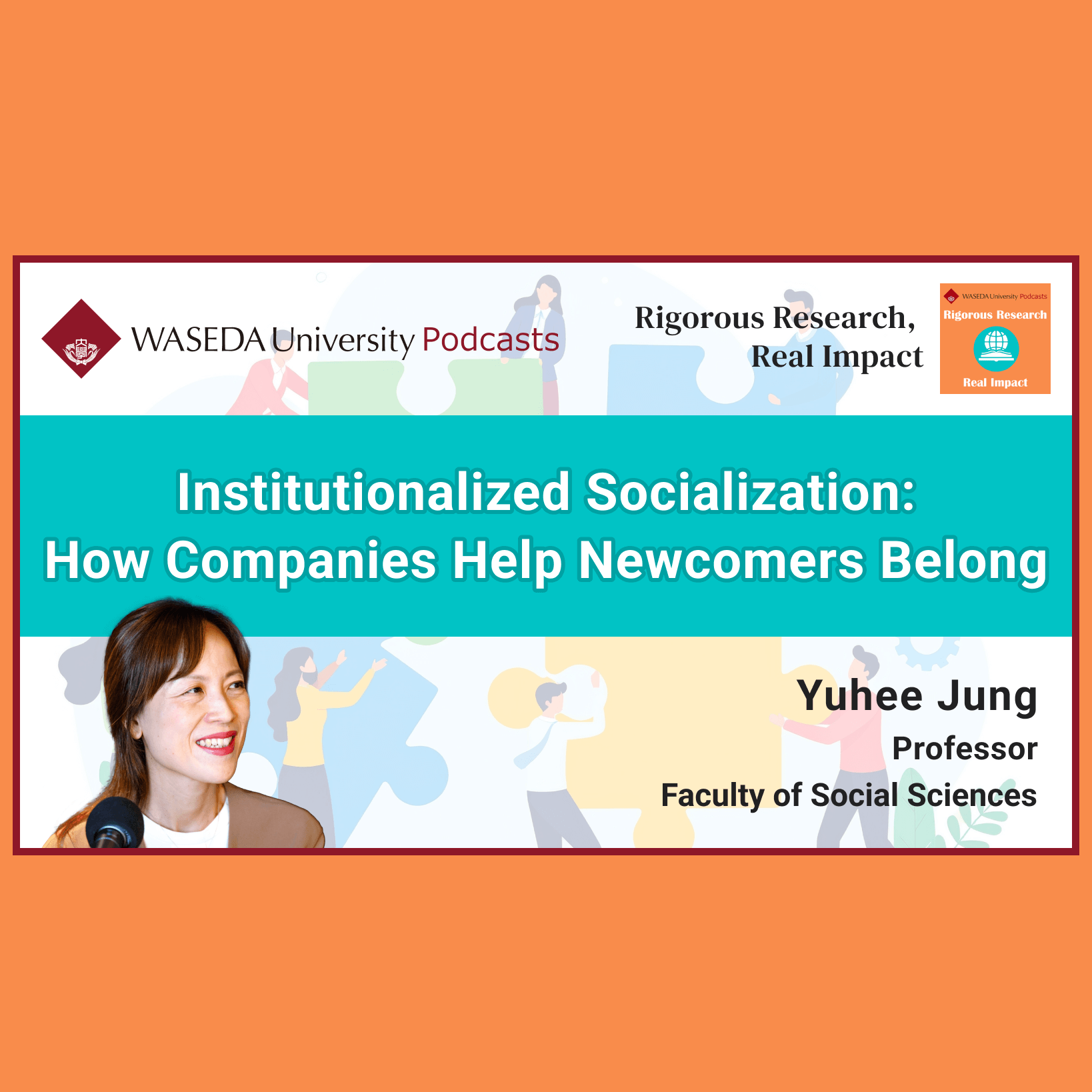 In the final episode of season two PhD student host Peter speaks with Professor Yuhee Jung of the Faculty of Social Sciences to explore how new employees transition from organizational “outsiders” to trusted “insiders.” Drawing on her research in organizational behavior and human resource management, Professor Jung explains how institutionalized socialization practices—such as structured training, mentoring, and continuous support—help build trust, commitment, and long-term success for newcomers. The conversation weaves together theory, real-world implications for Japanese companies navigating changing employment norms, and Professor Jung’s own international career journey, and offers an insider’s perspective of the Transnational and Interdisciplinary Studies in Social Innovation (TAISI) program, one of six English-based undergraduate degree progams at Waseda.
About Season 2
Season two features eight knowledgeable Waseda researchers casually conversing with Waseda PhD students about their recent, rigorously conducted research in the humanities/social sciences, their thoughts on working in Japan at Waseda, and the merits of the English-based degree programs they are a part of. Short 15-minutes episodes will cover a range of themes that include translanguaging in the Japanese sociolinguistic context, legendary game designer Hideo Kojima, and hybrid peacebuilding. It’s the perfect choice for international listeners considering attending university in Japan, current students contemplating further study in graduate school, and researchers looking to make the move to Japan and work for a university that stresses the importance of interdisciplinary approaches.

Professor Jung (left) recording with host Peter at the Haruki Murakami Library
About the Guest
Professor Yuhee Jung holds a PhD in Business Administration and specializes in organizational behavior and human resource management. She has previously served as an associate professor at Ritsumeikan University and a professor at Gakushuin University, and began teaching at the Faculty of Social Sciences at Waseda University in April 2020. Professor Jung also spent one year as a Visiting Scholar at the UCLA Anderson School of Management.
Transcript:
Introduction
Peter Chai (0:06):
Hello and welcome to Waseda University’s English podcast series titled “Rigorous Research, Real Impact.” In this series, we dive into interesting conversations and stories from Waseda’s vibrant academic and cultural community. I’m your host, Peter Chai, a PhD student in the Graduate School of Political Science here at Waseda.
MC Peter (0:25):
In a final episode of season two, we’ll consider a field crucial to both employees and organizations: organizational behavior and human resource management. We’ll be discussing how new employees change from outsiders to insiders and how important trust is when it comes to their success and commitment to a company.
MC Peter (0:45):
To explore this topic, we are pleased to have Professor Yuhee Jung from the Faculty of Social Sciences, where she teaches in both Japanese and in the English-based degree programs of the undergraduate and graduate schools. Her work delves into the critical process of how new employees integrate into an organization, focusing on how companies can build trust and ensure a smooth transition for their newcomers.
MC Peter (1:14):
Welcome to the show, Professor Jung.
Professor Yuhee Jung (1:16):
Thank you for having me. It’s a pleasure to be here.
MC Peter (1:19):
Professor, your research touches on something many of our listeners can probably relate to: the essential and yet sometimes challenging process of starting a new job and fitting into an organization. You’ve described this in your work as moving from an “outsider” to an “insider.” Could you tell us about the institutionalized socialization tactics you research? How do they help newcomers in the adjustment process?
Professor Jung (1:44):
Okay, thank you for the question. Most companies attempt to help their newcomers adjust smoothly and successfully by providing education, training, or a simple basic orientation. These approaches are known as socialization tactics. And actually, there are two types of socialization tactics: individualized and institutionalized tactics.
Professor Jung (2:11):
For example, if the companies implement individualized tactics, newcomers rarely receive education, training, or even a simple orientation. It is a very classic “sink or swim” situation. So, successful newcomer socialization is totally dependent on the newcomer’s experiences or their abilities. On the other hand, institutionalized tactics are very well-designed and organized company approaches. If the company implements institutionalized tactics, the newcomers will receive formalized orientation and continuous training, education, and even social support, such as a mentoring program. So, the newcomers can receive the very basic and necessary knowledge and education to conduct their job and performance.
Professor Jung (3:15):
Actually, previous studies found that, maybe you already imagined it, institutionalized tactics are very effective for newcomer socialization. That’s why those previous studies considered these types of tactics as sources of information. However, if we limit the role of those tactics to just simple information provision, we may miss a very important fact: that the newcomers begin to trust their organization as an employer.
A Researcher’s Journey: From Personal Experience to Academic Inquiry
MC Peter (3:52):
Thank you so much, Professor, for explaining to us the importance of institutionalized tactics. That was a very clear and helpful framework. Hearing about it makes me curious about your own path. You’ve researched a wide range of topics, from individual differences to organizational human resource management, or HRM practices, in order to understand how people achieve career success. What led you to focus on individuals’ career success in particular? Could you share a bit about the journey that brought you to this field?
Professor Jung (4:20):
Yes, thank you for this. To answer the question, let me briefly introduce or share my experiences in Japan. I’m originally from South Korea. After graduating from university in Korea, I came to Japan to pursue master’s and PhD degrees. As an international graduate student, I was worried about my career—whether I could get a job or a position in a Japanese university.
Professor Jung (4:51):
Japan is very famous for, can you guess? Not just sushi or ramen, I mean, it’s a male-dominated society. Of course, nowadays we have very good news; we have the first historical female prime minister. However, Japan still remains a male-dominated society. Can you imagine over 15 years ago? It was much more serious than now. At the time, back then, I couldn’t find a female faculty member from the university, especially in my research area of business management. All were male faculties. Besides, there were very limited tenure-track opportunities for international faculty.
Professor Jung (5:39):
Have you heard about the term “intersectional minority”? I’m kind of an international and female, a totally intersectional minority group in Japan. Therefore, naturally, I became interested in career research itself. Interestingly, at that time, there was a huge paradigm shift in career research. People began to pursue their own psychological satisfaction, well-being, and happiness more than just an objective career, such as a promotion or higher salary. Besides, people were becoming committed to their own careers more than the company itself. The people move around from company to company, across industries, and beyond countries. We call that phenomenon a “boundaryless career.”
Professor Jung (6:41):
I like that concept. That’s why for my PhD, I decided to stop worrying and enjoy what I’m doing, which is my research. My PhD dissertation focused on an individual’s subjective career success—how individuals pursue their own psychological satisfaction in their career. I also tried to compare the differences between male and female employees, between young and older employees, and across countries. That was my research.
Professor Jung (7:16):
And finally, thanks to God, I got my PhD degree and my tenure-track position. Since that time, I’ve changed universities three times. And honestly saying, Waseda is my fourth employer. I believe Waseda is my last employer because I’m pretty satisfied with my current job and workplace. That’s why I have experienced being a newcomer a lot, so I can totally understand how difficult it is to adapt to a new workplace. That’s why now I’m focused on newcomer socialization. So, my research journey is, I say, “me-search,” not just research. Many researchers do “me-search.” That is my research journey.
Japan’s Unique Employment Landscape
MC Peter (8:12):
Thank you, Professor, for sharing your personal experiences. I’m glad to hear that you are enjoying your time at Waseda. So, Professor, let’s now talk a bit about the setting of your research: Japan. The country is well-known for its employment systems like lifelong employment. From your perspective, what makes Japan such a fascinating and important place to study topics like organizational socialization and HRM? Are there unique dynamics here that you wouldn’t find elsewhere?
Professor Jung (8:34):
Yes, thank you. Japan is always a unique country in terms of culture, people’s behaviors, customers, and even the good food. So many people from all over the world are interested in Japan. In the same way, Japanese companies have a very unique management style. A long time ago, scholars already mentioned this unique Japanese management style.
Professor Jung (9:11):
As you already mentioned, long-term employment, which we call “lifetime employment,” seniority-based promotion, and company-based labor unions—so, interestingly, these three pillars characterize Japanese management. This is related to the very unique HR practice that I call the “simultaneous hiring system.” Simultaneous hiring system means that Japanese companies hire a large number of newcomers at once, just once a year. For example, I remember two years ago, Toyota, a large company, they hired 1,300 newcomers at one time. This is, interestingly, a totally different practice from other countries where companies hire their newcomers if they have a need for specific positions, they hire some people.
Professor Jung (10:08):
But Japanese companies, they hire a large number of newcomers every year at the same time. Mostly, these newly graduated newcomers don’t have any industrial experience; they have no idea. This means that Japanese companies have to take the responsibility to educate and train the newcomers until they can independently conduct their tasks. So it means that it costs, it’s expensive and takes time, at least over one year. So why do Japanese companies still keep doing this traditional thing? Because most Japanese managers strongly believe that those newcomers will stay with them until they retire, showing high loyalty to their company.
Professor Jung (11:13):
Actually, that was true, maybe for their parents’ generation. But nowadays, Gen Z in Japan is the same as Gen Z in other countries. Most of the young generation don’t believe they should stay with only one employer through their whole career. If they have a better chance, why not? They can move and change companies easily. So now we have a big gap between the individuals—the newcomers—and the company managers’ perspective. Many HR managers are now worrying about this situation, wondering whether they should keep this same simultaneous hiring system or not. So, Japan is now dynamically changing and transforming, and that’s why most researchers are focusing on these socialization issues in the Japanese context.
Bridging the Gap: Research-Based Solutions for Japanese Companies
MC Peter (12:13):
Thank you, Professor, for explaining the simultaneous hiring system in Japan. Japan is facing its own modern challenges, like attracting and keeping young talent. I believe it’s sometimes called the “Shichi-Go-San” phenomenon in Japanese. How can your research on building trust through socialization offer some practical advice or solutions for Japanese companies dealing with this type of issue today?
Professor Jung (12:32):
Thank you. As I mentioned, nowadays many HR managers are concerned and worried about this situation. As you mentioned, “Shichi-Go-San“—maybe you know what it is. Many, like 30% of college students, they change their first job within three years. It’s 50% for high school graduates change their job and 70% for junior high school graduates change the job. This means the young generation easily changes their first job.
Professor Jung (13:07):
You know, but still, many Japanese companies invest in their newcomers, expecting they will stay with them, but actually, it is not true. But still, my research, my findings, would say “yes”—maybe HR managers in Japan can still keep what they’re doing so far. This means that the concept of trust, the perception of trust, is still very important in the Japanese context for the relationship between the individual and the company. Actually, our research found that when the organization invests in their newcomers by providing continuous education and training, those newcomers perceive their organization as a trustworthy employer. They perceive, “Okay, maybe I can rely on this company. Maybe I can stay with this employer as long as possible.” So, yeah, maybe our research finds that Japanese companies can keep what they’re doing so far. That is my answer.
The TAISI Program: A Hub for Cross-Cultural Learning
MC Peter (14:16):
Thank you, Professor for sharing your research findings. To round out our conversation, I’d love to turn to any potential future Waseda students who might be listening. After listening about your research, I’m sure some are inspired. For those students who are interested in organizational behavior and HRM, what makes the Transnational and Interdisciplinary Studies in Social Innovation, or TAISI program, and the English-based degree program at the Graduate School of Social Sciences at Waseda a great place to dive into these topics?
Professor Jung (14:44):
Thank you. So actually, nowadays social issues—for example, like national relations, economics, or environmental issues—cannot be solved with only specific or very limited knowledge because all the issues are related in complicated ways. In the same way, most companies don’t run their business in only their home country, but also in more than two or three countries. So it means that HR managers should manage employees not only in their home country but also in host countries or even third countries. So, HR managers need to understand languages, diverse cultures, institutions, laws, and related environmental factors—they need everything.
Professor Jung (15:38):
So actually, I can say that the School of Social Sciences is the best place for students to learn this HRM. Actually, I don’t teach just HRM; I mean, I teach international HRM. Nowadays, we cannot think of only simple HRM; we need international HRM. Also, I teach organizational behavior, but not only OB—I mean, cross-cultural organizational behavior.
Professor Jung (16:05):
And not only me, the School of Social Sciences has very competent faculty members. They are each experts in various research topics, such as politics, economics, environmental economics, and like me, management. So, students can learn diverse perspectives and knowledge from these professors. So, I can say bravely that this place is the best place for students to learn HRM, especially nowadays.
A Final Message
MC Peter (16:41):
That has been such an enjoyable conversation. Before we finish, do you have a final message for students around the world who might be thinking about studying at Waseda or even researchers who might be considering taking up a position in Japan?
Professor Jung (16:55):
So, as we already discussed, Japan is a very unique country. As an international researcher, from my perspective, Japan’s uniqueness sometimes makes it harder to adapt to the rapidly changing environment, which is a huge challenge for Japan. Japan has a strong history and a long culture. Actually, Japanese values are human and harmony. And nowadays, Japan is actually changing to welcome international and global talents.
Professor Jung (17:30):
So, with this good balance between the historical, cultural tradition and the openness, I guess most global talents have a good opportunity to work here in Japan. Especially Waseda is very open to global talents, global researchers, and of course, international students. So, I just recommend strongly: come to Japan and come to especially Waseda, and maybe you can experience it by yourself. I strongly believe that you will never regret your decision.
MC Peter (18:04):
Thank you, Professor, for your time and for sharing your research areas, personal experiences, and the courses you are teaching.
Professor Jung (18:11):
Thank you for having me, and it was my pleasure.
Conclusion
MC Peter (18:18):
And thanks to all our listeners for tuning in to this final episode of season two. For more conversations from the corridors of Waseda University, don’t forget to subscribe and check out our homepage for more information on our university podcasts. Take care and stay curious.