Exchange Student at Graduate School of Asia-Pacific Studies
From Free University of Berlin
The sweet smell of a certain flower or perfume can sometimes trigger a long-forgotten memory of a place or a person, awakening emotions of nostalgia as one indulges into the scent. This is the power fragrances can hold. When I think of times in Japan where I was surrounded by scents so different than the ones at home in Germany, it was during my visits to temples. In Buddhism, these sacred places are not only a ground of worship, but a spiritual zone of calmness and purity. The incense becomes a fragrance of virtue and a lead for good spirits to follow.
I always wondered what incense are made of and how different nuances can be created. This is when I saw that the ICC offered an incense-making workshop. Luckily, I was able to participate and saw it as my chance to broaden another field of knowledge on Japanese culture and history.
We had a special guest from Juttoku. – a store that specializes in the craft of incenses – and learned a lot about the history of fragrances in Japan. I was surprised to find out that the first recorded mention of incense in Japan was written down in the Nihon Shoki, the chronicles of Japan. It is documented that around 595 a large log of fragrant agarwood drifted ashore on Awaji Island. When they burned it as firewood they were amazed by its wonderful aroma and soon after presented it to Prince Shōtoku – a devoted Buddhist who was so captivated by the fragrance, that he recognized it as a holy tool of purification used in Buddhist rituals. Nevertheless, throughout Japanese history incense have not only been used in religious ceremonies but also in various aspects of daily life. Especially among the noble ladies in the Heian Period, blending fragrances became a way of self-expression and identity. They would “bath” their kimonos in the beautiful fragrances instead of directly applying it to the skin. Later, samurai would use the calming smell of incense for focus of mind before a battle. Finally, in the Edo-Period the “Way of Fragrance” (kōdō) was officially recognized as one of the three classical Japanese arts of refinement, alongside the tea ceremony and flower arranging. It is exactly here where “listening to Incense” to focus the mind and deepen spiritual awareness came into practice.
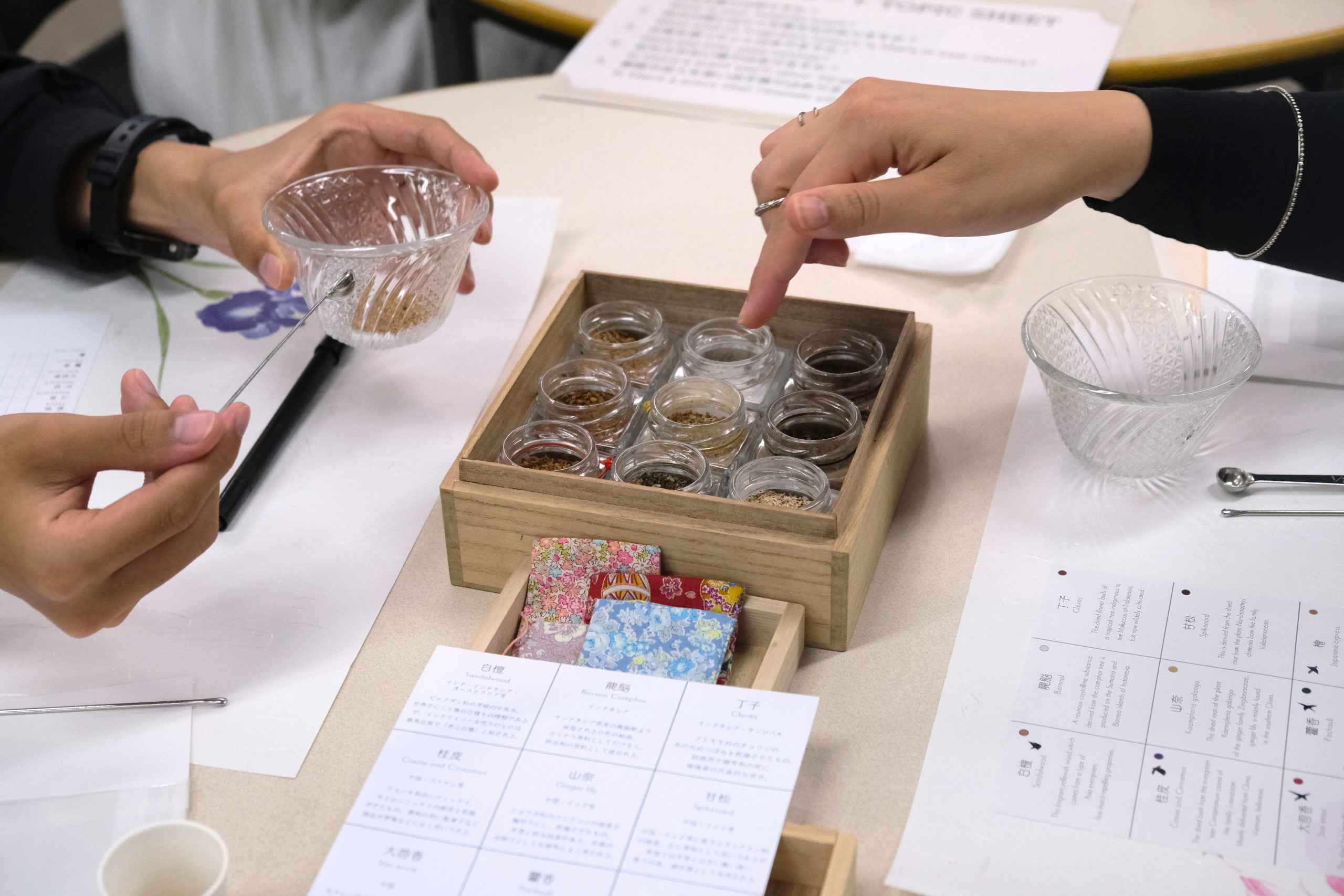
photo by ICC
The tables we were seated at all had a box with 9 different aromatic materials. These included Sandalwood, Borneol, Clove, Cassia, Kaempferia, Spikenard, Star Anise, Patchouli and Japanese Cypress. They all had different nuances from a sweet, to a deeper and woodier or kind of spicy aroma. We were to create our own fragrance bags by mixing 40 spoons of the materials. To keep track of how many spoons we used of the materials we chose, we got a paper with a special writing system.
The guide recommended us to use 10 spoons of sandalwood as a base and then mix from there on. Smelling the different aromas with the people I just met was a very fun experience. We were chatting about various things and exchanging our aromas.
It is amazing that even though we all used the same 9 ingredients, every fragrance bag had an individual smell.
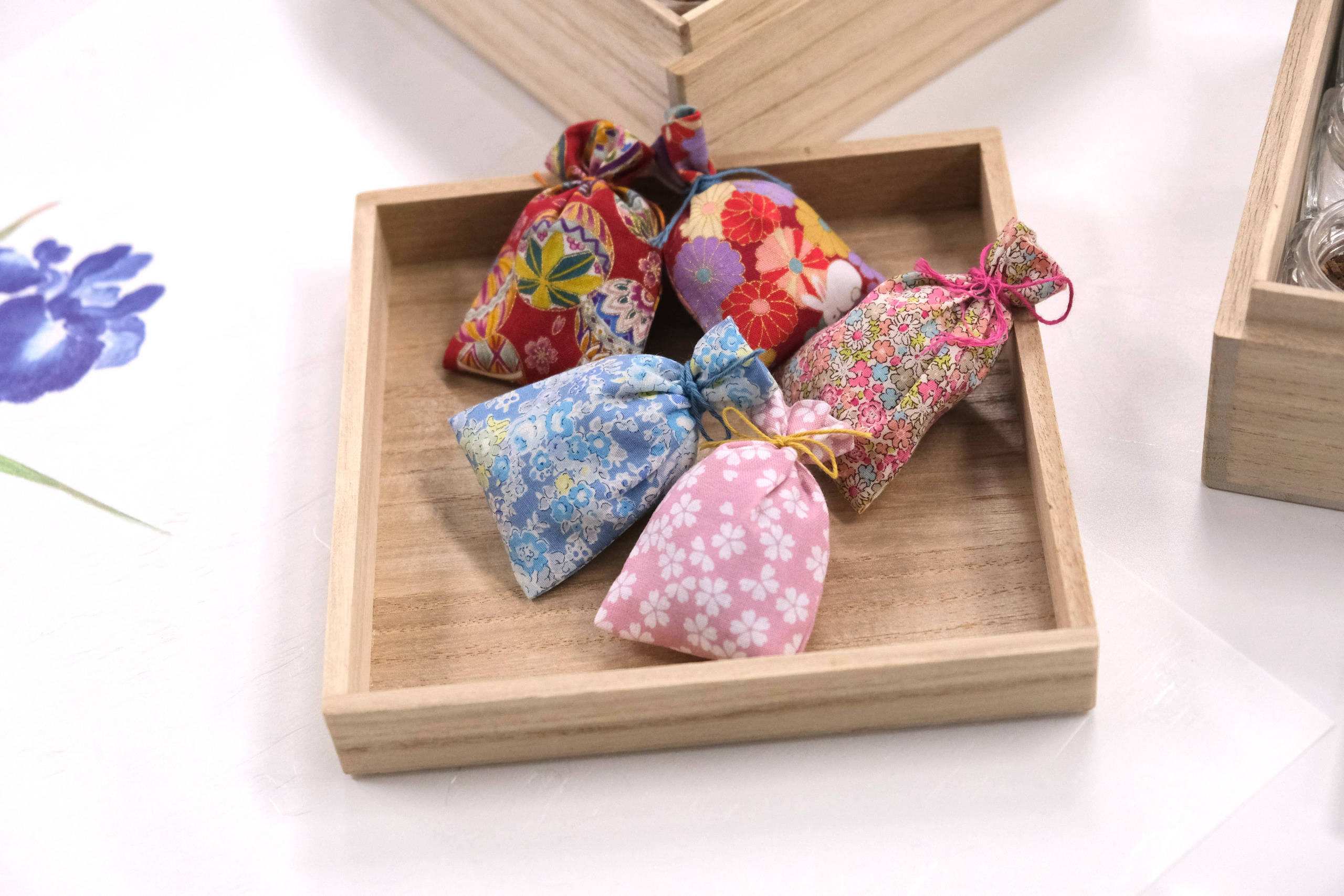
photo by ICC
In the end, to breathe life into our work, we had to give our fragrance a name. While mixing my ingredients I imagined myself standing in front of the Yasaka Pagoda of the Hōkanji-Temple in Kyoto. According to tradition, it was built by Prince Shōtoku and is said to have been inspired by a dream. Maybe it was because of the sweet temple-like aroma of my bag that created these images in my head or maybe in that moment the prince passed down his dream to me, so I named my work “Shōtoku Taishi”. And with that we all participated in a culture that has continued for over 1,500 years.
The experience was amazing and I learned so much about the way of incense thanks to the presentation. I even became friends with the people I met at this event and we had dinner afterwards. Thank you, ICC for this opportunity!