ユース陸上選手の最大スプリント走における下肢の神経筋活動:年齢群による違いとタレント発掘への示唆/ Neuromuscular Activation Strategies of the Lower Limb During Maximal Sprinting in Youth Track and Field Athletes: Age-Related Differences and Implications for Talent Identification
- Posted
- Tue, 13 Oct 2026
概要/Abstract
本研究では、男子ユース陸上選手18名の50 m全力走を分析し、U19群とU16群を比較しました。U19群は走速度、ピッチ、ストライドが高く、大腿直筋の遊脚初期の活動も大きいことが示されました。走タイムだけでなく、スプリント走中の神経筋活動を評価することが、選手育成やタレント発掘の参考となる可能性があります。
This study compared 50 m maximal sprinting in 18 male youth track and field athletes from U19 and U16 groups. The U19 group showed greater running speed, step frequency, and step length, as well as greater rectus femoris activation during early swing. Phase-specific muscle activity may complement sprint time when assessing youth athletes.
これまでの研究で分かっていたこと/Research Background
思春期のスプリント能力は、身体の成長と神経筋機能の発達に影響されます。しかし、ユース選手の年齢群によるスプリント中の筋活動の違いは十分に調べられていませんでした。
Sprint performance during adolescence is influenced by physical growth and neuromuscular development. However, age-related differences in muscle activity during sprinting have been insufficiently studied in youth athletes.
今回の研究で新たに実現しようとしたこと、明らかになったこと/Findings
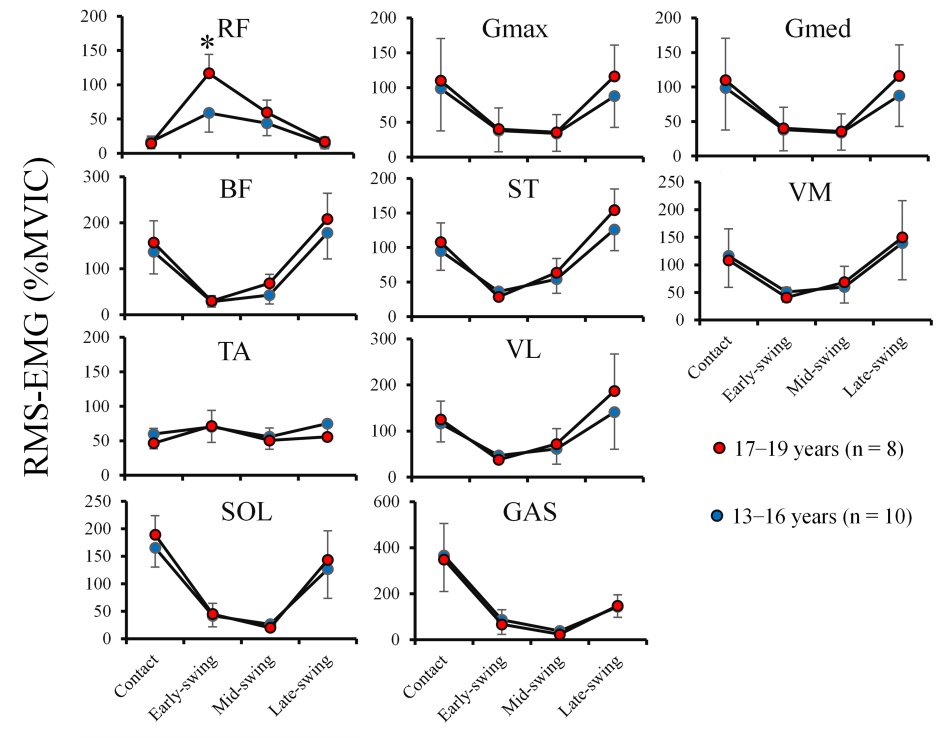
本研究では、ユース男子陸上競技選手18名をU19群(17~19歳、8名)とU16群(13~16歳、10名)に分け、50 m全力走中の下肢筋活動を比較しました。U19群はU16群に比べ、走速度(9.49 ± 0.39 vs. 8.67 ± 0.25 m/s)、ピッチ、ストライドが有意に高い結果でした。
下肢10筋の活動パターンは、走行局面全体では両群でおおむね共通していました。一方、大腿直筋では年齢群と走行局面の交互作用が認められ、U19群は遊脚初期の活動が有意に高くなりました。この局面での活動差は、スプリント中の脚の回収動作に関係する可能性があります。
これらの結果は、ユース選手のスプリント能力を理解するうえで、走タイムや身体的成長だけでなく、走行局面ごとの筋活動を評価する意義を示しています。ただし横断研究のため、この差が年齢やトレーニングによって生じたとは断定できません。また、表面筋電図は筋活動を測定するものであり、運動単位の動員や神経適応を直接確認したものではありません。
This study compared lower-limb muscle activity during a 50 m maximal sprint in 18 male youth track and field athletes: eight U19 athletes (17–19 years) and ten U16 athletes (13–16 years). Compared with the U16 group, the U19 group showed significantly greater running speed (9.49 ± 0.39 vs. 8.67 ± 0.25 m/s), step frequency, and step length.
Muscle activation patterns across the running cycle were broadly similar between groups. However, a group-by-phase interaction was observed for the rectus femoris, with significantly greater activation in the U19 group during early swing. This difference may be related to leg recovery during sprinting.
The findings suggest that phase-specific muscle activity may complement sprint time and physical growth when assessing youth sprint performance. However, the cross-sectional design cannot establish whether age or training caused the differences. Surface EMG measures muscle activity; it does not directly assess motor unit recruitment or confirm neural adaptation.
そのために新しく開発した手法/Methods developed
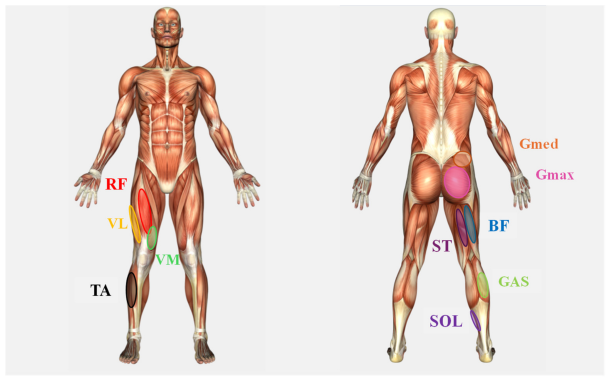
50 m全力走中に、ワイヤレス表面筋電図を用いて下肢10筋の活動を記録しました。走行局面を接地期、遊脚初期・中期・後期に分け、筋活動を最大随意等尺性収縮に対する割合(%MVIC)として比較しました。走速度、ピッチ、ストライドは高速度カメラと光電管で定量しました。
Wireless surface electromyography recorded activity from ten lower-limb muscles during a 50 m maximal sprint. Muscle activity was analyzed during contact and early, mid, and late swing, and normalized to maximal voluntary isometric contraction (%MVIC). Running speed, step frequency, and step length were evaluated using a high-speed camera and timing gates.
研究の波及効果や社会的影響/Research implications to the society
本研究は、ユース選手の評価や育成において、走タイムや身体的特徴に加え、走行局面ごとの筋活動も参考になる可能性を示しました。大腿直筋の遊脚初期の活動差は、選手のスプリント動作を理解するための重要な情報となり得ます。タレント発掘やトレーニングへの実用化には、さらなる検証が必要です。
This study suggests that phase-specific muscle activity may complement sprint times and physical characteristics in the assessment and development of youth athletes. The difference in rectus femoris activity during early swing may help characterize sprint mechanics. Further research is needed before applying these findings to talent identification or training practice.
今後の課題/Future issues
本研究は18名の男子選手を対象とした横断研究のため、結果を他の年齢層や女子選手に一般化するには限界があります。また、年齢群の違いには、身体成熟度やトレーニング歴なども影響している可能性があります。今後は、より多くの選手を対象にした縦断研究を行い、筋活動の変化と競技力の発達との関連を検証する必要があります。
This cross-sectional study included only 18 male athletes, limiting the generalizability of the findings to other age groups and female athletes. Differences between age groups may also be influenced by maturity and training history. Larger longitudinal studies are needed to examine how changes in muscle activity relate to the development of sprint performance.
研究者のコメント/Researcher’s Comment
欠畑
本研究では、ユース選手の最大スプリント中の筋活動を異なる年代の群間で比較し、走速度やピッチ、ストライドなどの差に加えて、大腿直筋の遊脚初期の活動にも違いがあることを示しました。成長期の選手を評価するとき、走タイムや身体的特徴だけでなく、走動作のどの局面で筋が活動しているかを見ることも、選手の理解を深める手がかりになると考えています。今後は、こうした評価がトレーニングやアスリートのタレント発掘や育成にどう役立つかを検証していきたいです。
Chee Yong, LOW (High Performance Sport Institute, Singapore)
This research provides us with a better understanding of sprinting from a neuromuscular perspective, particularly how young athletes recruit and coordinate their muscles as they develop. Importantly, these insights can help us translate the science for youth coaches, giving them a deeper understanding of what underpins sprint performance beyond what can be observed technically. The next step is to explore how these findings can be integrated into coaching methodology, so that the science can meaningfully inform how young athletes are taught and developed.
用語解説/Terminology
– 表面筋電図(surface electromyography):皮膚上の電極で筋活動に伴う電気信号を記録する方法。
Surface electromyography: A method for recording muscle-related electrical signals using electrodes placed on the skin.
– 遊脚期(swing phase):走行中、足が地面から離れて前方へ動く期間。
Swing phase: The period when the foot is off the ground and moves forward.
– 大腿直筋(rectus femoris):太ももの前面にある筋で、股関節屈曲と膝関節伸展に関与する。
Rectus femoris: A muscle at the front of the thigh that contributes to hip flexion and knee extension.
– 最大随意等尺性収縮(MVIC)
関節を動かさずに、筋肉を最大限の力で収縮させること。本研究では、スプリント中の筋活動をMVIC時の筋電図信号に対する割合(%MVIC)で示しました。
Maximum Voluntary Isometric Contraction (MVIC)
A maximal muscle contraction performed without joint movement. In this study, sprint muscle activity was expressed as a percentage of the EMG signal recorded during MVIC (%MVIC).
論文情報/Journal Information
雑誌名/Journal: Sports
掲載情報/Citation: 2026, 14(8), 353
著者/Authors: Gaku Kakehata (Waseda University), Tuncay Örs(High Performance Sport Institute, Singapore), Sofyan Sahrom(High Performance Sport Institute, Singapore), Chee Yong Low(High Performance Sport Institute, Singapore)
掲載日/Publication date: 17 August 2026
URL: MDPI article
DOI: 10.3390/sports14080353
研究助成/Research Grant
研究費名/Research Fund:科研費 国際共同研究加速基金(国際共同研究強化、国際共同研究強化(A))
Grant-in-Aid for Fund for the Promotion of Joint International Research (Fostering Joint International Research)
研究課題名/Research Subject:「神経制御の特徴に基づくスプリントトレーニングの開発」、Development of the sprint training program based on the neuro-muscular control
研究代表者名・所属機関名/Research Representative and Affiliated Organisation: 欠畑岳(早稲田大学スポーツ科学学術院)、KAKEHATA, Gaku (Waseda University)