
- NEWS
- 日本の農村地域における幼少期から中学生までの生活習慣に関する横断的研究/Lifestyle Behaviors from Early Childhood to Junior High School in Rural Japan: A Cross-sectional Study
日本の農村地域における幼少期から中学生までの生活習慣に関する横断的研究/Lifestyle Behaviors from Early Childhood to Junior High School in Rural Japan: A Cross-sectional Study
- Posted
- Fri, 28 Aug 2026
概要/Abstract
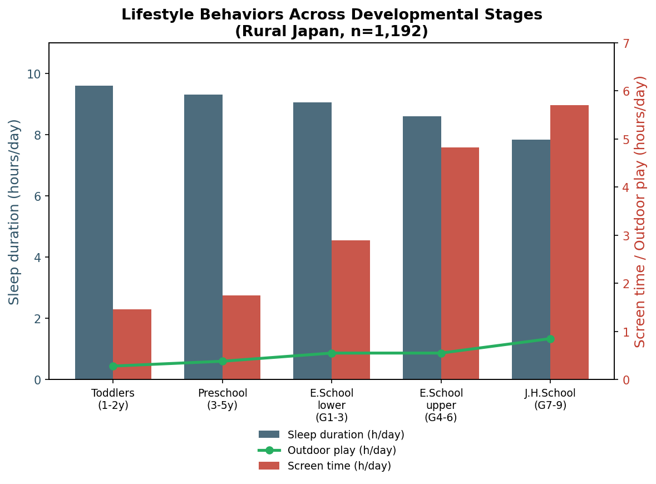
高知県佐川町の幼児~中学生1,192人を対象に、発達段階別の睡眠・屋外遊び・スクリーンタイムを調査。年齢とともに就寝時刻が遅くなり睡眠時間は短縮(9.60→7.83時間/日)、スクリーンタイムは約4倍に増加(1.46→5.70時間/日)する一方、屋外遊び時間はどの段階でも推奨水準を下回っていた。
This cross-sectional study examined sleep, outdoor play, and screen time among 1,192 children aged 1–15 years across five developmental stages in a single rural Japanese community (Sakawa Town, Kochi Prefecture). Bedtimes became progressively later and sleep duration shortened with age (9.60 to 7.83 h/day), while screen time increased nearly fourfold (1.46 to 5.70 h/day). Outdoor play time remained consistently below recommended levels throughout childhood, indicating that unhealthy lifestyle patterns emerge early and intensify with development.
これまでの研究で分かっていたこと/Research Background
子どもの生活習慣(身体活動、スクリーンタイム、睡眠)は心身の健康に重要な役割を果たすことが知られていたが、幼児期から中学生までの複数の発達段階を同一地域内で横断的に検討した研究は少なく、特に日本の農村地域に関する知見はほとんど存在しなかった。
Children’s lifestyle behaviors—physical activity, screen time, and sleep—are known to play a fundamental role in physical and mental health. However, evidence spanning multiple developmental stages within the same community has been limited, and studies focusing specifically on rural areas of Japan were especially scarce prior to this work.
今回の研究で新たに実現しようとしたこと、明らかになったこと/Findings
同一の農村地域(佐川町)において、幼児から中学生までの生活習慣を横断的に調査した結果、①睡眠時間はトドラー期の9.60時間から中学生の7.83時間へと減少し、その主因は起床時刻ではなく就寝時刻の遅れであったこと、②スクリーンタイムは1.46時間から5.70時間へと約4倍に増加し、特に小学校中学年以降で急増したこと、③屋外遊び時間はどの発達段階でも推奨水準を下回り、小学校高学年では女児が男児より有意に少なかったことが明らかになった。
By examining lifestyle behaviors across five developmental stages within a single rural community, the study found that: (1) sleep duration decreased from 9.60 h/day in toddlers to 7.83 h/day in junior high students, driven primarily by progressively later bedtimes rather than earlier waking; (2) screen time increased nearly fourfold (1.46 to 5.70 h/day, p<0.001), with the sharpest rise occurring between lower and upper elementary grades; and (3) outdoor play time remained below recommended levels at every stage, with a significant sex gap emerging in upper elementary school (girls less active outdoors than boys).
そのために新しく開発した手法/Methods developed
高知県佐川町の保育園・幼稚園4園、小学校4校、中学校2校に通う1から15歳の子ども1,192人(回収率74.6%)を対象に、保護者・本人記入式アンケート(2021年9から10月実施)を用いて就寝・起床時刻、睡眠時間、屋外遊び時間、スクリーンタイムを収集。発達段階(トドラー期、幼児期、小学校低学年、小学校高学年、中学生)と性別を要因とする二元配置分散分析、および発達段階の順序性を考慮した線形回帰モデルによる傾向分析を実施した。
Data were collected via parent- and self-reported questionnaires (September–October 2021) from 1,192 children aged 1–15 years attending four preschools, four elementary schools, and two junior high schools in Sakawa Town, Kochi Prefecture (response rate 74.6%). Bedtime, wake time, sleep duration, outdoor play time, and screen time were compared using two-way ANOVA with school stage and sex as factors, and linear regression models were fitted with ordered developmental stage as the predictor to test trends.
研究の波及効果や社会的影響/Research implications to the society
本研究は、不健康な生活習慣が幼児期からすでに始まり、発達とともに強まっていくことを示し、早期からのライフコース的な公衆衛生介入の必要性を示唆する。農村地域特有の交通手段の制約やレクリエーション施設へのアクセスの乏しさが、子どもの生活習慣形成に影響している可能性があり、学校・家庭・地域・行政が連携した支援策の重要性を提起する。
These findings highlight that unhealthy sleep, activity, and screen-use patterns emerge as early as toddlerhood and intensify with age, underscoring the value of a life-course approach to child health promotion. The results point to structural factors specific to rural settings—such as limited transportation and reduced access to recreational facilities—as potential contributors, supporting the case for coordinated efforts among schools, families, communities, and local government to promote healthier daily routines.
今後の課題/Future issues
本研究は横断的デザインであるため因果関係を特定することはできない。今後は、縦断的研究による発達的軌跡の検証、加速度計等の客観的指標を用いた身体活動評価、週末を含めた包括的かつ標準化された調査手法の適用が求められる。
As a cross-sectional study, this research cannot establish causal relationships between age and lifestyle behaviors. Future studies should employ longitudinal designs to confirm developmental trajectories, incorporate objective physical activity measures such as accelerometry, and assess behaviors using validated instruments across both weekdays and weekends.
研究者のコメント/Researcher’s Comment
農村部の子どもたちにおいて、不健康な生活習慣が予想以上に早い時期から始まっているという事実に、私は強い衝撃を受けました。特に、スクリーンタイムの急速な増加は、農村部と都市部を問わず共通の課題となっています。この研究が、子どもたちがどこに住んでいても健やかに成長できるよう、学校、家庭、地域社会を基盤とした支援体制の構築に寄与することを願っています。
It was striking to see how early unhealthy lifestyle patterns begin in rural children—earlier than I had expected. The rapid rise in screen time, in particular, is a challenge shared by rural and urban communities alike. I hope this research contributes to building school-, family-, and community-based support systems that help children grow up healthy,wherever they live.
用語解説/Terminology
※1 DID(人口集中地区)/ DID (Densely Inhabited District)
総務省統計局が定める、人口密度4,000人/km²以上かつ人口5,000人以上の地域区分。本研究の対象地域(佐川町)はこれに該当しない農村地域である。 / A classification by Japan’s Statistics Bureau for areas with a population density of at least 4,000 persons/km² and a population of 5,000 or more. The study area (Sakawa Town) does not meet this definition and is classified as rural.
※2 ライフコースアプローチ/ Life-course Approach
幼少期から成人期に至る生涯を通じた健康・行動パターンの形成過程に着目し、早期の介入によって将来の健康リスクを低減させようとする公衆衛生上の考え方。 / A public health perspective that focuses on how health and behavioral patterns form across the lifespan from early childhood to adulthood, emphasizing early intervention to reduce future health risks.
論文情報/Journal Information
雑誌名/Journal:BMC Public Health
論文名/Title:Lifestyle behaviors from early childhood to junior high school in rural Japan: a cross-sectional study
執筆者名・所属機関名/Authors and Affiliated Organisation:Haolu Shu¹, Linjing Jiang², Norikazu Hirose¹, Akira Maehashi³
1 Faculty of Sport Sciences, Waseda University
2 Institutes of Innovation for Future Society, Nagoya University
3 Faculty of Human Sciences, Waseda University
Publishment Date:Received: 14 February 2026 / Accepted: 22 May 2026 / Published online: 17 June 2026 (JST)
URL/DOI:https://doi.org/10.1186/s12889-026-27954-5