Yoshimasu Lab ~ Join us and rise to the challenge of RFIC & MMIC design together

- Posted
- Mon, 07 Jul 2014
Doctoral course Yang Xin
The research theme of our lab is the design RFIC and MMIC blocks, including LNA (low noise amplifier), VCO (voltage control oscillator), mixer, PA (power amplifier) and switch. Nowadays, RFIC has formed a fast growing market in civilian commercial areas, such as mobile phones, personal satellite communications, global positioning systems, direct broadcast satellite receivers, millimeter wave automatic collision avoidance system, and so on. RFIC design with higher performance, higher operational frequency, greater functionality and lower power consumption becomes one of the most popular research themes.
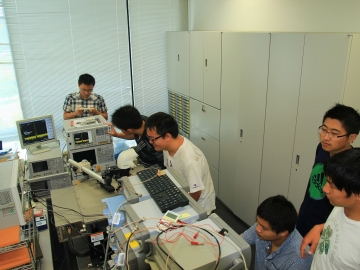
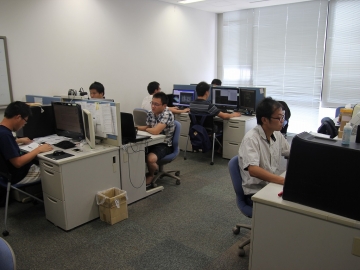
For circuit design, our lab has joined the VDEC (VLSI Design and Education Center) university program and set up a complete RFIC/MMIC developing software environment, including ADS and Cadence Environment, Goldengate for schematic simulation, Momentum and HFSS for EM simulation, Virtuoso for layout and Calibre for layout verification. For chip evaluation, our lab contains state of the art testing facilities for up to 67GHz integrated circuit measurement. Measurement equipment includes a Cascade probe station, vector network analyzers, noise analyzers, RF signal sources, power meters and low noise DC sources, which totally worth tens of millions JPY.
With sufficient design tools and measurement equipment, our lab can approach a complete RFIC/MMIC design project independently. Generally speaking, we have a chance to tape out our new IC designs and measure the chip performance each year. In recent years, we have designed RFICs with fabrication technologies of 65nm, 0.13um and 0.18um RFCMOS and 0.13um SiGe BiCMOS.
From PDK analysis to schematic design, layout, verification, tape-out and final measurement, RFIC design is challenging but exciting. When we think out good topologies, pass all the verification errors, and get the expected measurement results, we fill with a sense of happiness and accomplishment. What’s more, after we get good chip measurement performance, we can submit our papers to international conferences and journals with Pro. Yoshimasu’s help of revision. Until now, 66 papers have been published in international conference and journals.
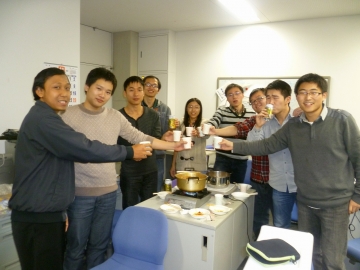
Currently, there are 2 PhD students and 7 master students in our lab. Besides doing research, lab members always have fun together. We always have supper together in “Sushiro”, “Toryuken” and “Costoco”, and sometimes we have BBQ and Sichuan hot pot party. Recently we saw the 2014 World Cup at midnight together and enjoyed a wonderful time.