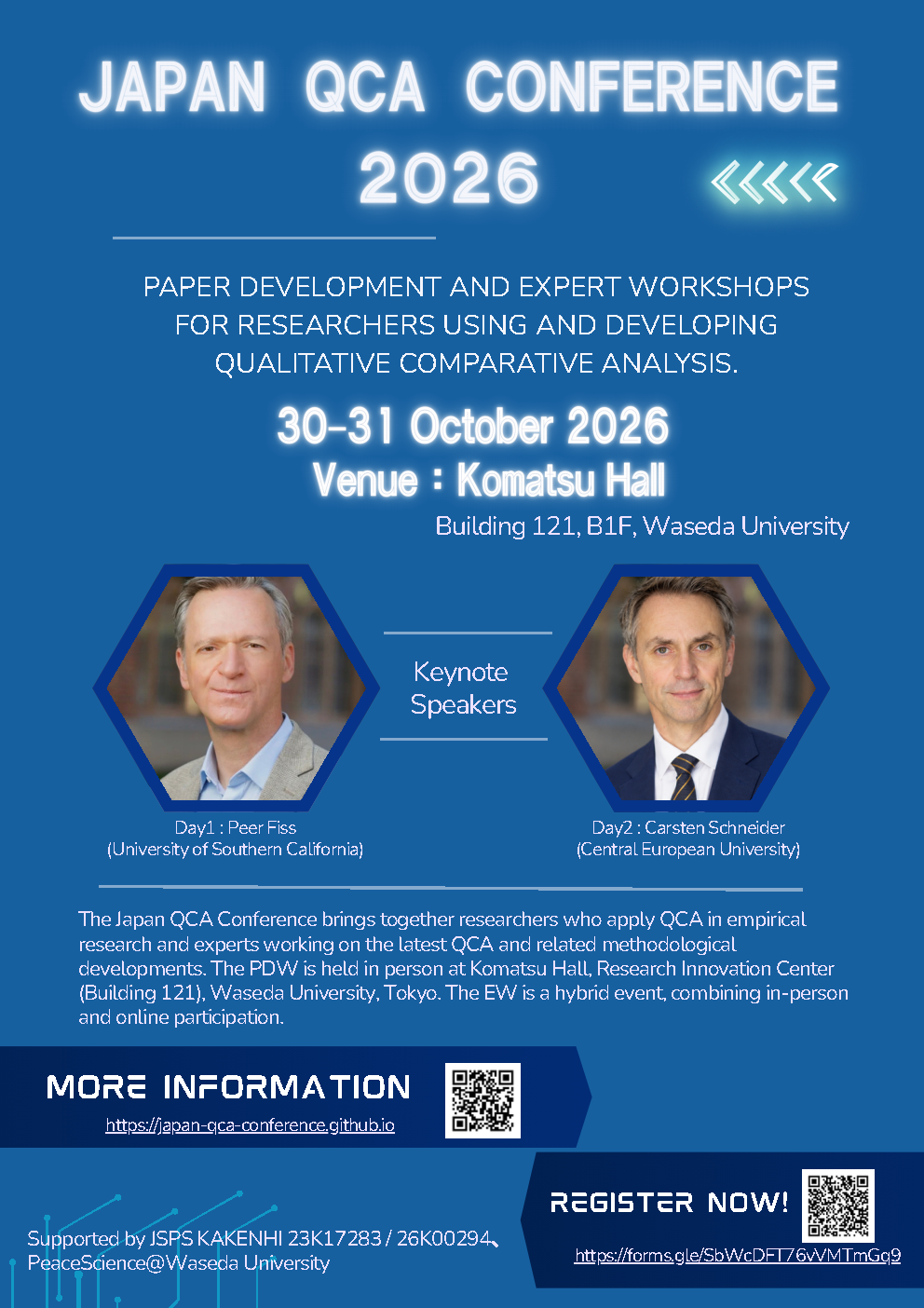
Japan QCA Conference 2026, Oct 30-31
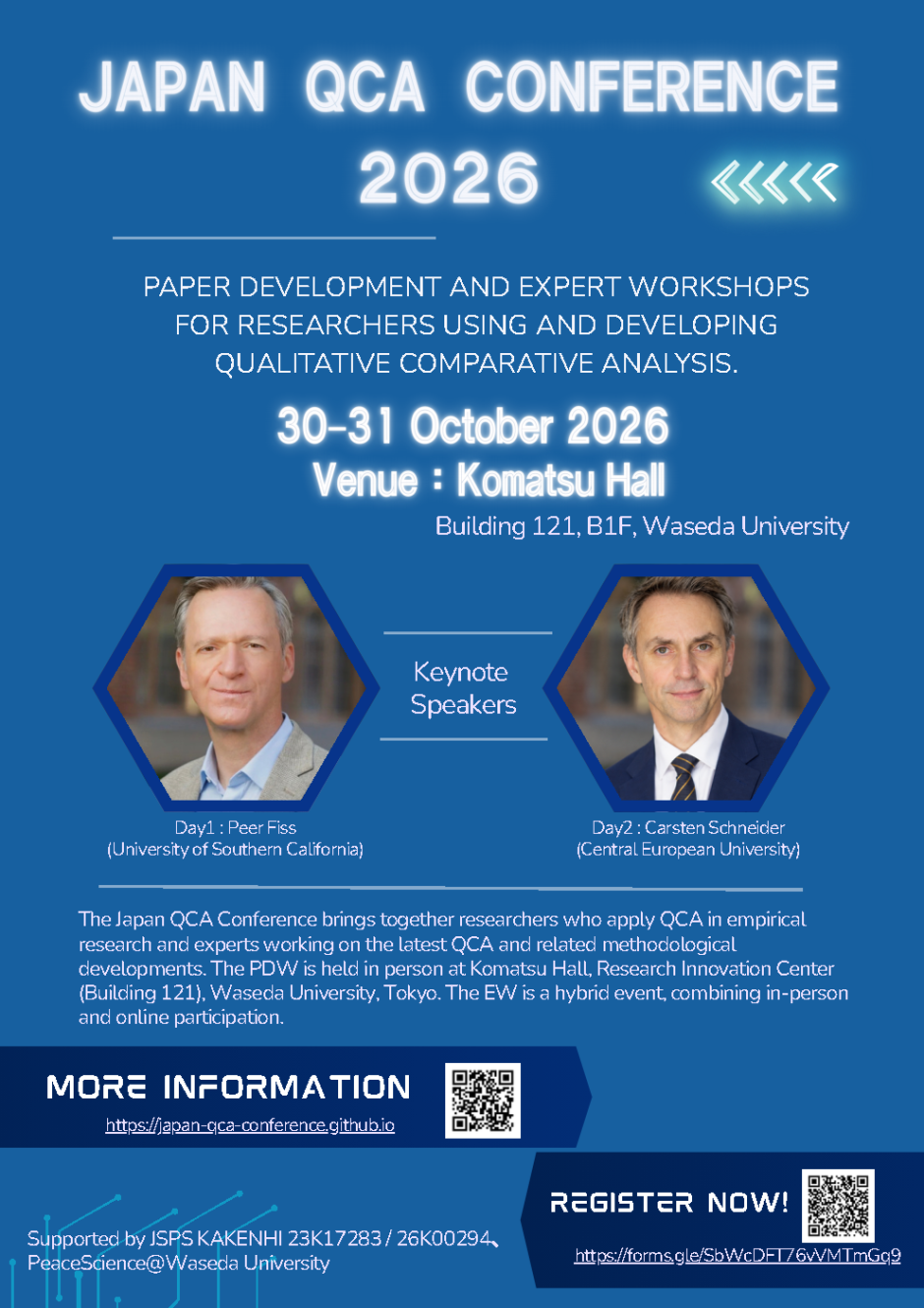
Dates
カレンダーに追加1030
FRI 20261031
SAT 2026- Place
- 早稲田大学121号館地下1階 コマツ100周年記念ホール Building 121, B1F, Waseda University
- Posted
- Thu, 08 Oct 2026
10月30日、31日に早稲田大学にてJapan QCA Conferenceを開催いたします。QCA Conferenceは2013年にヨーロッパ(European QCA Conference)で始まり、最近ではアメリカ(QCA Conference of the Americas)でも開催されるなど、QCAを用いた分析をブラッシュアップする場として、また手法を発展させる場としての役割を担ってきました。とりわけ、QCAの実践が政治学や社会学のみならず、最近では経営学や他の分野に広がる中で、他分野の研究者が交流する場が必要になっています。今回のJapan QCA Conferenceでは、政治学、社会学、経営学のQCAに関する研究者が運営チームを立ち上げ、日本で初の試みとして、実施するものです。
初日の基調講演には経営学の分野でQCAの実践を牽引し、アメリカのQCA Conferenceを組織されている Peer Fiss 教授(南カリフォルニア大学)にアプローチとしてのQCAについてお話いただきます。二日目の基調講演には政治学者として、またRパッケージSetMethodsを開発してきたCarsten Schneider 教授(中央ヨーロッパ大学学長)にテクニックとしてのQCAについてお話いただきます。
基調講演やPaper Development Workshopは対面で実施しますが、ラウンドテーブルやExpert Workshopはハイブリッド形式で実施します。事前登録が必要になりますので、以下のURLからご登録をお願いします。初日のプログラム終了後に懇親会を行います。こちらへのご参加についても、事前登録の際にお知らせいただければ幸いです。
The Japan QCA Conference will take place at Waseda University on 30 and 31 October. The International QCA Conference has been held annually in Europe since 2013 and is now known as the European QCA Conference (EQCA). It is also held in the United States as the QCA Conference of the Americas (AQCA). The conference provides a platform for refining QCA analyses and advancing the methodology. As QCA applications have expanded beyond political science and sociology to include business, management and other various fields in recent years, there has been a growing need for a forum where researchers from different disciplines can interact. For this Japan QCA Conference, a committee of QCA specialists from different fields has been formed to host the event, the first of its kind in Japan.
We are inviting two leading QCA scholars to the conference. On the first day, Professor Peer Fiss (University of Southern California) will deliver the keynote speech, focusing on QCA as an approach. On the second day, Professor Carsten Schneider (Rector of the Central European University) will give a keynote speech focusing on QCA as a technique.
The keynote speeches and the Pape Development Workshops will be held in person, while the roundtable discussions and Expert Workshops will be held in a hybrid format. Advance registration is required, so please register via the URL below. The dinner reception will be held after the programme concludes on the first day. During the advance registration process, please indicate whether you plan to attend this event.
日程:2026年10月30日(金)~ 31日(土)
Date: Friday & Saturday, October 30-31, 2026
場所:早稲田大学121号館地下1階 コマツ100周年記念ホール
Venue:Building 121, B1F, Waseda University
開催形式:対面
Format: In Person (with a hybrid option for select sessions)
言語: 英語
Language:English
事前登録・Pre-registration:https://forms.gle/gixsetR3L5d4e7MT8
Contact:日野愛郎(早稲田大学) Airo Hino (Waseda University) [email protected]
プログラム<Program>
October 30: Day 1 of the Japan QCA Conference
10:00–10:05 Welcome Address (Yuko Kasuya, IPSA President, Waseda University)
10:05–10:30 Why Japan QCA Conference?: Brief Introduction to QCA (Airo Hino, Waseda University)
10:30–12:00 Keynote Speech (Peer Fiss, University of Southern California)
12:00–13:00 Lunch (available on site)
13:00–14:30 Paper Development Workshop I
Session I (Discussant: Taisuke Fujita & Aya Kudo)
Satish Kumar, Who Gets External Finance and Why? A Fuzzy-Set Configurational Analysis of Equity Funding Access in Social Enterprises
Letitia Roman, When Rebels Lay Down Their Arms: Configurational Pathways to Collective Disarmament
Session II (Discussant: Narimasa Yokoyama & Sho Niikawa)
Yiting Wu, Yunqing Liu, Strategic Choice under Generative AI Disruption: A Contingency Configurational Analysis of Chinese AI-related Enterprises
Aastha Arora, T. N. Krishnan, Pathways to Career Success: A Configurational Comparison of Assigned and Self-Initiated Expatriates
Coffee Break
14:45–15:45 Roundtable (Hybrid Format): QCA as an Approach Moderator & Facilitator: Yuko Kasuya (IPSA President, Waseda University)
Panelist: Peer Fiss (University of Southern California), Carsten Schneider (Central European University), Srikrishna Ayyangar (National Law School of India University, online)
Coffee Break
16:00–18:00 Expert Workshop I (Hybrid Format) (Moderator: Taisuke Fujita, Saitama University)
Srikrishna Ayyangar (online), A Tale from Two Cultures: Making the Case for Computational Social Science Research in India by Revisiting Governance Analysis in an Indian State
Gershom Mukisa, Under which combinations of institutional, economic, environmental, social, and renewable-energy conditions do Uganda’s energy transition cases achieve balanced and low-risk transition outcomes?
Ran Chu, QCA using a proportional threshold: The proposal of inclusion difference
Sho Niikawa, From Necessity to Sufficiency: An Empirical Bayesian Diagnostic for Qualitative Comparative Analysis (QCA)
18:00 Reception
____________
October 31: Day 2 of the Japan QCA Conference
10:25–10:30 Day 2 Opening Remarks (Sho Niikawa, Kobe University)
10:30–12:00 Keynote Speech (Carsten Schneider, Central European University)
12:00–13:00 Lunch (available on site)
13:00–14:30 Paper Development Workshop II
Session III (Discussant: Nobukazu Azuma & Carsten Schneider)
Azuma Wakana, Interministerial Coordination and Aid Motivations: A QCA of German VET Aid to Africa under the Merkel Governments
Hyungseok Kim, Building Social Assets from Failure in the AI Transition: An Exploratory Fuzzy-Set Analysis of OECD Countries
Session IV (Discussant: Atsushi Ishida & Peer Fiss)
Christopher Schelletter, An fsQCA Analysis of the Socio-Historical Conditions for the Emergence of Texts with the Characteristics of the Novel of Formation in European and East Asian National Literatures
Vlad Surdea-Hernea, The Many Roads to Decarbonization: Environmental States and Energy Transitions in the European Union
Acácio Dom Luís, Causal Configurations of Customer Satisfaction in Mobile Telecommunications in Mozambique: An Integrated MLR and fsQCA Approach
Session V (Discussant: Airo Hino & Taketo Terada)
Masaki Unohara, Public Innovation and Democratic Control of Collaborative Governance: An Analysis of Political Intervention by Legislatures and Politicians
Keigo Minemoto, How the German Greens Enter Government: Constructing a Model of “Coalition Formation through Electoral Performance” in the Federal States and Validating Empirically with csQCA
Aya Kudo, Kentaro Nagai, Characteristics of Social Media Election Campaigns in Japan: Content Analysis and QCA of Twitter Posts from the 2021 and 2022 Elections
Coffee Break
14:45–15:45 Roundtable (Hybrid Format): QCA as a Technique Moderator & Facilitator: Airo Hino (Waseda University)
Panelist: Carsten Schneider (Central European University), Peer Fiss (University of Southern California), Sho Niikawa (Kobe University)
Coffee Break
16:00-17:30 Expert Workshop II (Hybrid Format) (Moderator: Atsushi Ishida, Kwansei Gakuin University)
Airo Hino, Time-differencing Qualitative Comparative Analysis (QCA): A Set-theoretical Development
Sho Niikawa, Evaluating Process Tracing: Set-theoretic Expectation and Reasoning
Lungta Seki, Good Practices in Political Science
17:30–18:00 Conference Summary and Closing Remarks (Yokoyama Narimasa, Doshisha University & Nobukazu Azuma, Aoyama Gakuin University)