“The World Is Closer Than I Thought”
Tue, Nov 24, 2026-
Tags
“The World Is Closer Than I Thought”
– How at Short-term Study Program in Leipzig Shaped the Paths of Three Waseda Students –
Three Waseda students took part in a short-term study program in Leipzig, Germany, but what did they gain from the experience? Thanks to their time abroad, one student has begun considering a longer-term study abroad program. Another will soon enroll at a university in Germany as an exchange student. And the third, who has since graduated, is looking for new avenues for learning even after entering the workforce. Each student stands at a different point today, but the time they shared in Leipzig had a significant impact on their studies and career paths that followed. We spoke with these three students about the meaning of learning a language, the value of going abroad, and the possibilities that such an experience can open up for the future.
In addition to promoting study abroad programs that send Waseda students to study at international partner universities as exchange students, Waseda University also offers the Faculty-Led Education Abroad Program Grant to support student participation in overseas programs planned and conducted by Waseda faculty members. The grant supports a wide range of educational activities, including language programs, seminar participation, and fieldwork, providing students with opportunities to put the knowledge and language skills they have cultivated in the classroom to the test in real-world settings while encountering different perspectives and ways of thinking.
The exchange program with Leipzig University, led by Professor Miki Ikoma, is one such example, and through their experiences on site, many students have discovered new learning opportunities and future possibilities. In this article, we hear from participating students to trace the learning and growth the grant has made possible.
*Check out the following article to read the perspective of Professor Miki Ikoma of the School of Political Science and Economics, who accompanied the students on the Leipzig Program
⇒ Outside the Classroom, Learning Comes Alive – Professor Miki Ikoma and the Leipzig Program: Fostering International Learning –
Turning the Idea Going Abroad into a Reality
The three students who took part in the Leipzig Program shared an interest German, whether that means had been studying it since high school or had only begun studying it seriously after entering university. Even so, the decision to go to Germany to study was by no means a given. One of the students, Nihongi, reflects:
“I had never traveled overseas, and I didn’t even have a passport.”
The students were left in charge of procuring their own passports, booking flights, and making travel plans within Germany. For the program itself, they were to meet and disband on location in Leipzig. What led Nihongi to take part was a simple desire to give Germany a shot.
“I thought that with support from the Faculty-Led Education Abroad Program, maybe I could take on the challenge, too.”
Another student, Ueda, had also been interested in studying abroad but unsure of what to do.
“I joined the Leipzig Program because I thought it would help me decide whether or not to commit to a long-term study abroad experience in the future.”
For students with no overseas experience, taking that first step abroad is by no means easy – yet it can lead to so many new sights and realizations that cannot be achieved otherwise. The foundation of exchange with Leipzig that Professor Ikoma and other faculty members have built over the years, together with the support provided by the Faculty-Led Education Abroad Program Grant, made this opportunity into a reality. And for the students, the Leipzig Program became the gateway that turned a vague desire to go abroad into a feasible option.
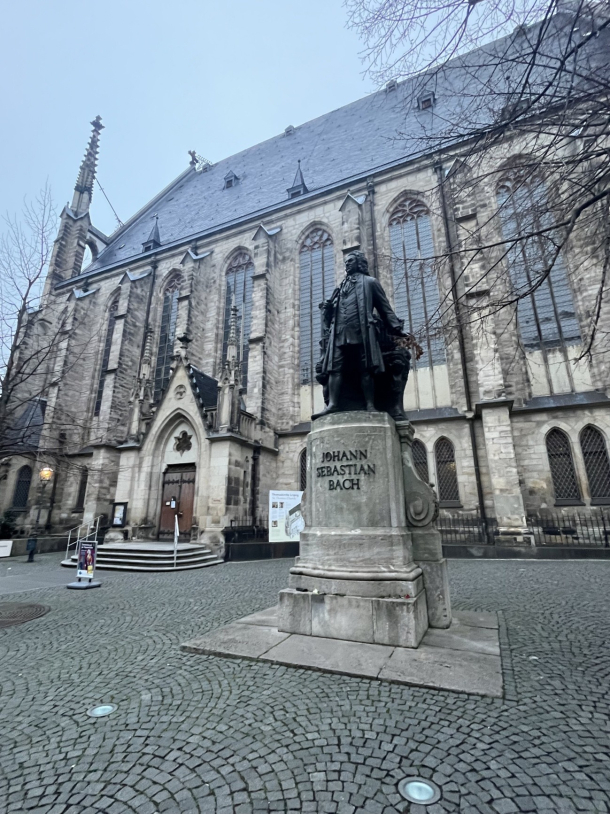
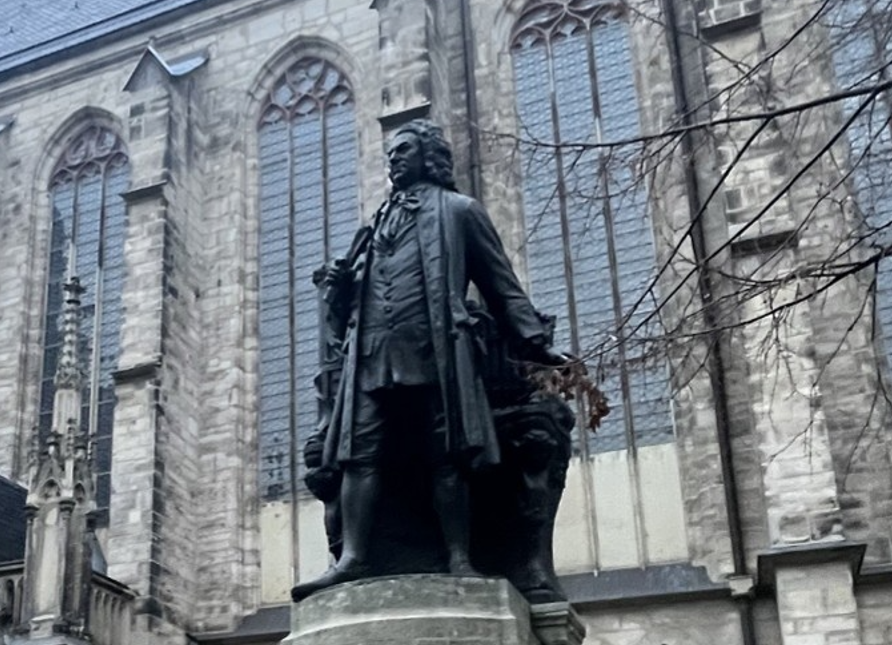
St. Thomas Church in Leipzig and a statue of the composer Bach
Using German Outside of the Classroom
What awaited the students upon arriving in Leipzig was the opportunity to see German not merely as a subject of one’s studies but as the language of daily life. Ordering at restaurants. Navigating the train system. Holding conversations with local students. From morning to night, their days were enveloped in the German language.
Of course, the students had by no means neglected their studies up to that point. Even if they hadn’t all started learning the language in high school, all were enrolled in intensive classes at Waseda and were well used to giving presentations and conversing in German. Even so, once they arrived in Germany, they realized how much there was still to learn.
“The German students spoke much faster than I had expected, and I was made keenly aware that I still have a long way to go,” remarks Ueda.
At the same time, that frustration became a motivating factor for increased study. The students gave presentations in German and exchanged opinions with the local students at Leipzig University. They also took part in joint presentations and discussions on the theme of Japanese culture. Amino, who has since graduated, says:
“If you study abroad at a language school, you tend to interact mostly with other international students. But in Leipzig, being able to interact with local students made a big difference. The experience I had gained from giving presentations in class back in Japan also proved very useful.”
Language knowledge they had first acquired in Waseda’s classrooms came alive through real conversations in Germany. At the same time, they also saw what they were still lacking. By taking part in the Leipzig program, the students gained not only improved language skills, but also the satisfaction of working through difficulties and finding means of self-expression in a foreign environment, as well as a tangible sense of being connected to the world.
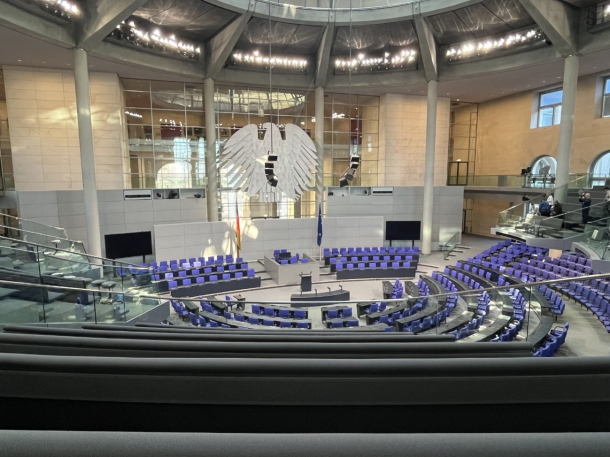
The Reichstag Building, seat of the German Bundestag, visited while touring Berlin
Beyond the Headlines: Experiencing German Politics Up Close
The students’ stay in Leipzig also happened to take place during Germany’s 2025 federal election. For them, as students at the School of Political Science and Economics, this was an especially exciting experience.
Political party booths lined the streets, and election campaigns were in full swing. The experience left a strong impression on Nihongi:
“The politics we had learned about in class and seen in the news was actually happening right there on the streets.”
Through their interactions with local students and even political party members, the students encountered aspects of German society that cannot be seen simply from following election results from abroad: anxiety about economic stagnation, social divisions, debates over immigration policy, and the hopes and fears young people hold about the future.
Amino reflects: “[Through this experience] I was able to see both the good and the bad aspects of German society.”
This was not the Germany of textbooks. It was a living society that became visible precisely because they had studied German and were able to converse directly with local students. The students made another discovery as well:
“I felt like the local students might have known even more about Japan than we did.”
Meeting with local students in Leipzig who were learning Japanese and had a strong interest in Japanese culture also prompted the students from Waseda to reflect on and learn about Japan themselves. Getting to know the world abroad meant getting to know Japan, too, and learning more about society was a way of broadening their own horizons.
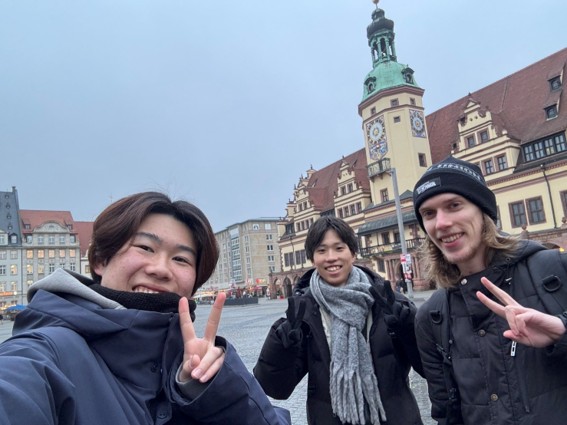
Strolling around the university area in front of Market Square
Learning That Began After Returning Home
The experience in Leipzig continued to have effects even after the students returned to Japan. In fact, this is when the real changes began. About a year and a half has passed since the Leipzig Program. After returning home, Ueda took more German courses and began actively participating in German-related activities and exchange events both on and off campus. Soon, he will embark on a long-term study abroad program back in Germany. Thus, the student who once wavered over whether to study abroad will soon take that step.
“The program was a major catalyst for my decision to study abroad,” he says.
And Nihongi, for his part, has also begun moving toward his next goal of an exchange program.
“Just going there once makes a real difference,” he claims. “The new German expressions I picked up in Leipzig still come to me naturally even now.”
Since returning home, his motivation to study has grown, and he continues to work toward making study abroad a reality in the future.
Both of them agree that they have pursued their studies not merely as preparation for studying abroad, but because the Leipzig Program ignited their passion and drive for learning. The people they met on location. The thoughts they wanted to convey but couldn’t fully express. The desire to understand others better. The accumulation of these feelings and experiences has fed their motivation to take the next step and keep improving. Studying abroad alone is not the goal. They want to know more about the world they glimpsed in Leipzig, and that desire is leading them along their current paths.
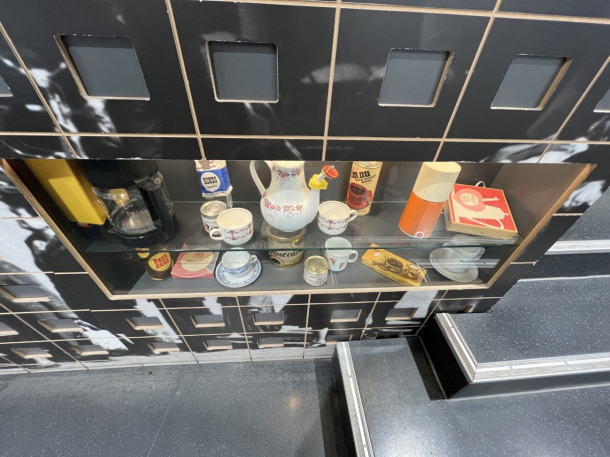
Visiting a museum dedicated to the former East Germany during a trip to Berlin
That Time in Leipzig Lives On
For Amino, who graduated in spring 2025, the program in Germany is already becoming a memory of her student days. Yet its influence continues even now that she has entered the workforce. Since graduating, she has been working while taking time to reexamine her own path and way of life. In the process, she has rediscovered her interest in learning about other cultures.
“I realized once again that I really do like languages and going abroad.”
As a student, she had found enjoyment in language learning itself. Now that she is out in the working world, she has also begun to see the tangible benefits.
Through work involving people and companies from other countries, Amino has come to appreciate anew the power of words.
“Just being able to understand even a little of the local language brings you closer to people.”
This is not simply a matter of language ability. In the working world, she feels all the more strongly the importance of interfacing with people with various backgrounds and values and working to understand one another. During the program, through interactions with local students and encounters with German society, she came to realize that what is normal in Japan is not normal everywhere in the world. That experience changed not only how she sees the world, but also how she views her own potential.
“Seeing a different society with my own eyes was truly fascinating,” she reflects.
She is now exploring new learning challenges, including the possibility of pursuing a graduate degree overseas. Since entering the workforce, she has continued asking herself what she wants to learn and how she wants to engage with the world. And having faced those questions, she found herself ready to step out into the world once again.
Through the Leipzig Program, Nihongi has begun working toward the goal of studying abroad. Ueda is soon about to embark on a long-term exchange program. And Amino, even after graduating, continues to pursue new possibilities for learning.
The changes brought about by those few days in Leipzig have taken different forms for each of these three students, but at their origin lies a shared experience of seeing the world outside Japan with their own eyes.
For one student, that experience led to a decision to study abroad; for another, to a new goal for the future. And for a graduate, it provided an opportunity to reconsider one’s life direction.
The ability to see the world with one’s own eyes, think independently, and choose the next step.
What is gained from even a short-term program of a few days abroad can lead to sustained increased motivation for learning and taking on challenges. The Faculty-Led Education Abroad Program Grant is one initiative that makes such experiences possible.
The step they took in Leipzig that day continues to lead each of them toward their own future.
Faculty-Led Education Abroad Program Grant
Waseda University’s Faculty-Led Education Abroad Program Grant supports student participation in overseas programs planned and conducted by faculty members. Not limited to language programs, the grant is used for a wide range of educational activities, such as seminar participation and fieldwork, providing students with opportunities to put the knowledge and language skills they have cultivated in the classroom to the test in real-world settings while encountering different perspectives and ways of thinking. In the exchange program with Leipzig University in Germany, led by Professor Miki Ikoma of the Faculty of Political Science and Economics, sustained teaching efforts by faculty have gone hand in hand with students’ own willingness to take on challenges, opening the door to new learning experiences and future paths.
Student Profiles
Ms. Amino
Graduated from the School of Political Science and Economics in March 2025. She has remained interested in going abroad since the Leipzig Program and is now exploring new learning opportunities, including the possibility of graduate study overseas.
Mr. Nihongi
Third-year student in the School of Political Science and Economics (matriculated in 2024). He has continued studying German since the Leipzig Program and is aiming to take on an exchange program.
Mr. Ueda
Third-year student in the School of Political Science and Economics (matriculated in 2024). He decided to go on an exchange after participating in the Leipzig Program and is set to enroll at the University of Freiburg in Germany as an exchange student for the Fall 2026 semester.