Waseda Podcasts: Rigorous Research, Real Impact– “East Asia in a Dollar-Dominated World”
Wed, Sep 9, 2026-
Tags
Waseda University released the first episode, “East Asia in a Dollar-Dominated World”, of Season 3 of its English language podcast series “Rigorous Research, Real Impact” on September 9, 2026. All podcast episodes are available for free on Spotify, Apple Podcasts, Amazon Music, and YouTube.
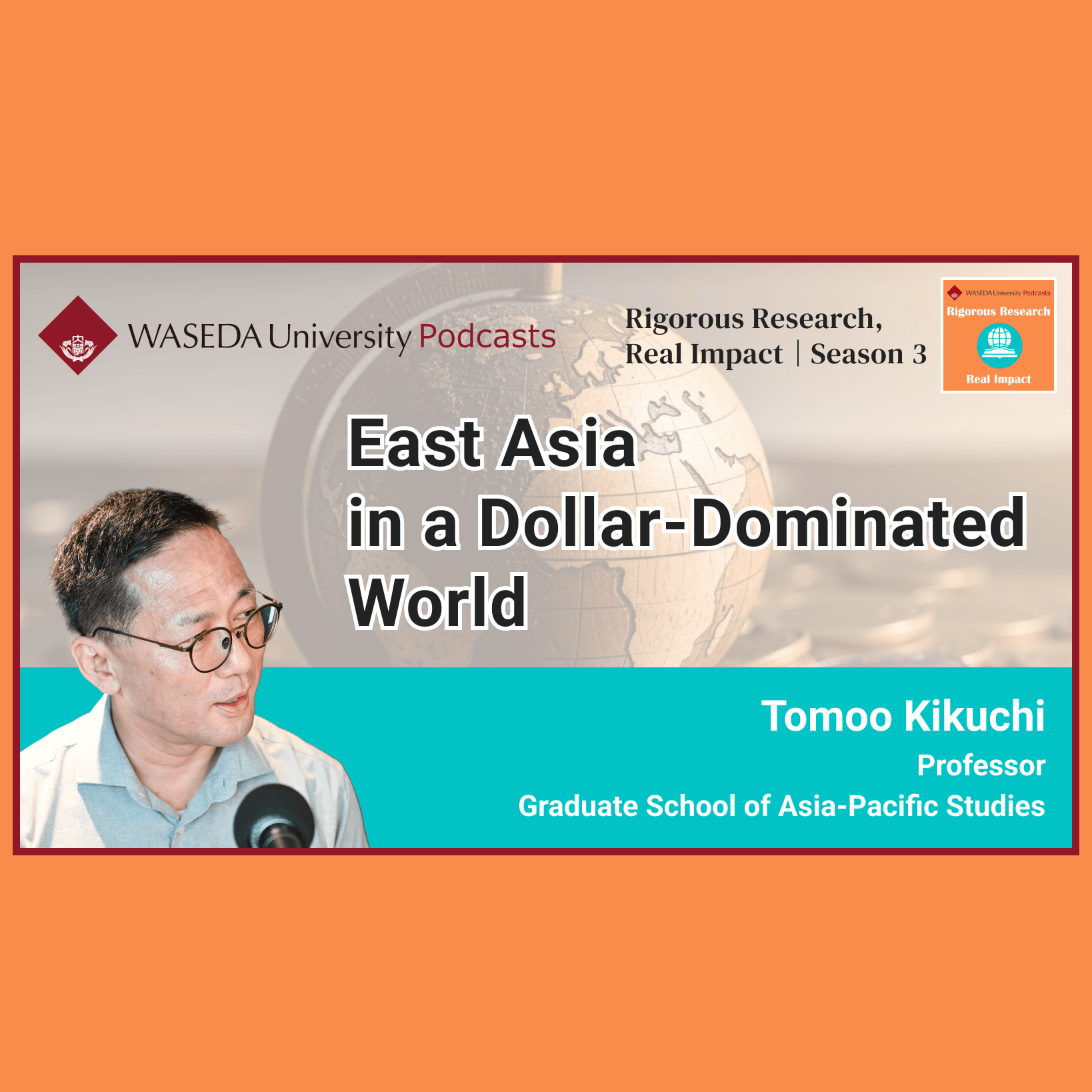
Episode 1: “East Asia in a Dollar-Dominated World”
In this first episode, host and Waseda student Kanon Kurabayashi speaks with Professor Tomoo Kikuchi of the Graduate School of Asia-Pacific Studies about the US dollar’s continued dominance of the global financial system and what it means for East Asian economies. They explore why the Renminbi has yet to challenge the dollar’s international role, how growing US-China trade tensions and economic competition are reshaping the global economic order, and how Japan can respond. Professor Kikuchi also discusses the advantages of studying global economic issues from Japan and at Waseda University, drawing on the University’s longstanding connections across Asia and its diverse international academic community.
About Season 3
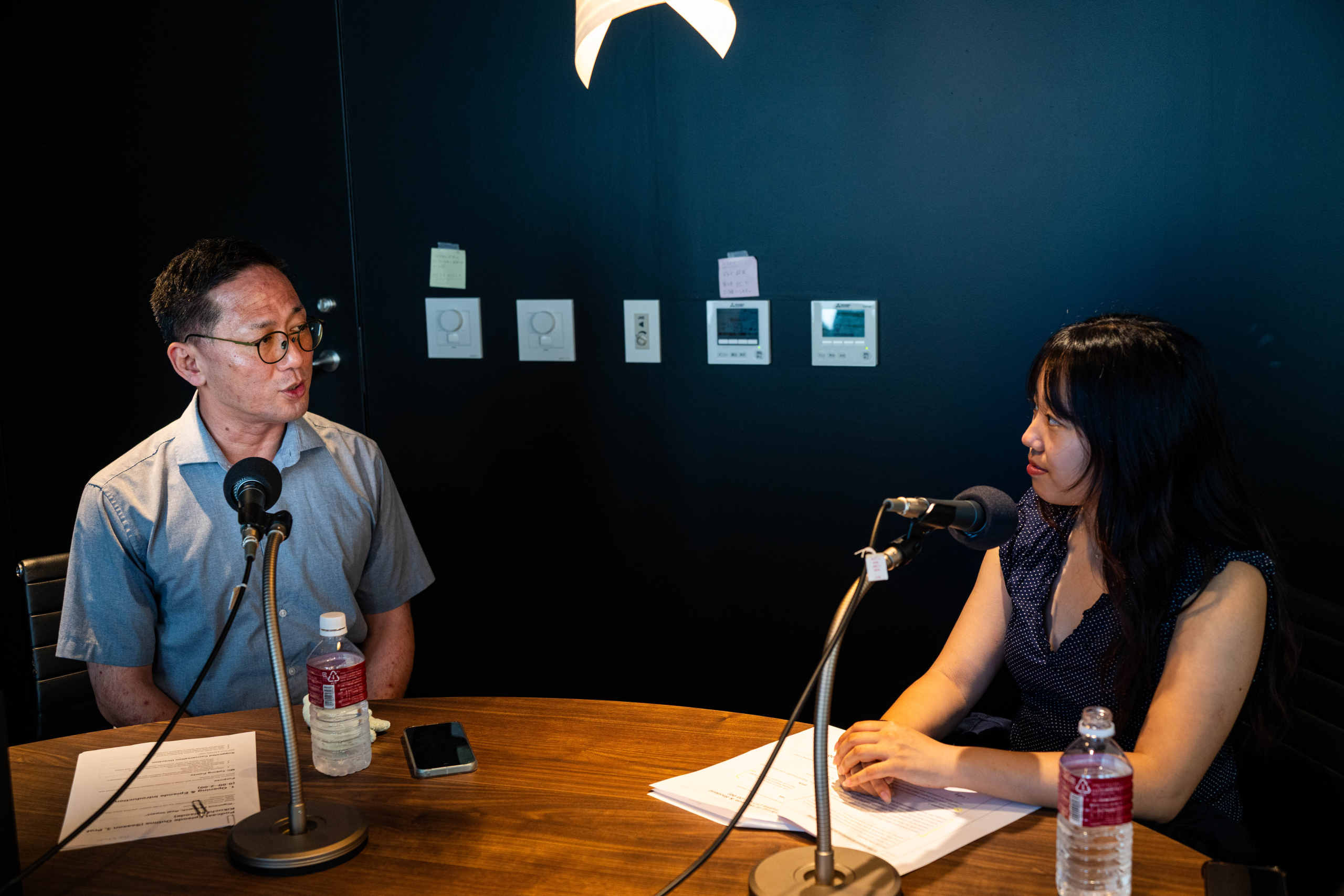
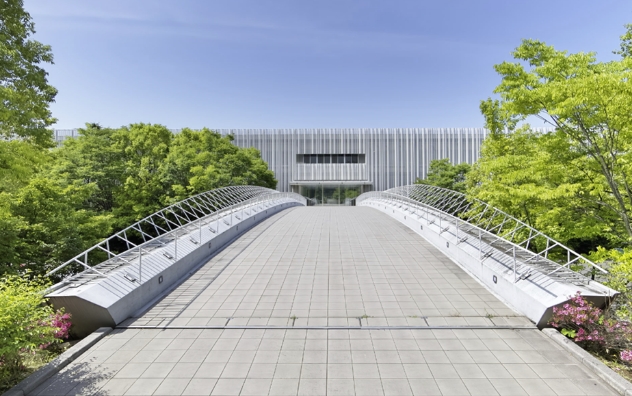
Professor Kikuchi and MC Kanon recording at the Waseda International House of Literature (Haruki Murakami Library)
This season, eight Waseda researchers will join three charismatic Waseda students, who will take on the role of MCs and guide the conversations. In relaxed, approximately 15-minute episodes, the researchers will introduce their areas of expertise, discuss how their research intersects with current social debates and trending news, and talk about their experiences teaching in Waseda’s English-based degree programs. Topics explored throughout the season include Japan’s economy, labor and migration in Japan, business in Japan, Japanese culture, and AI. By bringing academic expertise into accessible conversations about contemporary issues, the podcast offers international audiences a fresh perspective on Japan and the research taking place at Waseda. It is especially aimed at prospective international students, those considering further study or research in Japan, and anyone interested in discovering new perspectives on the issues shaping Japanese society and beyond.
About the Guest
Professor Tomoo Kikuchi is a professor at Waseda University’s Graduate School of Asia-Pacific Studies and Director of the Institute of Japan in the Global Economy. His research focuses on international macroeconomics, economic growth and development, and the impact of global capital markets on economic development. His work examines international capital flows, financial bubbles, production networks, and trade and investment in East Asia and the Japanese economy.
Transcript
Introduction: Global Economy and the Role of the US Dollar
MC Kanon Kurabayashi (00:08): Hello and welcome to Waseda University’s English podcast series titled Rigorous Research, Real Impact. In this series, we dive into interesting conversations and stories from Waseda’s vibrant academic and cultural community. I’m your host, Kanon Kurabayashi, a fourth-year undergraduate student in the School of International Liberal Studies here at Waseda.
When you think about the global economy, the US dollar probably comes to mind. It’s the currency we see in movies and international news, and it’s the benchmark for global trade. But have you ever stopped to wonder why the dollar holds such a dominant position, and what that means for major economic players in Asia like Japan and China?
Today, we’re exploring a field that is crucial for understanding our interconnected world: international macroeconomics. We’ll be discussing the complexities of the global financial system, why the US dollar remains king, and what challenges and opportunities this presents for East Asian economies.
To guide us, we are honored to have Professor Tomoo Kikuchi from the Graduate School of Asia-Pacific Studies. His work offers a deep dive into the dynamics of the global economy, particularly focusing on international capital flows, financial markets, and how East Asian economies navigate the dollar-dominated international monetary system.
East Asia’s Dollar Dilemma and Network Centrality
MC Kanon (01:31): Welcome to the show, Professor Kikuchi!
Professor Tomoo Kikuchi (01:33): Thank you for having me. It’s a pleasure to be here.
MC Kanon (01:36): In our opening, we touched on the enduring dominance of the US dollar. Your article, East Asia’s Dollar Dilemma, dives right into this. Could you break down for us what this “dollar dilemma” really means for East Asian economies, and what challenges it presents for a country like Japan?
Professor Kikuchi (01:54): Ok, East Asia consists of, obviously, many countries, including China, Japan, Korea, and Southeast Asian countries. But, if you look at China, Japan, or Korea—the representative economies in East Asia—they have all grown by having export-oriented economies. The main consumer of these exports from East Asian economies was the United States.
Not only that, most countries in East Asia—and Japan is not an exception—run a current account surplus. That means that they are exporting capital instead of importing it. Guess where this capital flows to?
MC Kanon (02:41): The US?
Professor Kikuchi (02:42): Exactly, that’s the US. Japan holds the highest foreign reserves in US dollars next to China, and Japan is the largest holder of US Treasury bills. That means a a lot of savings are denominated in US dollars.
But, the conflict that you currently see represented as this US-China trade conflict kind of indicates limitations to this model of keep growing the economy by exporting goods and also capital to the United States. The United States government debt, for example, now reaches 100% of GDP, and there are questions asked about the sustainability of US government debt. And as you probably know, also, President Trump doesn’t really like the fact that the US keeps running trade deficits vis-à-vis countries in East Asia.
However, unlike the European Union, which has the common currency euro, we have no alternative to the US dollar in the region. I think a lot of my research addresses this question of what we can do in East Asia when we don’t have an alternative to the US dollar yet we are so dependent on it.
MC Kanon (04:02): Thank you. In your analysis, you use a network model to explain how a currency’s dominance is linked to a country’s centrality in the trade network itself. I was wondering how, despite China’s rapid growth in trade volume, what are the main reasons why the renminbi has not been able to challenge the US dollar’s supremacy?
Professor Kikuchi (04:23): First of all, I probably need to clarify the term “centrality” because that’s probably not familiar to most of you. Centrality in a network simply means if you occupy a position and you’re connected to a lot of others…international trade volume to how many trading partners you have. But not only the number of trading partners—how much you trade with them. And the third point that’s most insteresting is also how many trading partners and how much trade your trading partners conduct with other playsers. So, if you trading partner has more trading partners and trades a lot with others, then your centrality is also going to increase. So simply, it’s a technical index that captures how important you are in a given network.
In my research, we highlighted how important the position of a country is in the international trade network when choosing which currency to use for trade settlement. And as you already said, in the last 20 years, China has become very dominant in international trade. Today China actually surpasses the United States in terms of trade volume for both exports and imports. And you might think then it’s natural that the RMB, the Chinese currency, is going to be used more globally. That is happening to some extent, but nowhere near to how much the US dollar or the euro is used in, not just international trade, but also in international finance. And the question is, “why?”
So one thing, from the trade perspective, is that even though China’s trade volume is very high, among China’s top trading partners, there are countries like Vietnam, or Malaysia, or Australia, who are themselves not very central in the trade network. That means that even though they trade with China and they might settle part of their trade in RMB, it does not spread to other trading partners because they’re not so important in the network. So, that’s one reason.
The key point is that knowing China and China’s trading partners do not occupy as important a position as the US and US trading partners in the trading system, China has actually less incentive to promote its currency globally. Because China knows that whatever it does, it’s not going to replace the US dollar as the dominant global currency. So, it’s kind of a self-fulfilling thing.
MC Kanon (07:23): So they know the game they’re playing. Got you.
Professor Kikuchi (07:27): That is an insight that our research provides. A lot of people say China is internationalizing the RMB, but our message is that China is doing that only to a limited extent, because it actually knows and probably even doesn’t want to replace the US dollar.
And one of the key points, why China wants to keep its current position is because it is not ready and not willing to open its capital account. And that means China is not willing to have completely free flow of capital in and out of the country.
Dual Great Power Shocks and Japan’s Strategic Policy Space
MC Kanon (08:14): Now I was wondering if we could shift to some broader societal debates and recent news trends: in your recent article for Counterpoint Indo-Pacific, you mentioned that dual “great power shocks” from the US and China are steadily eroding the liberal economic order. How are these shifting global dynamics actually creating a new policy space for middle powers like Japan?
Professor Kikuchi (08:44): For decades, the world economy has been trying to negotiate lower tariffs for the import and export of goods, but also services, and the main negotiation took place at the World Trade Organization (WTO). But, the negotiations somehow stalled because not all countries could agree on the terms.
Now, we live in a world where you have the two biggest economies having a trade conflict. You’re probably aware that President Trump in the United States has imposed tariffs, not just on China, but in fact, on all the economies in the world, which is kind of against the global liberal economic order which kind of “thinks” that it’s desireable to have the free flow of trade and services, but also capital.
And it’s not just the United States. China has its own ways to exercise economic coercion against other countries. Japan has experienced that. For example, China has banned the export of rare earths to Japan, which is a very critical mineral that is used in batteries and many other manufacturing products. And you can see, that it is also a weaponization of economic tools, and that again goes against this idea of a liberal economic order.
Whether it’s in the economic or security realm, the power of the United States is in relative decline—relative to other powers in the world. Then the question is: what should Japan do? What should other middle powers do that have been relying on the United States so much in terms of security, but also economy.
I think what you see in the current Takaichi administration is, first of all, a strong will to strengthen the Japanese economy in the global supply chain.
MC Kanon (11:05): Do you think that’s working?
Professor Kikuchi (11:06): We still have to wait and see, because none of these policies has been really implemented yet. The Takaichi administration has identified 17 sectors to which it decided to give heavy subsidies, among them AI and semiconductors, and so on. We have to wait to see whether these are really going to work.
This is against the backdrop of the current trend…you might have heard of “friend-shoring”? What’s happening in international trade is a kind of reorgnization of global supply chains. And have you heard of the company TSMC? This is the largest semiconductor manufacturer in the world—Taiwan Semiconductor Manufacturing Company, which built a factory in Kumamoto in Kyushu, and it’s planning to build the second one. That has attracted also other companies related to the semiconductor industry. You probably don’t know, but Kumamoto was once known as “Silicon Island.” What we see today is kind of a revival with the policy support from the Takaichi administration. And that’s one thing that’s happening.
Japan is trying to attract more foreign direct investment into Japan to strengthen Japan’s position in the global supply chain. At the same time, Japan wants to also have more alternatives to its reliance on the Japan-US alliance. So Japan is seeking security partners globally. So in this region that would be Australia, India, South Korea, but also going beyond that are European countries, right.
I don’t know whether you know. Japan has currently a partnership and project together with Italy and the United Kingtom to manufacture and produce the next-generation of fighter jets. And that’s kind of a quite remarkable collaboration because you see that Japan is not just waiting and seeing what’s going to happen with its relationship to the United States, but it’s trying to diversify the risks and seeking more multilateral cooperation. And that’s also another characteristic of the Takaichi administration.
That’s the state of our region today. We have conflicts. We have…and amid these conflicts, the Japanese government is trying to seek for multilateral colalborations.
Academic Life and Research Environment at Waseda University
MC Kanon (13:50): Thank you so much for that insightful conversation. I’d actually like to move on to the significance of researching in Japan. Given that you have researched and taught in various countries, what is unique about being based in Japan, and specifically at Waseda University, when studying global topics like international macroeconomics?
Professor Kikuchi (14:09): Interesting question. Before coming to Waseda, I taught for 12 years in Singapore. After that, a bit less than two years I was teaching in Seoul, and then came to Waseda. 25 years of being away from Japan because I also did my graduate studies in the UK and Germany.
I think that Waseda’s strength is its international orientation and I think strong relationship to Asian countries, particularly China and Korea. In China, Waseda is known as sometimes even the best university in Japan. You’d be surprised—I don’t know whether you know, even a hundred years ago, Waseda University hosted I think all together like two thousand students from the late Qing dynasty, among them also people who later became founders of the Chinese Communist Party.
So it has a very strong connection to China, but also Korea. You might know that the founder of Samsung has studied at Waseda University, and some of his children also studied at Waseda University. So, a strong connection, right? Samsung today is representative of one of the biggest companies in Asia. There is no Japanese company that matches Samsung’s market capitalization in Japan.
MC Kanon (15:38): Not even Panasonic?
Professor Kikuchi (15:39): No. And yeah, that’s kind of a unique environment, so if you think about this Japan and Waseda University have always served as a bridge between the Western and Eastern worlds. Japan was the first country to industrialize in Asia, unfortunately, also invaded other countries in East Asia. It has a lot of legacies and strong relationships with Asian countries but also Western nations.
So I think that perspective is quite unique to be and as I was trying to elude to, I think for the future, we really have to think seriously about this region. We are going to have to establish a relationship with the United States, with China, with other players. How autonomous we can be in term of economic securities, but also military securities, so on. And to think about all these questions, I think Japan and particulary Waseda is an ideal place because of its tradition but also large body of international students. If not ratio, I think Waseda University is the University with the biggest number of international students in Japan, I think if not one of the biggest.
MC Kanon (17:10): I think Waseda has different international opportunities in each department. I think SILS, School of International Liberal Studies, obviously has a lot of international students from different backgrounds. And I think that GSAPS has more of an Asian background with the students, and then the TAISI program and social studies department also has international students, so I think each department has that opportunity. Do you see different demographics in each department?
Professor Kikuchi (17:38): Okay, I cannot really talk about other schools, but at GSAPS, Graduate School of Asia-Pacific Studies, we have students coming form more than 50 countries. So our student body is very diverse. Of course, the biggest student group is from, I guess, I think you can guess which country.
MC Kanon (17:58): Um, China?
Professor Kikuchi (18:01): Yeah, it’s China. Next comes countries like Korea, Vietnam, Nepal, United States. Many countries in Asia, but we also do have a lot of exchange students. And we do have a double degree program with Free University of Brussels (ULB). We have students coming from Belgium, from Brussels, over to Wasada. What actually we want to do more is to send our own students to universities outside Japan. I think SILS does that by requiring Japanese students to spend a semester or two outside Japan.
It is very difficult because our student body, 80 to 90 percent, actually international students. So we only have 10 percent of Japanese students. And they are already international students in Japan, right? So they come to Japan from their home and they don’t really have an incentive to then go to other countries. Not many of them, but we want to encourage that too.
MC Kanon (19:05): Great. So Professor Kikuchi, thank you so much for this insightful conversation. Before we finish, do you have a final message for students around the world who might be thinking about studying at Wasada or even researchers who might be considering taking up a position in Japan?
Professor Kikuchi (19:20): I think Japan is an interesting, attractive country. It has long history, long tradition and culture combined with also modern aspects. I think a lot of students come to Japan because they grew up with Japanese anime or manga. These are the soft powers of Japan. What I think makes, to be honest, Japan very attractive today. It is very reasonable in terms of cost of living, but also studying compared to other leading universities. Outside Japan, if you think about how expensive it can be to study in New York or in London or even Sydney, Melbourne, Japan is very reasonable. That means a lot of students who might have been thinking to study overseas, but the countries that I mentioned are too expensive. I think Japan is an attractive option. Also, Japan is very safe, even Tokyo. Greater Tokyo has a population of 35 million people, still remarkably efficient and clean and safe. Wasada is located in the heart of Tokyo, right? So you have access to all the modern urban culture and living.
I welcome any, not just students, but researchers if they would like to study. We’re talking about social sciences, so particularly students who are interested in the region and the future of the region, not just how Japan should partner with other countries, but other countries in Asia, how we can promote regional integration and so on. These are all exciting topics to study in Japan at Wasada. And one more thing if I may highlight at Wasada University is I think Wasada University has very liberal traditions. That is also a very attractive point of Wasada University.
MC Kanon (21:29): Thank you. I think that absolutely wraps up why I chose Wasada at the end of my juken era. So thank you so much for your time and sharing your expertise with us.
Professor Kikuchi (21:39): Thank you for having me. It was a pleasure.
MC Kanon (21:51): And thanks to all our listeners for tuning in. For more conversations from the corridors of Wasada University, don’t forget to subscribe and tune in to the next episode on Rigorous Research, Real Impact. Until then, take care and stay curious.