scLS: A Computationally Efficient Differentially Expressed Gene Detection Algorithm
Tue, Sep 1, 2026-
Tags
scLS: A Computationally Efficient Differentially Expressed Gene Detection Algorithm
The proposed algorithm enables pseudotime-based dynamics without the need for explicit regression models or branch assignment
Trajectory inference of single-cell RNA sequencing datasets enables tracking of cell dynamics over an inferred pseudotime. However, downstream analysis algorithms for the identification of differentially expressed genes and the handling of complex cell trajectories are lacking. Researchers have now developed scLS, which represents gene expression patterns in the frequency domain. It enables both dynamic and shifted expression tests and does not require explicit regression models or branch assignment, serving as an efficient first-pass screening tool.
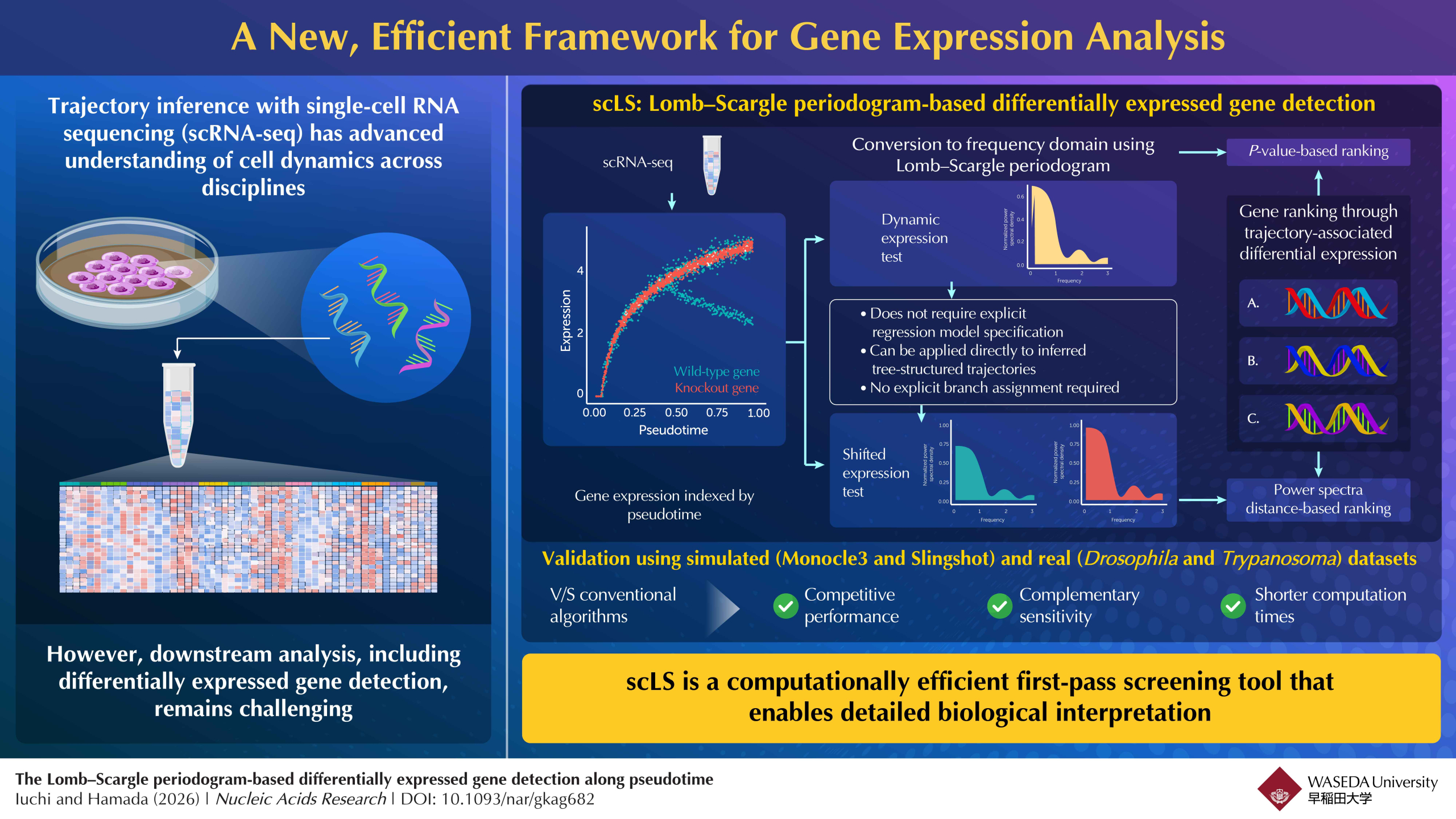
Image title: Proposed scLS algorithm
Image caption: The scLS algorithm enables the detection of pseudotime-dependent dynamics in branching trajectories while being more computationally efficient and not requiring explicit regression models or branch assignment.
Image credit: Assistant Professor Hitoshi Iuchi from Waseda University
License type: Original content
Usage restrictions: Cannot be reused without permission
Single-cell RNA sequencing (scRNA-seq) is a method to measure gene expression of individual cells, allowing observation of various cellular processes, including cell differentiation, the cell cycle, and stimulus-response for each unique cell instead of averaging across millions of cells. It provides high-resolution snapshots of biological processes. However, it does not track the same cell continuously over time. To address this limitation, trajectory inference approaches have been developed that computationally arrange cellular snapshots along an inferred developmental trajectory known as pseudotime.
Recent advances in trajectory inference algorithms have enabled researchers to generate datasets containing hundreds of thousands or even millions of cells. However, downstream analyses of these trajectories, particularly the identification of differentially expressed genes (DEGs), remain challenging. DEGs can have two patterns: genes whose expression changes dynamically over pseudotime and genes whose patterns are shifted between two conditions. Although dynamic expression analysis is more widely used, identifying shifted expression patterns is also important. Additionally, cells can be distributed irregularly along pseudotime, and the inferred trajectory may contain multiple branches, where conventional models require explicit regression models or branch assignments. It is essential to develop novel downstream analysis techniques that capture DEG patterns and handle complex cell trajectories.
In a new study, a research team led by Assistant Professor Hitoshi Iuchi and Professor Michiaki Hamada from the Faculty of Science and Engineering at Waseda University in Japan has developed a new downstream analysis algorithm called scLS. “scLS is a computational method for identifying pseudotime-associated genes from single-cell RNA sequencing data,” explains Iuchi. “It reduces the need for arbitrary branch correspondence decisions and can be used to prioritize genes for more detailed biological interpretation.” Their study was made available online on July 16, 2026, and published in Volume 54, Issue 13 of Nucleic Acids Research on July 22, 2026.
Conventional trajectory analysis methods typically fit explicit regression models that describe gene expression as a smooth function of pseudotime, which may not adequately capture complex expression patterns. scLS, on the other hand, uses the Lomb–Scargle (LS) periodogram, a signal-processing technique designed for unevenly sampled data, to represent gene expression patterns in the frequency domain. This enables the algorithm to analyze irregularly distributed pseudotime data and detect complex expression patterns in branching trajectories without requiring explicit regression models or predefined branch correspondence.
scLS supports both the dynamic gene expression test and the shifted gene expression test. For both tests, the pseudotime domain data for each gene are first converted to the frequency domain through the LS periodogram. For the dynamic gene expression test, the LS periodogram is used to evaluate false-alarm probabilities (FAPs) over a predefined frequency grid, which are then used to calculate the gene-level P-value, defined as the minimum FAP across the scanned frequencies. For the shifted expression test, LS periodograms are computed separately for two conditions for each gene, such as for wild-type (WT) and knockout variants (KO), and the distance between their power spectra is used as the observed test statistic to calculate a right-tailed P-value under a normal approximation.
Through simulations and real datasets, scLS demonstrated competitive performance compared to conventional algorithms in detecting pseudotime-dependent dynamics in branching trajectories while being more computationally efficient. Although the method cannot localize expression dynamics to specific branches or lineages, it can serve as an efficient first-pass screening tool and be complemented by lineage-aware analyses for more detailed biological interpretation.
“scLS can be applied to single-cell studies of differentiation, development, immune activation, cellular reprogramming, disease progression, and drug response, as well as for comparing wild-type and genetically perturbed cells, untreated and drug-treated samples, or healthy and disease-associated cells,” notes Hamada.
Overall, scLS provides a computationally efficient approach for downstream trajectory analysis, offering researchers a flexible method for identifying pseudotime-associated genes and advancing our understanding of complex biological processes.
Authors: Hitoshi Iuchi1 and Michiaki Hamada1,2,3
Affiliations:
1Faculty of Science and Engineering, Waseda University, Japan
2Cellular and Molecular Biotechnology Research Institute, National Institute of Advanced Industrial Science and Technology, Japan
3Graduate School of Medicine, Nippon Medical School, Japan
Title of original paper: The Lomb–Scargle periodogram-based differentially expressed gene detection along pseudotime
Journal: Nucleic Acids Research
DOI: 10.1093/nar/gkag682
About Assistant Professor Hitoshi Iuchi
Hitoshi Iuchi is an Assistant Professor in the Faculty of Science and Engineering at Waseda University. A key member of the Hamada Lab, his primary research focuses on bioinformatics, system genome science, and sequence analysis. Before joining Waseda, he conducted research at the National Institute of Advanced Industrial Science and Technology (AIST). His work centers on developing computational algorithms and machine learning frameworks to analyze biological sequence data, single-cell RNA sequencing, and temporal gene expression. His published studies cover diverse applications, including virus–host interactions, deep learning representation models, and biomarker detection in cancer genomics.