Scientists Discover Asymmetric Diffusion of Magnetic Skyrmions in Simulations
Tue, Aug 25, 2026-
Tags
Scientists Discover Asymmetric Diffusion of Magnetic Skyrmions in Simulations
Researchers show asymmetric diffusion of skyrmions in a structured environment, unveiling a new path towards unconventional information processing
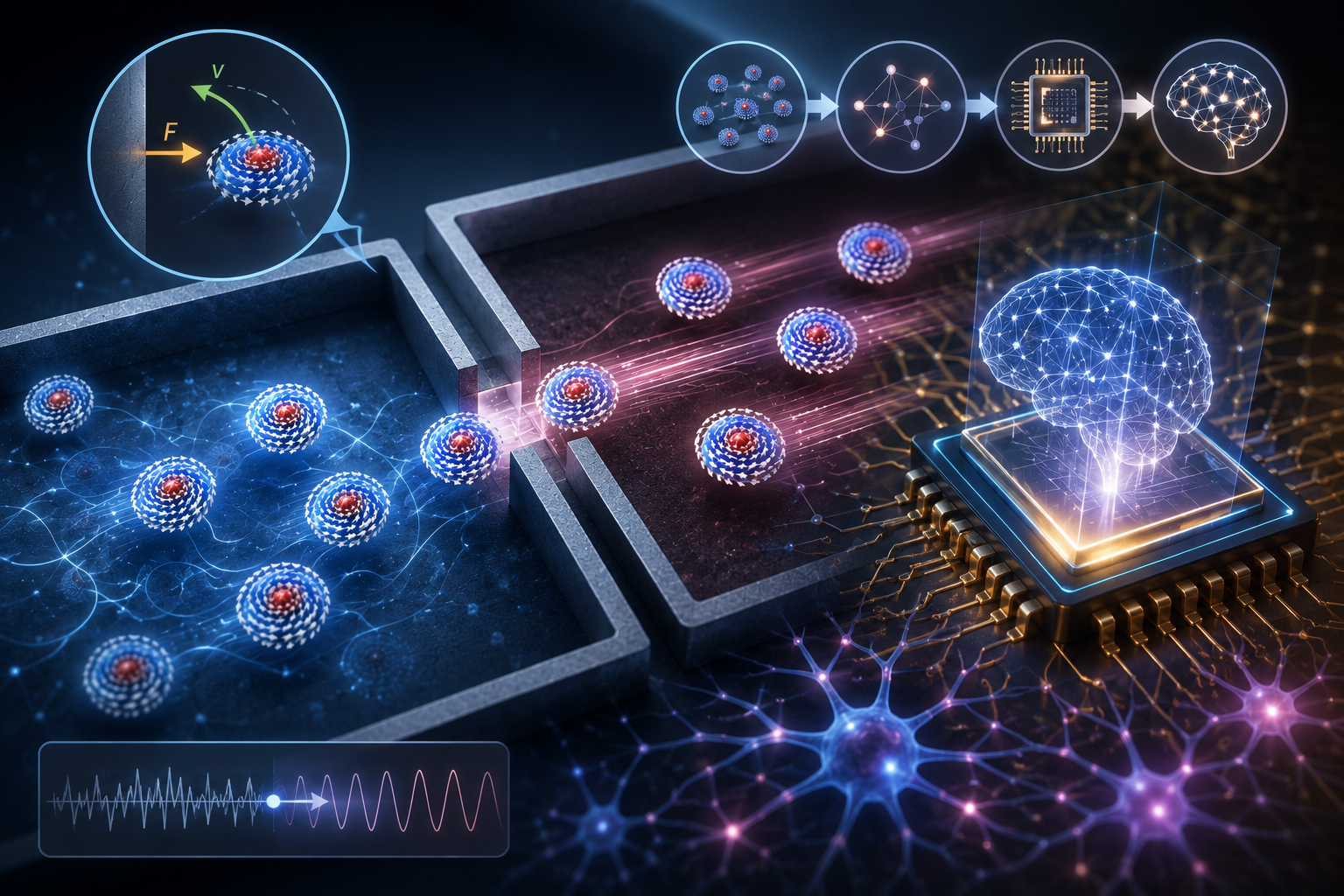
Magnetic skyrmions are nanoscale spin textures that can behave like particles and move and diffuse in real space. This makes them promising information carriers for future memory and computing technologies. A new computational study in npj Spintronics shows how geometry and topology can guide asymmetric thermal diffusion of magnetic skyrmions, offering insights for unlocking unconventional computing paradigms, including future stochastic and neuromorphic computing devices for more efficient artificial intelligence (AI) applications.
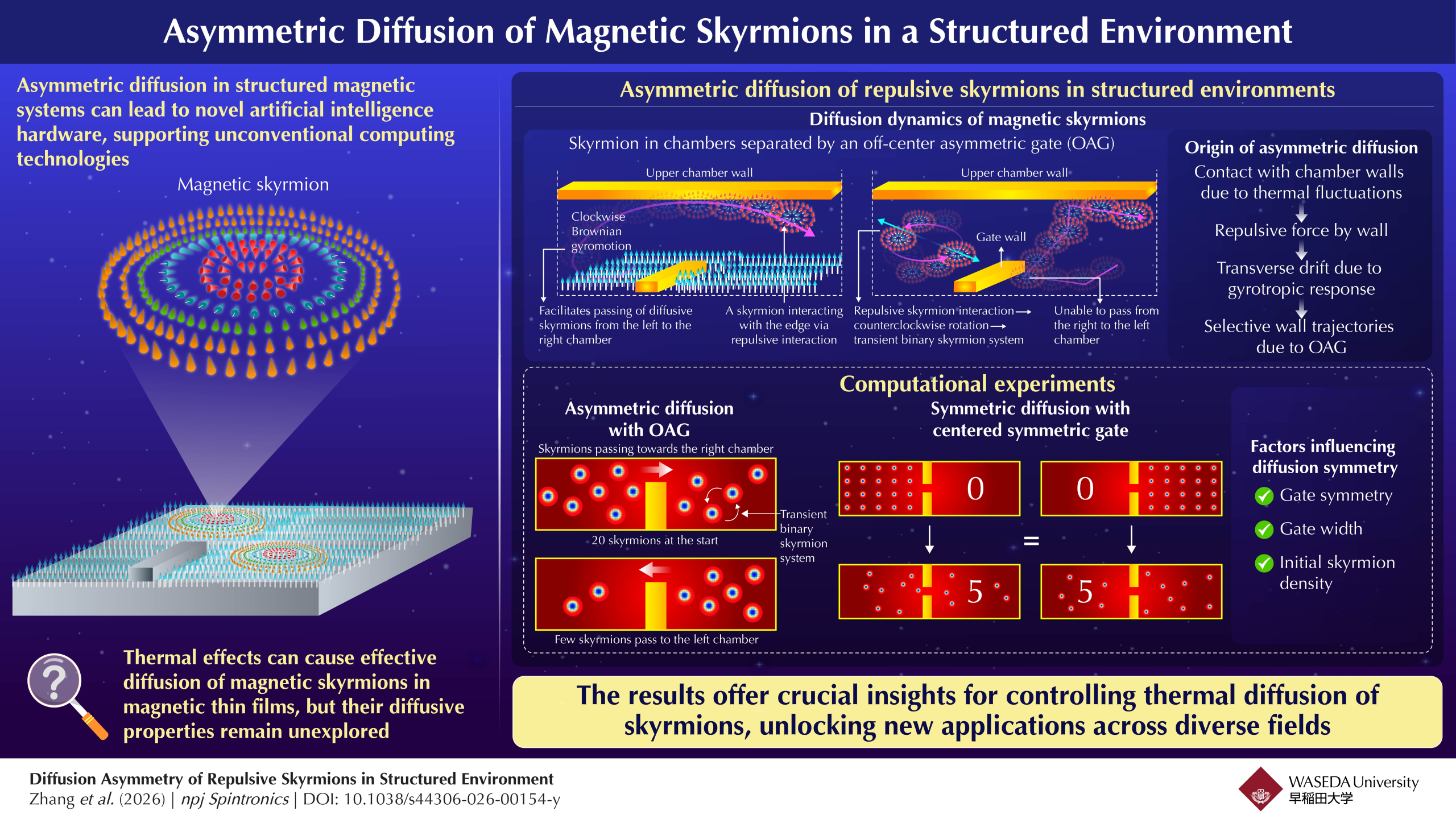
Image title: Asymmetric diffusion of magnetic skyrmions in a structured chamber
Image caption: Magnetic skyrmions diffuse more easily from the left chamber to the right chamber owing to their nontrivial random-walk dynamics and topology-dependent interactions with the off-center asymmetric gate. This mechanism offers a promising route toward unconventional artificial intelligence hardware.
Image credit: Dr. Qiming Shao, Dr. Rui Zhang, and Professor Masahito Mochizuki from Waseda University, Japan
License type: Original content
Usage restrictions: Cannot be reused without permission
Diffusion is a fundamental natural phenomenon that can be observed across a wide range of length and time scales. It plays a key role in many different fields, including physics, biology, and economics. In particular, asymmetric or directional diffusion of particle systems has attracted growing interest for practical applications, including the development of unconventional artificial-intelligence (AI) hardware, where it could enable nonlinear, geometry-controlled information processing.
Magnetic skyrmions are a type of topological spin textures that can behave as particle-like objects with chiral dynamic nature. Interestingly, recent reports have shown that even tiny thermal fluctuations can drive effective diffusion of skyrmions in ultrathin magnetic films and layered heterostructures. Some experiments have also revealed a topology-dependent sideways, wall-guided motion known as the Brownian gyromotion of skyrmions when they interact in a confined space. Magnetic skyrmions can also exhibit exotic dynamic behaviors that cannot be reproduced by common particles. Particularly, their diffusive properties have immense potential in novel information processing applications. However, these properties, especially in structured environments, remain largely unexplored.
In a breakthrough study, a research team led by Professor Masahito Mochizuki and Associate Professor Xichao Zhang from the Department of Applied Physics at Waseda University, Japan, has shown that magnetic skyrmions can exhibit asymmetric diffusion in a structured environment. “When many repulsive skyrmions diffuse thermally inside two connected chambers separated by an off-center gate, they can pass more easily in one direction than the other within a finite time interval,” explains Prof. Masahito Mochizuki. “This establishes a new principle for controlling thermal diffusion using topology and geometry.” Their study was published in npj Spintronics on July 16, 2026.
To study the diffusion of skyrmions in a structured environment, the team designed a theoretical model, consisting of Néel-type skyrmions confined in a nanostructured magnetic thin-film system containing two chambers linked by a narrow off-center asymmetric gate (OAG). Their analysis showed that despite thermally induced random motion of magnetic skyrmions, the off-center geometry caused a clear directional imbalance in their diffusion. Skyrmions placed in the left chamber were more likely to pass through the OAG than skyrmions approaching from the opposite side.
Computational simulations with multiple repulsive skyrmions initially placed on either side of the OAG confirmed this theoretical finding. The team found that this key mechanism was not simply due to the asymmetric configuration of the gate but instead emerged from the interplay between the structured environment and the unique topology-dependent dynamics of skyrmions.
When a skyrmion approaches a chamber wall, the wall exerts a repulsive force. Because of the nontrivial topology of the skyrmion, this force guides it into Brownian gyromotion. Since the OAG exposes the skyrmion to different sections of the wall in the direction from which it arrives, the resulting motion favors one crossing direction over the other. In contrast, in the case of a centered symmetric gate, the simulations showed a nearly symmetric diffusion for skyrmions on both sides.
The results further revealed that two diffusive skyrmions can transiently rotate around one another, forming a short-lived binary skyrmion system, highlighting the importance of interactions between repulsive skyrmions and their density. The researchers also found that a high initial skyrmion density may push skyrmions out of the chamber without effective interaction with the OAG. Moreover, the diffusion asymmetry depends strongly on the gate opening width. An OAG with a much wider width than the skyrmion diameter can allow all skyrmions to pass through, while a narrow OAG can prevent any skyrmion from passing. Only a reasonable OAG width can lead to asymmetric diffusion.
“Topological magnetic textures, such as skyrmions, are spatial patterns formed by localized magnetic moments residing on the atomic lattice sites of a magnetic crystal. It is remarkable that such a mere magnetization pattern can demonstrate particle behavior and exhibit thermal diffusion. Even more intriguing is the fact that its thermal diffusion becomes asymmetric due to the topological geometric origin,” remarks Prof. Mochizuki. “Our findings uncover novel physics beyond that of conventional particle systems and are expected to open up a new research field in nonequilibrium statistical mechanics focused on magnetic textures.”
“Over the past decade, the community has primarily focused on the conventional dynamics of a single skyrmion or a solid lattice of skyrmions. In both scenarios, skyrmion–skyrmion and skyrmion–environment interactions are either absent or trivial. It is therefore of great significance to explore the physics of interacting skyrmions, where richer interactions may give rise to odd dynamics, especially when they are coupled with structured environments,” remarks Dr. Zhang. “This study deepens our understanding of skyrmion diffusion in confined and structured environments, paving the way for novel physical computing platforms, where randomness, geometry, dissipation, and topology work together.
Authors:
Xichao Zhang1,2,3, Charles Reichhardt4, Cynthia J. O. Reichhardt4, Qiming Shao2,3,5,6, Rui Zhang5,6,7,Yan Zhou8, Yongbing Xu9,10, and Masahito Mochizuki1
Affiliations:
1Department of Applied Physics, Waseda University, Japan
2Department of Electronic and Computer Engineering, The Hong Kong University of Science and Technology, China
3IAS Center for Quantum Matter, The Hong Kong University of Science and Technology, China
4Theoretical Division and Center for Nonlinear Studies, Los Alamos National Laboratory, USA
5Department of Physics, The Hong Kong University of Science and Technology, China
6State Key Laboratory for Displays and Opto-Electronics, The Hong Kong University of Science and Technology, China
7Center for AI for Science, The Hong Kong University of Science and Technology, China
8Guangdong Basic Research Center of Excellence for Aggregate Science, The Chinese University of Hong Kong, China
9National Key Laboratory of Spintronics, Nanjing University, China10School of Physics, Engineering and Technology, University of York, UK
Title of original paper: Diffusion asymmetry of repulsive skyrmions in structured environment
Journal: npj Spintronics
DOI: 10.1038/s44306-026-00154-y
About Professor Masahito Mochizuki
Masahito Mochizuki is a Professor at Waseda University in Japan. He received his Ph.D. from The University of Tokyo in 2003. His area of expertise is theoretical condensed-matter physics, and his research interests include strongly correlated electron systems, multiferroics, spintronics, topological magnetism, and photoinduced nonequilibrium phenomena. He is a member of the Physical Society of Japan, the Japan Society of Applied Physics, and the Magnetics Society of Japan.
About Associate Professor Xichao Zhang
Xichao Zhang was an Associate professor at Waseda University in Japan. He received his Ph.D. from Shinshu University in 2018. His research centers on the dynamics and functionalization of interacting topological quasiparticles on artificially structured magnetic surfaces and interfaces. He also pursues interdisciplinary research at the interface of magnetism, soft matter, active matter, and fluid science, which may contribute to the design and development of unconventional applications, including artificial intelligence (AI) functionalities. He is a recipient of the Waseda Research Award, and he is a senior member of the IEEE. He joined Hong Kong University of Science and Technology as a scientist in 2026.