Slime Mold-Inspired Computing
Wed, Aug 26, 2026-
Tags
Slime Mold-Inspired Computing
Researchers explore how amoebae can be used to develop highly energy-efficient computing systems, aimed at solving complex mathematical problems
Complex mathematical problems, such as combinatorial optimization problems, have wide-ranging industrial applications and require extensive computational resources to solve. Slime molds represent a promising avenue for developing new, efficient computing paradigms to mitigate this issue. However, their physical implementation is still challenging. Now, researchers have developed a new, simpler amoeba-inspired computing model that enables physical implementation across diverse materials and physical phenomena, without compromising optimization performance.
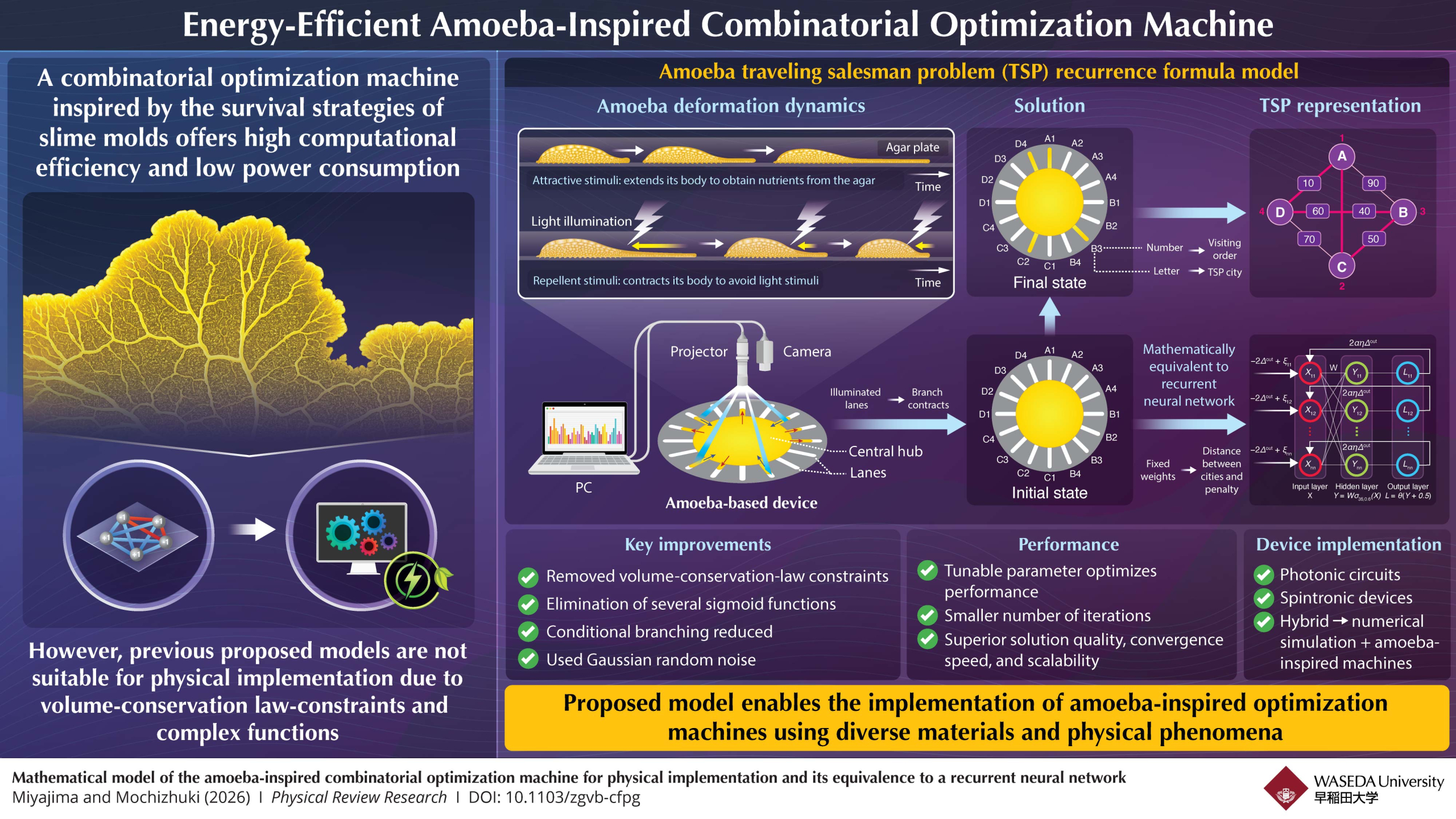
Image title: Proposed amoeba TSP recurrence formula model
Image caption: The proposed model eliminates complex mathematical functions and conservation-law constraints, allowing physical implementation using a wide range of materials and physical phenomena, while making the model simpler and more performant.
Image credit: Assistant Professor Yusuke Miyajima and Professor Masahito Mochizuki from Waseda University
License type: Original content
Usage restrictions: Cannot be reused without permission
Combinatorial optimization problems are ubiquitous, underpinning decision-making in a wide range of fields, including logistics, transportation, communication networks, drug discovery, and materials science. However, these problems are computationally expensive, especially for conventional computing systems. As a result, researchers are exploring new computing paradigms capable of solving such problems more efficiently.
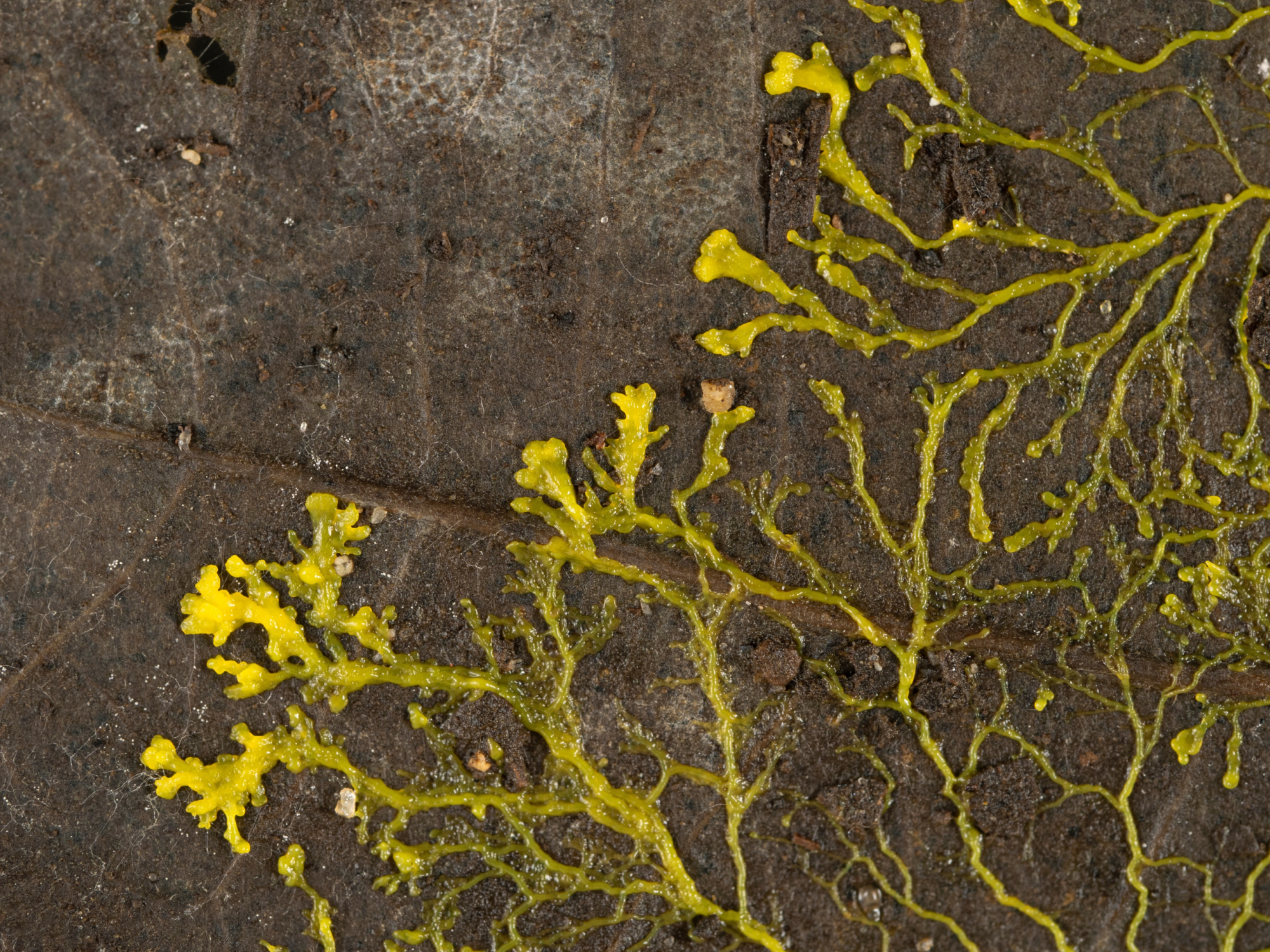
One promising source of inspiration comes from living organisms, specifically the survival strategies of slime molds. Slime molds, which exhibit amoeba-like behavior, demonstrate remarkable computational capabilities through their deformation dynamics, continuously adapting their shape in response to environmental cues to maximize nutrient intake while avoiding unfavorable conditions such as light. In doing so, they effectively balance competing objectives like solving an optimization problem. Indeed, researchers have harnessed these behaviors to solve maze-navigation and combinatorial optimization problems. One notable example is the Amoeba TSP model. However, existing slime mold-based models are difficult to implement as physical computing devices because of constraints like the volume-conservation law, multiple conditional branches, and numerous complex functions, which limit the range of suitable materials and physical systems.
Now, Assistant Professor Yusuke Miyajima and Professor Masahito Mochizuki from the Department of Applied Physics at Waseda University, Japan, have proposed a simplified recurrence formula for the Amoeba TSP model that streamlines its information-processing procedure while enabling physical implementation. “Our approach eliminates a major constraint, the volume-conservation law, making it possible to implement slime-mold computers using a much wider variety of materials and physical phenomena,” explains Miyajima. Their study was published in Volume 8, Issue 2 of Physical Review Research on June 09, 2026.
The TSP is a classic combinatorial optimization problem in which a salesman must determine the shortest route that visits multiple cities exactly once before returning to the starting point. The Amoeba TSP model represents slime-mold dynamics to solve this. In the model, an amoeba is confined within a circular device with several radially extending lanes, each corresponding to a particular city at a specific position in the travel sequence. The amoeba is placed on an agar plate containing nutrients. Initially, the amoeba only occupies the central hub. To collect nutrients, it extends into the non-illuminated lanes. These extended parts are called branches. On the other hand, if the lanes are illuminated, the branches contract. The lengths of the branches, together with the illumination pattern, collectively encode candidate solutions to the TSP.
To mitigate the inherent constraints of the existing model, the researchers proposed five targeted modifications, including replacing complex sigmoid functions with constants or simpler functions and removing conditional branching, counting operations, and conservation-law constraints. This yields a simple recurrence formula that allows the model to be reproduced using a wider variety of physical materials and physical phenomena. Additionally, the team also introduced a tunable parameter to control and optimize the model’s performance.
In tests, the proposed model produced a feasible solution with a considerably smaller number of iterations than previous models, including the original Amoeba TSP model and the Improved Amoeba TSP model. Moreover, it can handle up to 180 cities, whereas the Improved and original Amoeba TSP models are limited to 100 and 30 cities, respectively.
Notably, the researchers also demonstrated that the proposed model is mathematically equivalent to a recurrent neural network with fixed weights, where each weight represents the distance between two cities or a penalty for violating the constraints. This result suggests that slime-mold information processing and neural networks may share a common computational principle.
The researchers also identified potential candidates for physical implementation, including photonic circuits, spintronic devices, and mechanical or fluidic systems. In particular, they presented an example of an implementation using spintronic devices, which are stable against heat and radiation and can operate with low energy consumption. This device architecture directly reflects the features enabled by the proposed modifications.
“The increased flexibility of our model can accelerate the development of energy-efficient slime-mold computers,” says Mochizuki. “This decentralized mode of information processing could prove valuable for AI and large-scale combinatorial optimization, where conventional computers require significant power consumption.”
Overall, the study represents an important step toward developing energy-efficient computing systems inspired by living organisms and also a new way to understand intelligent behavior in single-celled organisms.
Authors: Yusuke Miyajima1 and Masahito Mochizuki1
Affiliations: 1Department of Applied Physics, Waseda University, Japan
Title of original paper: Mathematical model of the amoeba-inspired combinatorial optimization machine for physical implementation and its equivalence to recurrent neural networks
Journal: Physical Review Research
DOI: https://doi.org/10.1103/zgvb-cfpg
About Assistant Professor Yusuke Miyajima
Dr. Yusuke Miyajima is an Assistant Professor at Waseda University in Japan. He received his Ph.D. from Waseda University in 2025. His research focuses on the application of machine learning to physics and nature-inspired computational technologies. He is a member of the Physical Society of Japan and the Japan Society of Applied Physics.
About Professor Masahito Mochizuki
Dr. Masahito Mochizuki is a Professor at Waseda University in Japan. He received his Ph.D. from the University of Tokyo in 2003. His research interests are theories of strongly correlated electron systems, multiferroics, spintronics, topological magnetisms, and photoinduced nonequilibrium phenomena. He is a member of the Physical Society of Japan, the Japan Society of Applied Physics, and the Magnetics Society of Japan.