![[Podcast Column] Why Great Science Doesn’t Always Make Great Startups](https://www.waseda.jp/top/en/assets/uploads/2026/08/2026.6.29-startup-screenshot-for-podcast-column-7.jpg)
[Podcast Column] Why Great Science Doesn’t Always Make Great Startups
Thu, Aug 6, 2026-
Tags
This podcast column features an episode of Season 2 of Waseda University’s English-language podcast “Rigorous Research, Real Impact.” In this episode, Professor Alex Coad (Faculty of Commerce) appears as a guest to discuss entrepreneurship, innovation, and the differing dynamics of startups emerging from universities and corporations.
Framed by his research in entrepreneurship and innovation studies, Professor Coad questions the widely held assumption that, despite producing leading scientific breakthroughs, universities are also the primary source of the most successful startups. In the excerpt below, he explains why empirical evidence challenges this view, highlighting differences in performance between university spinouts and private-sector startups, as well as the unexpected advantages often given to academic entrepreneurs.
All eight episodes of Season 2 of Waseda University’s English podcast “Rigorous Research, Real Impact” are currently streaming for free on Spotify, Amazon Music, Apple Podcasts, and YouTube.
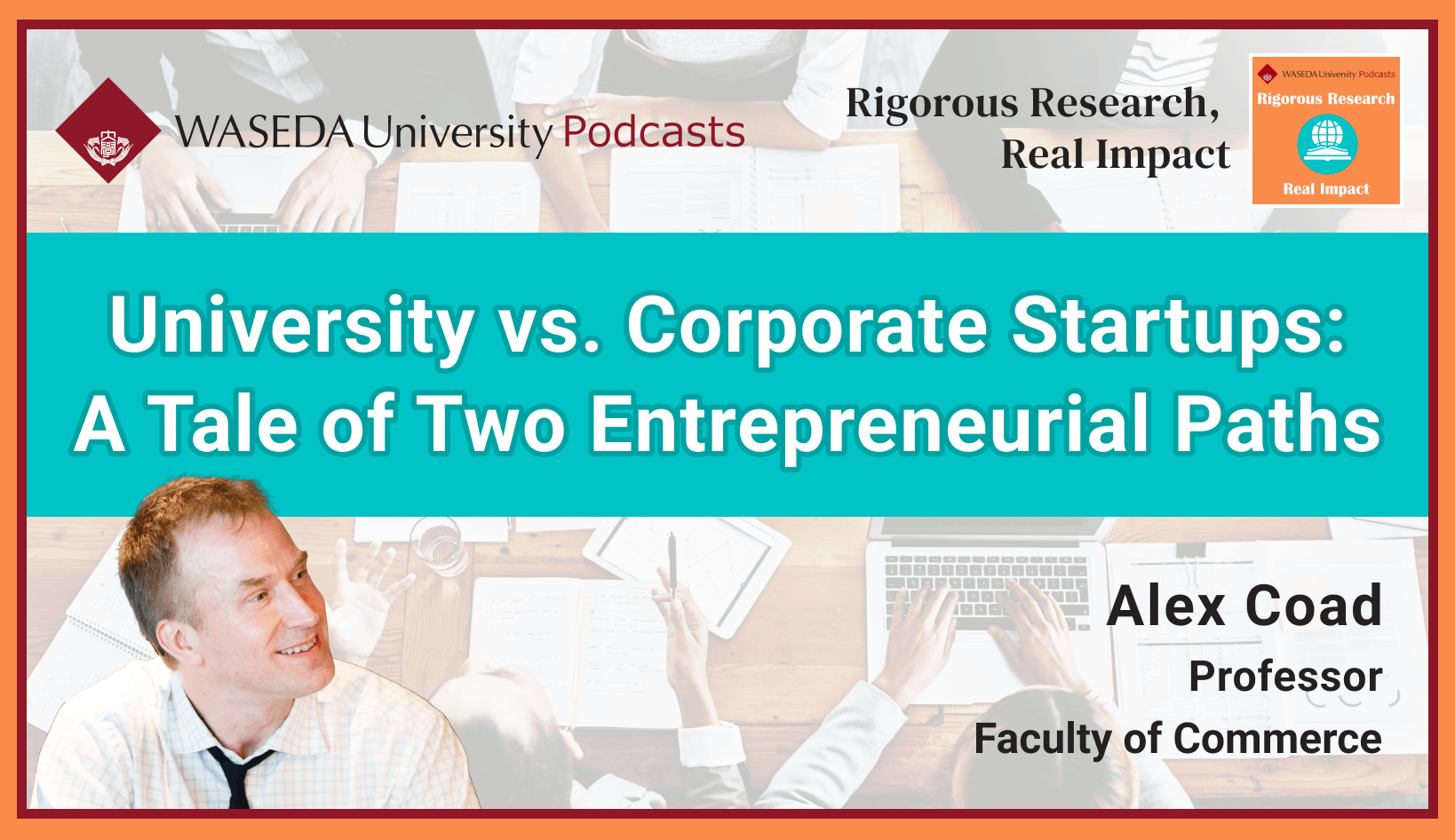
You can read the full transcript by clicking the above episode banner.
Question: Since universities are often seen as sources of major scientific breakthroughs, there is a common assumption that they also produce the most successful startups. Your work challenges this. What made you question this assumption and explore the gap between scientific and entrepreneurial success?
Prof. Coad (5:02):
First of all, there’s the assumption often held by policymakers and economists that because universities often have the world’s best scientific research, that this research should automatically translate into innovative entrepreneurship. So, it makes sense to assume that, but it doesn’t really work out that way in the real world.
So, when we look at the data on where are these most innovative startups, where are the innovative entrepreneurs actually coming from, we don’t see that university spinouts perform better; they actually seem to perform a bit worse than spinoffs and startups coming from the private sector.
So, the first thing that got me interested in this topic was the kind of disconnect between the policymakers’ and economists’ assumption and what the evidence is saying from the many high-quality studies that have been published looking at large sample evidence in large sample representative data sets.
And also, considering all of the support that university-based entrepreneurs get. So, university-based entrepreneurs, they benefit from all kinds of support: financial support from their department, they can take the intellectual property with them in many cases, and if it doesn’t work out, they can come back to their previous job at the university.
That is unheard of in the private sector. You can’t leave a company, take their secrets with you, try to set up your own business, and then if that fails, come back to your previous job in the private sector. So university entrepreneurs have all of this support, why don’t they do better? That’s something that led me to investigate this issue.
About the Guest:

Professor Alex Coad is a highly-cited scholar in the areas of firm growth, entrepreneurship and innovation, and has published over 80 articles in leading international peer-reviewed journals. Prof. Coad is an editor at the journals ‘Research Policy’ (Financial Times Top 50 list of journals for Business Schools) and ‘Small Business Economics.’ Previously he obtained a joint PhD from Université Paris 1 Panthéon-Sorbonne and the Sant’Anna School, Pisa, Italy. In December 2016, Prof. Coad received the 2016 Nelson Prize at University of California Berkeley.