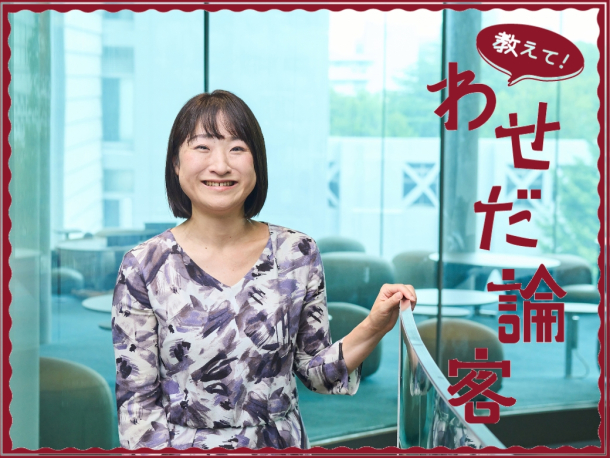
The theme for the 2026 "Lectures by Experts" is "Food." We will explore food from the perspectives of multiple experts. Our guest for the fourth installment is Professor Tomomi Nonaka (Faculty of Science and Engineering), who specializes in "Management Systems Engineering and Service Engineering." Currently serving as the research representative for the "Space QOL Research and Development Center for Realizing Healthy and Comfortable Space Living for the General Public" (hereinafter referred to as the "Space QOL Research and Development Center"), Professor Nonaka discusses the possibilities of food from a systems design perspective and the future of food in the era of living in space.
How will food change in the age of living in space?
The extreme environment of space presents an opportunity to re-examine the taken-for-granted aspects of food on Earth, and to reconsider the entire cycle from agriculture to cooking, processing, preservation, and recycling. Furthermore, food can connect people from diverse fields and serve as a catalyst for considering "what kind of future we want."
INDEX
▼Towards an era where "ordinary civilians" live in space
▼ System Design that connects automobiles, food, and space.
▼Redesigning deliciousness in space
▼Designing the future society through food
Towards an era where "ordinary civilians" live in space
What kind of project is the "Space QOL Research and Development Center" led by Professor Nonaka?
This is a research and development project with a maximum duration of eight years, selected for funding from JAXA (Japan Aerospace Exploration Agency) (*1). The key point is that it focuses on space and targets ordinary civilians. Until now, only astronauts who had undergone rigorous selection and several years of training had stayed in space. However, with the realization of space travel and space factories, it is believed that in the future, people with diverse purposes will live and work in space. The Japan Society for Aeronautical and Space Sciences envisions a scenario where 10,000 to 100,000 people worldwide will stay in space annually by the 2040s. The purpose of this project is to support these people's stay in space in terms of health and comfort.
*1 Selected as a project of the "JAXA Space Strategic Fund Phase 2 SX-CRANE"
In low Earth orbit and on the lunar surface, gravity, air, and water are different from those on Earth, making the development of ECLSS (*2) essential for human survival. Representative ECLSS technologies include the regeneration of air and water, and the adsorption and desorption of CO₂ emitted through respiration. These technologies have been developed primarily in chemical engineering. Our project further expands the concept of ECLSS, focusing on "people" living in the ECLSS environment. Leveraging knowledge from various fields including ergonomics, sports science, and health and medicine, our research approach is characterized by a human-centered approach that supports comfort and health by influencing physiological responses, cognition and perception, and subjectivity and motivation. The project involves cross-disciplinary participation from science, engineering, and humanities fields at Waseda University, and is being advanced in collaboration with diverse institutions in industry, academia, and government, including Tokyo University of Science, Keio University, Tokyo Women's Medical University, and Kanagawa Prefecture.
*2 ECLSS stands for Environmental Control and Life Support System, a technology essential for supporting human activities in the space environment.
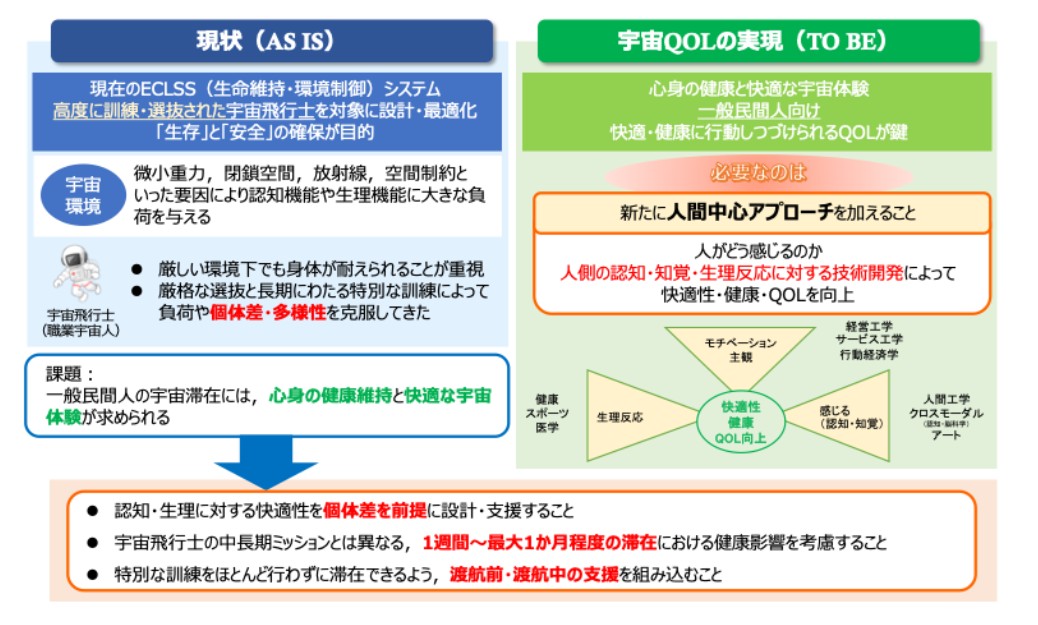
Space Quality of Life Research and Development based on the premise of "ordinary civilians" (Click to enlarge)
System design that connects automobiles, food, and space.
Your area of expertise is management systems engineering, but what kind of research did you originally do?
I earned my PhD in Systems Engineering. Here, "system" refers to anything that can be broken down into its elements, and where those elements interact with each other to achieve a purpose. Humans, organizations, and even laws are all systems if you break them down. Originally, when hybrid cars first appeared in society, I was researching sustainable supply chains for environmentally friendly automobiles. From there, I expanded my research to the systems of food, and now to space systems. I believe my research has remained consistent in its focus on systems design, which considers how to combine elements to make the whole system work well.
The Space Quality of Life Research and Development Center consists of nine groups, with ergonomics, sports science, and health and medicine playing central roles. I belong to the System Design group, which oversees the entire center, and the "Private Space Services and Service Design" group, where I am responsible for designing the infrastructure for diverse people to stay in space and managing interdisciplinary research aimed at the social implementation of developed technologies. Incidentally, the Department of Management Systems Engineering in the Faculty School of Creative Science and Engineering, where I currently belong, is the oldest department in the field of management engineering in Japan.
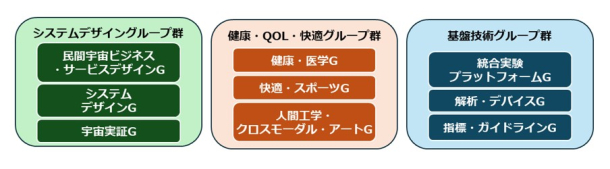
Three research groups and nine research groups promoting research and development on space quality of life.
Redesigning deliciousness in space
How is food positioned within this project?
Food is deeply connected to people's quality of life. Delicious food transcends nationality and culture, and is an important element that makes people feel good. Of course, people need to eat even in space. For this reason, food is involved in various research projects. Among the nine groups, there is no team that specializes in food, but related research projects are studying food systems in space.
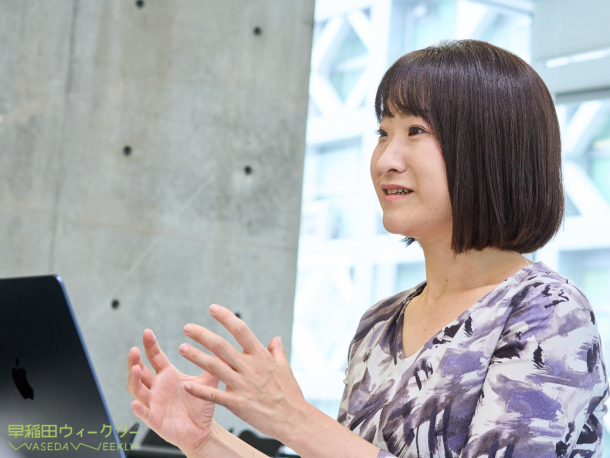
For example, to recycle resources in a closed environment like the lunar surface, it is essential to develop a "biological ECLSS" environment that includes agriculture and food. To maintain a constant CO₂ concentration, developing technologies such as "sequence cultivation," which involves planting a fixed amount and harvesting a fixed amount each day, is crucial. Under the severe resource constraints of space, it is necessary to design a single system that encompasses everything from agriculture and harvesting to storage, cooking and processing, preservation, and recycling, while simultaneously achieving nutrition, taste, and sustainability.
What's interesting is that in space, the very concept of "deliciousness" needs to be redesigned. It's said that it takes about a month and a half for the human body to adapt to the space environment, and during that time, fluid shifts, where bodily fluids move to the upper body, can cause facial swelling and a feeling of nasal congestion. However, fluid shifts can affect the entire body, including the autonomic nervous system, so the symptoms are not limited to these. Also, under microgravity, liquids become spherical due to surface tension. The way we taste food, including how it comes into contact with our taste buds, is also different from on Earth. It's not simply a matter of taking something that tastes good on Earth into space.
In my laboratory, we are researching technologies to produce and consume rice and beans, and to cook them deliciously using limited water resources. I believe that food is one of the fields where the excitement of rethinking terrestrial technologies and designing new value in space is most readily apparent.
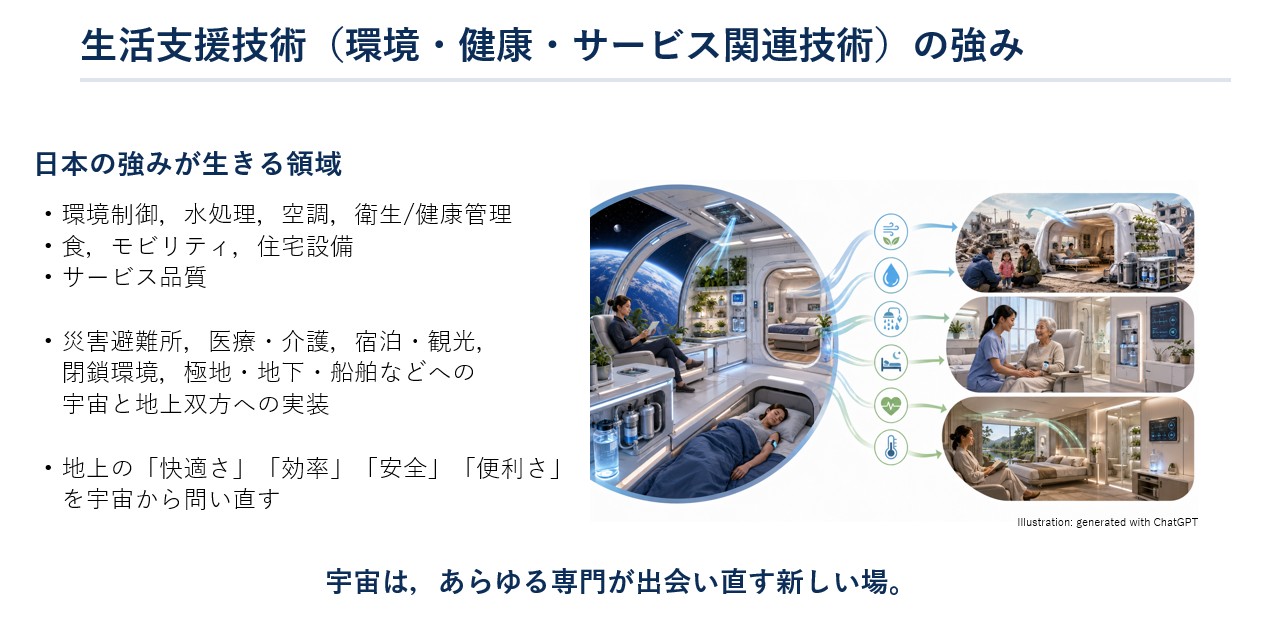
Life support technologies that connect space and Earth, leveraging Japan's strengths (Click to enlarge)
Designing the future society through food
Is there anything students should know about their daily diet?
Food self-sufficiency is a matter of national security, and international organizations such as the FAO (Food and Agriculture Organization of the United Nations) predict that the stable supply and access to food will be threatened by conflict, climate change, and economic inequality, and that by 2030, approximately 512 million people will face chronic hunger. Various technologies have been developed to address food problems, such as food loss reduction, preservation techniques, and cultured meat, but as a systems researcher, I believe it is important to keep diverse options open rather than relying on a single technology.
Ultimately, deciding what kind of food system to leave for the future boils down to a matter of decision-making and design: "What kind of future do we want?" Because food is something everyone interacts with every day, it can be a familiar entry point for students in any faculty or department to think about the future of society and technology.
What does food mean to Professor Nonaka?
This experience has broadened my perspective as a researcher and expanded the scope of my research. As I expanded my research subject from "automotive systems" to "food systems," I feel that the diversity of the people involved, that is, the stakeholders, has increased dramatically. I've had more opportunities to collaborate on research with experts I hadn't met before, such as primary producers like farmers, chefs, researchers and designers from diverse fields.
It could be said that research into food paved the way for subsequent research into space quality of life. I believe that food is a nexus that connects various fields and people.
Finally, do you have a message for Waseda University students?
In the world of space exploration, knowledge from non-space fields is now needed, not just for rockets and satellites. Economics, philosophy, law, and ethics are all connected to space. Just as there is a field of study called "food science," food is truly an integrated science, adjacent to all academic fields. Don't think that "it's not related to my field of expertise," but please take an interest and think about the future of food from your own field of expertise. Also, since Waseda University has many international students, I hope that you will broaden your interest in food by learning about the diverse food cultures around the world through various interactions on campus.
Tomomi Nonaka
Faculty of Science and Engineering, School of Creative Science and Engineering, Department of Management Systems Engineering, Professor. After graduating from Keio University's Faculty of Environment and Information Studies, she worked at a company and completed the master's program at the Graduate School of System Design and Management (SDM), Keio University, finishing her doctoral program early. At SDM, she was dispatched to graduate school at Delft University of Technology and the Swiss Federal Institute of Technology, and did research internships at MIT. Her Ph.D. is in Systems Engineering.
Her specialties are management systems engineering, service engineering, and system design. She previously served as a specially appointed assistant professor at the Graduate School of System Informatics, Kobe University, an assistant professor in the Department of School of Science and Engineering Systems Engineering, Faculty of Science and Engineering, Aoyama Gakuin University, Associate Professor the Faculty of Food Management, Ritsumeikan University, and deputy general manager of Ritsumeikan EDGE+R, before assuming his current position in April 2023. She is engaged in research and development of space QOL for civilian space stays, human-centered ECLSS research, and service production system design starting from human information such as job satisfaction and productivity. She is the research representative for the SX-CRANE project of the Space Strategy Fund Phase 2, and the research representative for the Space Specialist Human Resource Development Program Ministry of Education, Culture, Sports, Science and Technology Science and Technology's FY2025 Space and Aerospace Science and Technology Promotion Commission. She is also a temporary member of the Council for National Research and Development Corporations Ministry of Education, Culture, Sports, Science and Technology, Sports, Science and Technology (Japan Aerospace Exploration Agency subcommittee), a member of the Green Innovation Project Subcommittee of the Industrial Structure Council of the Ministry of Economy, Trade and Industry, a well-being policy advisor for Onomichi City, a full member of IFIP WG5.7, a director of the Japan Industrial Management Association, a director of the Japan Society for Creativity, a director of the Japan Innovation Association, and a director of the Japanese Food Culture Society.
Courses taught: "Production and Distribution Management," "Service Engineering and System Design," "Method Engineering Exercises," "Human Life Engineering," etc.
Interview and text: Kenichi Marumo
Photography: Seiji Ishigaki