
Which Firms have Advanced Capabilities—and What Others Must Build First
Mon, Jul 6, 2026-
Tags
Researchers introduce a new method to measure firm capabilities and structure them into a nested hierarchy called a “capabilities ladder”
Organizational capabilities are important for growth, innovation, and competitive advantage. However, these capabilities are difficult to measure, limiting empirical research. Using financial data from ~45,000 Indian firms and a nestedness algorithm, researchers have created and tested a new approach to quantify firm capabilities and rank their position on a “capabilities ladder.” Analysis revealed a nested hierarchy of capabilities ranging from basic to advanced. With further insights, the study holds relevant implications for organizations and governments.
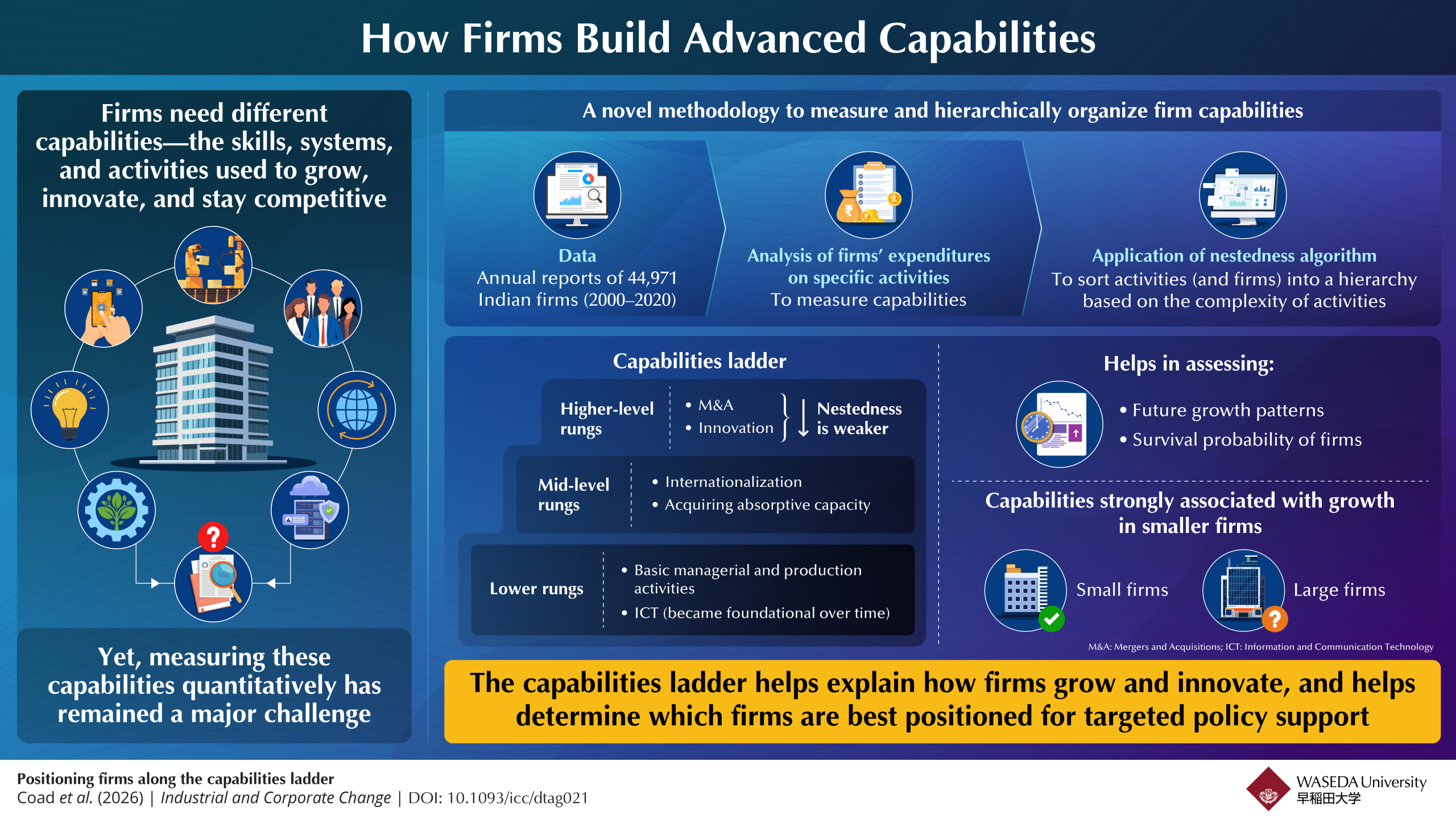
Image title: A new method to quantify firm capabilities and organize them in a hierarchical and nested “capabilities ladder”
Image caption: Using company annual reports and a nestedness algorithm, researchers have quantitatively measured firm capabilities and developed a capabilities ladder. It has three main steps representing basic, mid-level, and advanced capabilities. Firms progress from basic to mid and then to advanced capabilities, reflecting the nestedness of capability development.
Image credit: Professor Alex Coad from Waseda Business School, Waseda University
License type: Original content
Usage restrictions: Cannot be reused without permission
Understanding how firms build their capabilities, such as managerial skills, technology adoption, and innovation capacity, is important for explaining why some firms perform better and how others can improve. However, unlike sales or profits, firm capabilities are not easily quantifiable. So, existing studies have used surveys or interviews to assess them, but these methods are costly, time-consuming, and susceptible to bias.
To address these challenges, a research team involving Professor Alex Coad from Waseda Business School, Waseda University, Japan, developed and tested a new method to measure firm capabilities and sort them into a hierarchy to identify basic and advanced capabilities. “Previous studies have used qualitative methods, focused on individual sectors, or were ad hoc. But our approach is a low-cost way of quantifying capabilities using widely available data and relies on algorithms from network science,” explains Coad. The team included Professorial Fellow Nandita Mathew from the United Nations University (UNU) Institute on Comparative Regional Integration Studies, Belgium and Dr. Emanuele Pugliese from the UNU Maastricht Economic and Social Research Institute on Innovation and Technology, Spain. Their study was published online in the journal Industrial and Corporate Change on May 11, 2026.
Researchers retrieved annual reports of 44,971 Indian firms (2000–2020) from the PROWESS database developed by the Centre for Monitoring Indian Economy. They measured capabilities by assessing firms’ expenditures across 47 activities, which were grouped into seven capability categories. They used an existing nestedness algorithm to check for a nested hierarchy of capabilities. In other words, they examined if firms must first have mid-level capabilities to develop advanced capabilities, and if firms must first have basic capabilities to develop mid-level capabilities. To do this, the algorithm ranks capabilities by complexity and places firms on a “capabilities ladder.” A capability is defined as complex if it is possessed by only a few firms at the top of the hierarchy.
The results showed significant nestedness within the capabilities ladder. At the lowest rungs, firms have basic managerial, production, internet access, and communication capabilities. At the mid-level rungs, firms expand into international markets and actively leverage new knowledge for future innovation. At the highest rungs, firms engage in patenting, mergers, environmental initiatives, and so on, but these capabilities were not clearly organized into a hierarchy. This is because firms with advanced capabilities have more freedom to build their customized capabilities ladders, whereas firms with lower capabilities have a clear hierarchy of capability development.
This hierarchy of capabilities remained stable between 2000 and 2020, except in two cases. Information and Communication Technology (ICT) capabilities were initially possessed only by advanced firms, but by 2005, they had become more common and foundational for most firms. Similarly, environment, welfare, and amenities capabilities became slightly more foundational for firms only in 2015.
Researchers also found that firm size and capability development were positively correlated among small firms, but this correlation weakened among larger firms. Further analysis also showed that firms with advanced capabilities showed higher growth rates, but firms engaging in highly advanced activities relative to their size tended to show lower survival probabilities.
As expected, not all industrial sectors and sub-sectors had the same capability profiles. For instance, firms in sectors such as finance, real estate, and trade were spread across the capabilities ladder, while firms in the ICT service and technologically advanced manufacturing sectors were mostly at the top rungs.
These diverse insights are relevant for firms and policymakers. Coad elaborates, “Our analysis may guide firms in identifying areas that need to be upgraded so that they can progress towards more advanced activities. Our results also highlight the capabilities that firms must possess to undertake more complex activities. Given this, governments can develop targeted policies to help eligible firms take their first steps in a new domain. For instance, export support could be given only to firms that have basic digital capabilities.”
The study’s new approach broadens quantitative research on firm capabilities and may help firms progress toward more advanced activities.
Authors:Alex Coad1, Nanditha Mathew2,3,4, and Emanuele Pugliese4,5
Affiliations:
1Waseda Business School, Waseda University, Shinjuku, Japan
2United Nations University Institute on Comparative Regional Integration Studies, Brugge, Belgium
3Brussels School of Governance, Vrije Universiteit Brussel, Brussels, Belgium
4United Nations University-Maastricht Economic and Social Research Institute on Innovation and Technology, Maastricht, Netherlands
5European Commission, Joint Research Centre, Seville, Spain
Title of original paper :Positioning firms along the capabilities ladder
Journal:Industrial and Corporate Change
DOI:10.1093/icc/dtag021
About Professor Alex Coad from Waseda University
Dr. Alex Coad is a professor at the Waseda Business School in Tokyo. He received his joint PhD in Economics in 2007 from Université Paris 1 Panthéon-Sorbonne and Sant’Anna School of Advanced Studies. His research focuses on firm-level R&D investment, firm performance, entrepreneurship, strategy, and innovation policy. He has published over 100 articles in leading international peer-reviewed journals and serves as an editor at the journals Research Policy and Small Business Economics. He also provided consultancy services to various international organizations, including the World Bank and the European Commission.