![[Podcast Column] Beyond Entertainment: Progressive Game Design and Hideo Kojima’s Vision](https://www.waseda.jp/top/en/assets/uploads/2026/06/2026.6.29-kojima-scenery-screenshot-for-podcast-column-2.jpg)
[Podcast Column] Beyond Entertainment: Progressive Game Design and Hideo Kojima’s Vision
Wed, Jul 1, 2026-
Tags
This podcast column inroduces the second episode of Season 2 of Waseda University’s English-language podcast “Rigorous Research, Real Impact.” In this installment, Associate Professor Bryan Hikari Hartzheim (Faculty of International Research and Education) appears as the featured guest in “Hideo Kojima and the Art of Game Design.”
Drawing on his expertise in game and media studies, he introduces “progressive game design” as a way of thinking about video games that goes beyond entertainment, aiming instead to influence developments within the gaming industry while also engaging with broader cultural and social questions. In the excerpt below, he explains how Hideo Kojima’s creative approach illustrates this idea, from reworking familiar gameplay conventions to helping establish entirely new genres.
All eight episodes of Season 2 of Waseda University’s English podcast “Rigorous Research, Real Impact” are currently streaming for free on Spotify, Amazon Music, Apple Podcasts, and YouTube.
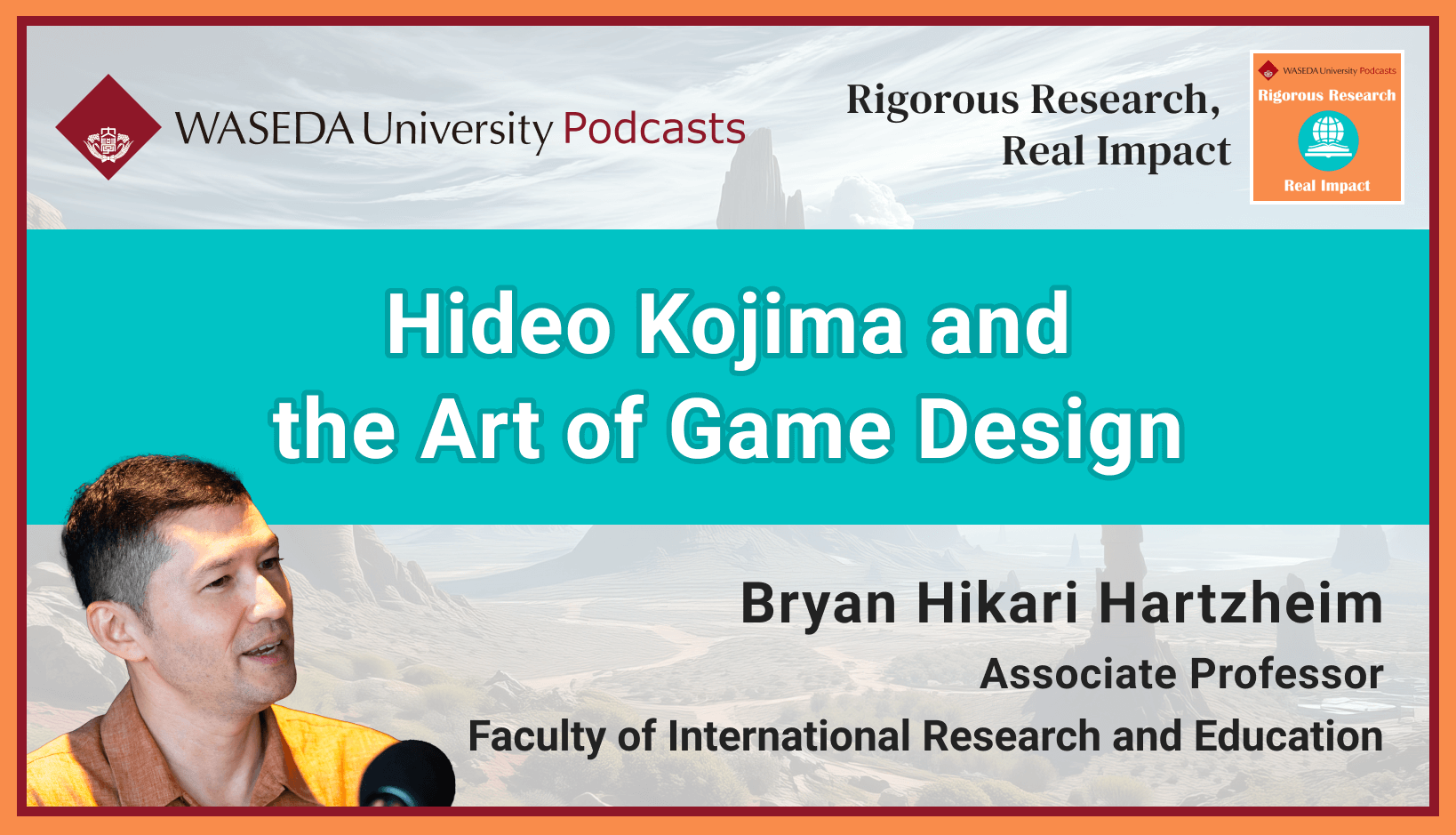
You can read the full transcript by clicking the above episode banner.
Question: Your book on Hideo Kojima introduces the concept of “progressive game design.” Could you briefly explain what it means, its key features, and how Hideo Kojima’s work exemplifies it?
Professor Hartzheim (01:44):
So, I use the term progressive game design to capture what I view as a particular design ethos that is embodied by Hideo Kojima and his design teams. And basically, it means to design games with the hope of contributing some kind of progress to the games industry and, through this, to some of the questions of our time.
So, on the former end, Kojima and his team’s work were insistent about creating different forms of play that were evolutions from existing popular genres.The most famous example is when Kojima, in his attempt to create an action game that didn’t involve combat, he created the tactical espionage game called Metal Gear, which maybe you’ve heard of and many people probably have heard of. And this game would lead to its own franchise at Konami Studios, where he worked, and eventually to the formation of this entire genre of games called “stealth.”
And the gameplay in this genre involves not destroying the enemy like in combat games that had existed at that time, or are still very popular today in first-person shooters, but instead of total destruction, total avoidance. So, sneaking past guards or using tools and costumes to distract them.
So, this kind of new genre that was an evolution from other genres is one of the ways that Kojima and his designers looked to kind of push the envelope in terms of industry and industry expectations.

About the Guest:
Associate Professor Bryan Hikari Hartzheim *Currently on sabbatical
Dr. Bryan Hikari Hartzheim is an Associate Professor in the Faculty of International Research and Education. He teaches in the English-based degree programs of the School of International Liberal Studies (SILS) and the Graduate School of International Culture and Communication Studies (GSICCS). He recieved his Ph.D. in Cinema and Media Studies from University of California, Los Angeles (UCLA). His research areas include aesthetics and art studies, game studies, media industry and production studies, and anime/manga studies.