Thermal Transport Modulation in YbN-Alloyed AlN Thin Films to the Glassy Limit
Wed, Jan 28, 2026-
Tags
Thermal Transport Modulation in YbN-Alloyed AlN Thin Films to the Glassy Limit
Researchers establish rational design principles for achieving ultralow thermal conductivity via controlled chemical disorder
A major challenge in thermal-management and thermal-insulation technologies, across multiple industries, is the lack of materials that simultaneously offer low thermal conductivity, mechanical robustness, and scalable fabrication routes. An international team of researchers addresses this long-standing problem by demonstrating that ytterbium nitride alloying in aluminum nitride can dramatically reduce its thermal conductivity to near-amorphous levels without disrupting the crystalline structure. This provides a new industry-compatible solution for high-temperature insulation, cryogenic systems, and semiconductor thermal shielding.
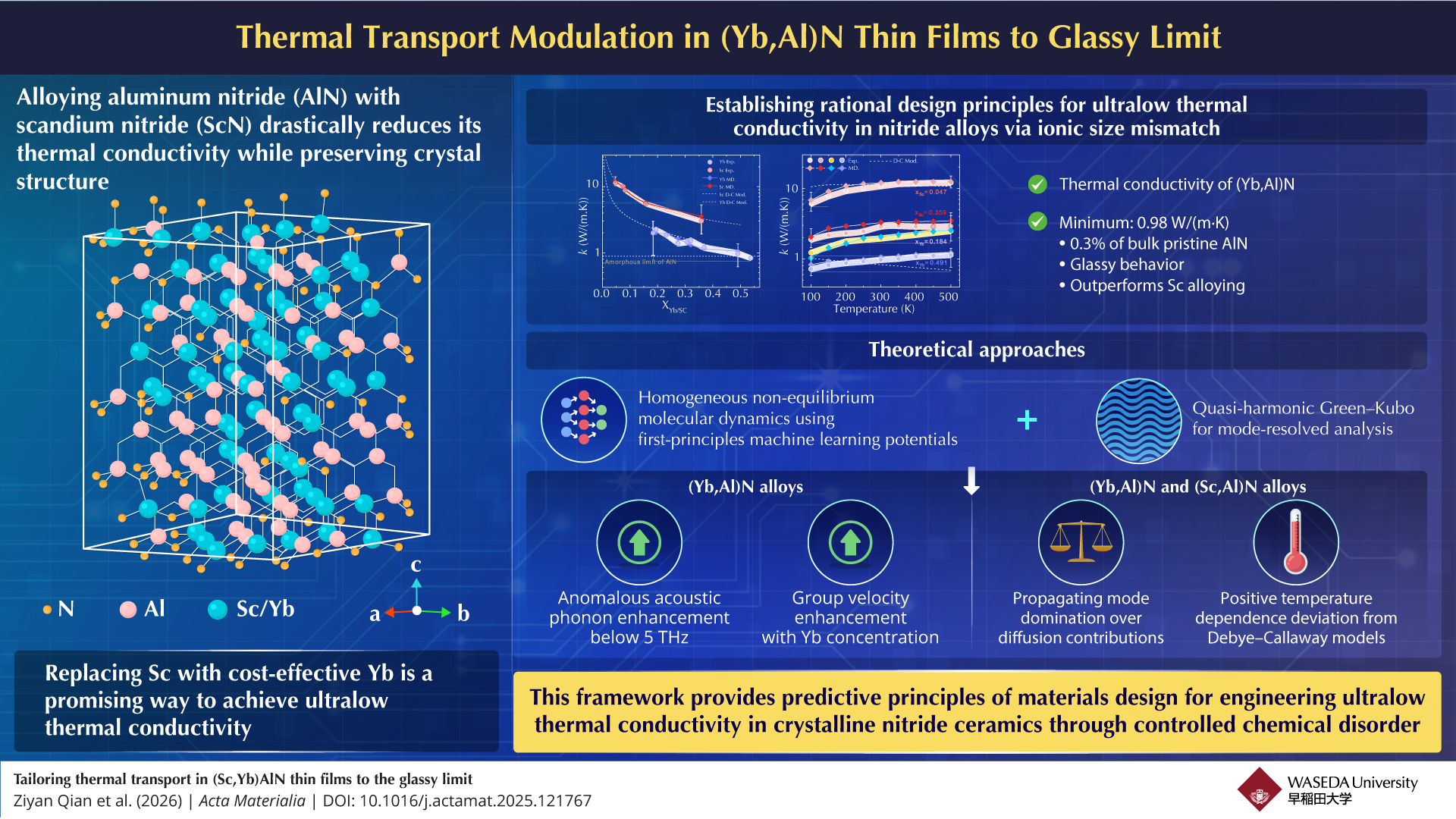
Image title: Ultralow Thermal Conductivity in YbN–AlN Alloy
Image caption: This study provides new predictive insights for engineering crystalline materials with amorphous-like thermal conductivity values.
Image credit: Professor Junjun Jia from Waseda University, Japan
License type: Original content
Usage restrictions: Cannot be reused without permission.
Discovering materials that exhibit completely insulating thermal behavior—or, conversely, extraordinarily high thermal conductivity—has long been a dream for researchers in materials physics. Traditionally, amorphous materials are known to possess very low thermal conductivity. This naturally leads to an important question: Can a crystalline material be engineered to achieve thermal conductivity close to that of an amorphous solid? Such a material would preserve the structural stability of a crystal while achieving exceptionally low thermal conductivity.
Notably, aluminum nitride (AlN) is a widely used industrial material, and alloying it with ytterbium nitride (YbN) can drastically reduce its thermal conductivity to values approaching that of its amorphous state, while preserving the original crystal structure. Such ultralow thermal conductivity is advantageous in many industrial scenarios that require long-term operation under stable temperature conditions, for example, as thermal-insulation materials in chemical reactors and blast furnaces and in cryogenic insulation for liquified natural gas (LNG) carriers.
Recently, a team of researchers led by Professor Junjun Jia from the Faculty of Science and Engineering at Waseda University, Japan; Assistant Professor Qiye Zheng from The Hong Kong University of Science and Technology, Hong Kong SAR, Hong Kong; and Professor Takahiko Yanagitani from Waseda University, achieved record-low thermal conductivity in wurtzite-structured AlN, approaching its glassy limit. Their findings were made available online on November 26, 2025, and have been published in Volume 304 of the journal Acta Materialia on January 1, 2026.
The researchers alloyed YbN within AlN, forming a (Yb,Al)N solid solution, which suppresses thermal conductivity to 0.98 W/(m·K)—only 0.3% of bulk pristine AlN and 10% higher than the amorphous limit of AlN (0.89 W/(m·K)). Based on this experimental result, the team established a materials design rule grounded in ionic size and mass mismatch. YbN alloying, with an ionic radius of Yb nearly twice that of Al, induces dramatically greater thermal-conductivity reduction than conventional scandium nitride (ScN) alloying, providing clear guidance for chemical-disorder-based phonon engineering.
Importantly, the researchers used cutting-edge theoretical approaches—combining homogeneous nonequilibrium molecular dynamics based on the first-principles machine learning potentials with quasi-harmonic Green–Kubo mode-resolved analysis—to uncover physics beyond classical models. Their simulations reveal that (Yb,Al)N exhibits anomalously stable acoustic phonon properties below 5 THz, where group velocities counterintuitively increase with rising Yb concentration—opposing conventional alloying principles. By contrast, commercially used (Sc,Al)N follows the expected broadband thermal-conductivity suppression. In both (Yb,Al)N and (Sc,Al)N alloys, propagating phonons dominate heat transport, contradicting predictions from the Allen–Feldman framework, while the positive temperature dependence of thermal conductivity defies classical Debye–Callaway models. Together, these findings establish new paradigms for thermal transport in disordered nitride alloys.
Jia points out the implications of their work. He says: “Our systematic framework provides the predictive principles of materials design for engineering ultralow thermal conductivity in crystalline nitride ceramics through controlled chemical disorder. The exceptional thermal suppression achieved in cost-effective YbN-alloyed AlN opens pathways for scalable thermal barrier coatings and guides material co-optimization in advanced thermal management technologies.”
“Its potential applications include thermal-shielding layers in next-generation semiconductor packaging to suppress thermal crosstalk, as well as high-temperature insulation for chemical process equipment such as reactors and blast furnaces. In addition, ultralow thermal conductivity characteristics are attractive cryogenic insulation in LNG and related low-temperature energy systems,” concludes Jia.
Reference
|
Title of original paper: |
Tailoring thermal transport in (Sc,Yb)AlN thin films to the glassy limit |
|
Authors |
Ziyan Qian1, Guangwu Zhang1, Zhanyu Lai2, Ayaka Hanai2, Yixin Xu1, Guang Wang1, Yang Lu1, Jiaqi Gu1, Yanguang Zhou1, Takahiko Yanagitani2,3, Junjun Jia2, 4, and Qiye Zheng1 |
|
Affiliations |
1Department of Mechanical and Aerospace Engineering, The Hong Kong University of Science and Technology |
| Latest Article Publication Date: |
1 January 2026 |
|
Journal: |
Acta Materialia |
|
DOI: |
https://doi.org/10.1016/j.actamat.2025.121767 |
About Professor Junjun Jia
Dr. Junjun Jia is a full-time Professor at Waseda University, Japan. He earned his Ph.D. from the University of Tokyo in 2011. His research focuses on the design and fabrication of functional solid-state materials/devices, such as solid-state thermal circuital elements, acoustic wave-based devices, and nonequilibrium electronic devices. His broader interests span nonlinear optics and non-equilibrium physics, particularly the behavior of excited electronic and phononic structures in solid materials. Dr. Jia has published extensively in peer-reviewed journals such as Advanced Functional Materials, Physical Review B, and Physical Review Applied. He has received several distinctions, including a paper award from the Materials Research Society, and serves on multiple scientific committees, such as the Materials Research Society of Japan.
About Professor Takahiko Yanagitani
Dr. Takahiko Yanagitani is currently a Professor at Waseda University, Japan. His main fields of research interests are piezoelectric thin films and BAW filters. He was the first to report ScAlN BAW resonator, which is now in practical use and installed on most smartphones. He also first reported a polarization inversion type BAW resonator, which is under active development. He is a member of technical program committee of the IEEE International Ultrasonics Symposium. Prof. Yanagitani is the author of more than 200 presentations and 3 invited presentations at the IEEE international conference.