Rule-Breaking, Extremely Fast-Growing Supermassive Black Hole in the Early Universe
Thu, Jan 22, 2026-
Tags
Rule-Breaking, Extremely Fast-Growing Supermassive Black Hole in the Early Universe
An international research team led by scientists at Waseda University and Tohoku University has discovered an extraordinary quasar in the early Universe that hosts one of the fastest-growing supermassive black holes known at this mass scale. Observations with the Subaru Telescope reveal a striking, rule-breaking combination: the quasar is undergoing extremely rapid accretion while simultaneously shining brightly in X-rays and producing strong radio emission from a jet—features that many theoretical models do not expect to coexist. This unexpected juxtaposition of phenomena offers a new perspective on how supermassive black holes grow in the early Universe.
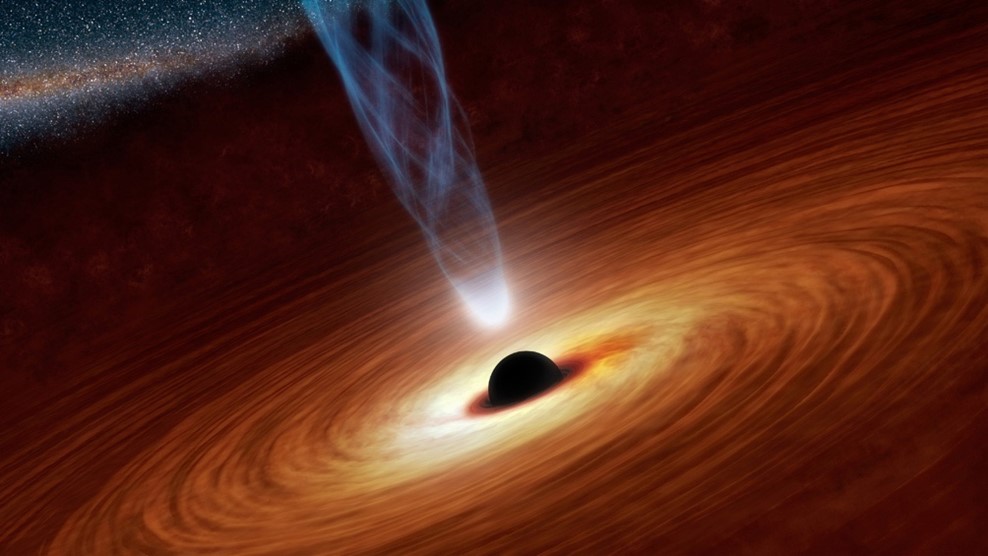
Figure 1: Artist’s impression of a quasar, a supermassive black hole system. Infalling gas forms an accretion disk; in some systems a jet is launched. (Credit: NASA/JPL-Caltech)
Supermassive black holes, millions to billions of times the mass of the Sun, sit in the centers of most galaxies. They grow by pulling in surrounding gas. As gas spirals inward, it forms an accretion disk and can also power a compact region of hot plasma known as a corona (a key source of X-rays). In some systems, a jet that emits strongly at radio wavelengths (Figure 1) also forms. The brightest actively feeding black holes are called quasars. Yet a fundamental puzzle remains: how did some supermassive black holes become so massive so early in cosmic history?
Breaking the “Speed Limit“ of Black Hole Growth
A leading idea for fast early growth is super-Eddington accretion. In the standard theory, radiation produced by infalling matter pushes back on the gas and sets an upper limit, called the Eddington limit, on steady growth. But in special conditions, black holes may temporarily exceed that limit, enabling rapid mass build-up over short cosmic timescales.
To test whether such extreme growth occurs in the early Universe, the team used the Subaru Telescope’s near-infrared spectrograph (MOIRCS) to measure the motion of gas close to a quasar and estimate the black hole’s mass from the Mg II (2800 Å) emission line. As a result, the team discovered a supermassive black hole in the early Universe roughly 12 billion years ago whose accretion rate, inferred from X-ray observations, reaches about 13 times the Eddington limit (Figure 2).
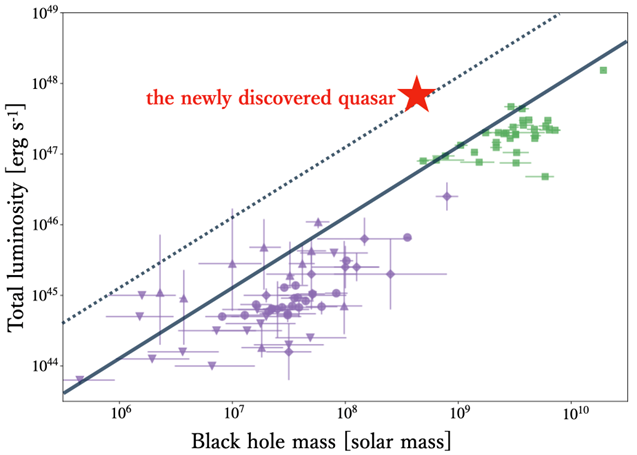
Figure 2: Quasar luminosity (vertical axis), which traces the black hole growth rate, versus black hole mass (horizontal axis), for the newly discovered object (eFEDS J084222.9+001000; red star) and previously observed objects (purple and green symbols). The solid line indicates the theoretical upper limit of the black hole accretion rate (the Eddington limit), while the dashed line indicates gas accretion at ten times this limit. Accurate measurement of the black hole mass, thanks to the Subaru Telescope observations, revealed that this object exhibits super-Eddington accretion, exceeding the Eddington limit. (Credit: NASA/JPL-Caltech)
The Surprise: Bright X-rays and a Powerful Radio Jet
What makes this object especially striking is its multiwavelength behavior. During super-Eddington phases, many models predict that the inner flow structure changes in ways that can reduce the observed X-ray emission, and that jets may be less prominent. However, this quasar shines brightly in both X-rays and radio wavelengths, indicating that it is growing at an extreme rate while simultaneously sustaining an active corona and a powerful jet. This unexpected combination hints at physical mechanisms not yet fully captured by current models of extreme accretion and jet launching.
Catching a Black Hole in Transition After an Accretion Burst
The team proposes that the object may be caught during a short-lived transitional stage—for example, after a sudden burst of inflowing gas. In this picture, a rapid surge in accretion could push the system into a super-Eddington state, while a bright X-ray corona and a strong jet remain simultaneously energized for a limited time before the system settles toward a more typical regime.
If correct, this discovery offers a rare observational window onto time-variable black hole growth in the early Universe—an important step toward understanding how the massive black holes assembled so quickly.
Why This Matters for Galaxy Evolution
The quasar’s strong radio emission implies a jet energetic enough to influence its environment. Such jets can inject energy into the host galaxy, potentially regulating star formation and shaping how galaxies and black holes co-evolve. The link between super-Eddington growth and jet-driven feedback remains poorly understood, and this object provides a new benchmark for testing those ideas in the early Universe.
Lead author Sakiko Obuchi (Waseda University) says:
“This discovery may bring us closer to understanding how supermassive black holes formed so quickly in the early Universe. We want to investigate what powers the unusually strong X-ray and radio emissions, and whether similar objects have been hiding in survey data.”
These results appeared as Obuchi et al. “Discovery of an X-ray Luminous Radio-Loud Quasar at z = 3.4: A Possible Transitional Super-Eddington Phase” in the Astrophysical Journal on January 21, 2026.
This research was supported by Grants-in-Aid for Scientific Research (Grant Nos. 25K01043, 23K13154, 22H00157), the JST FOREST Program (JPMJFR2466), and a research grant from the Inamori Foundation.
The Subaru Telescope is a large optical-infrared telescope operated by the National Astronomical Observatory of Japan, National Institutes of Natural Sciences with the support of the MEXT Project to Promote Large Scientific Frontiers. We are honored and grateful for the opportunity of observing the Universe from Maunakea, which has cultural, historical, and natural significance in Hawai`i.
Reference
Journal:THE ASTROPHYSICAL JOURNAL
Title of original paper:Discovery of an X-Ray Luminous Radio-loud Quasar at z = 3.4: A Possible Transitional Super-Eddington Phase
Latest Article Publication Date:21 January 2026
DOI:https://doi.org/10.3847/1538-4357/ae1d6d