"We aim to become one of Waseda's 'Top Five Oil Fields,' and satisfy the appetites of Waseda students."
Sota Tashiro, 3rd year student, School of Fundamental Science and Engineering
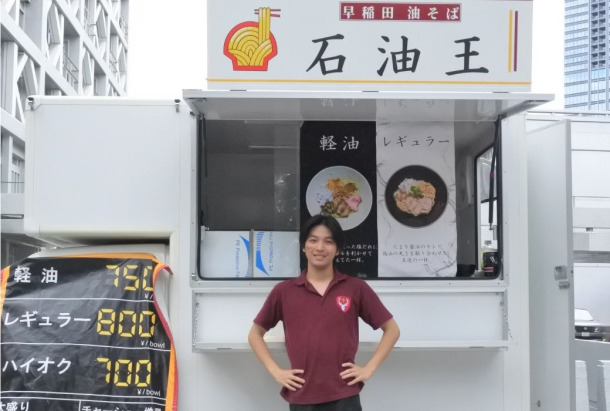
In the courtyard of Nishi-Waseda Campus. Tashiro stands in front of the "Waseda Abura Soba Sekiyu-Oh" food truck.
In May 2026, a food truck resembling a gas station appeared on Nishi-Waseda Campus. It's a specialty abura soba shop called "Waseda Abura Soba Sekiyu-Oh" (hereinafter, "Sekiyu-Oh"). The menu currently consists of two items: "Regular" and "Diesel" (the "High Octane" shown in the photo above is under development), and the concept, inspired by the Waseda students' "refueling" (*) culture, is eye-catching and very Waseda-like. The representative is Sota Tashiro from School of Fundamental Science and Engineering. We spoke to Tashiro, who loves eating out, about his journey to opening the shop, his commitment to taste, and his future goals.
*This is a term used by Waseda University students to refer to eating greasy food such as abura soba around Waseda University.
—What was the reason for you to start your "Sekiyu-Oh" persona?
I love eating delicious food and visit around 600 restaurants a year. This hobby led me to start my own gourmet student club, "Waseda Bishoku Club," in 2025, where I served as the first chairman. The student club has grown to about 150 members since its inception, and I even get help for "Sekiyu-Oh" through my connections.
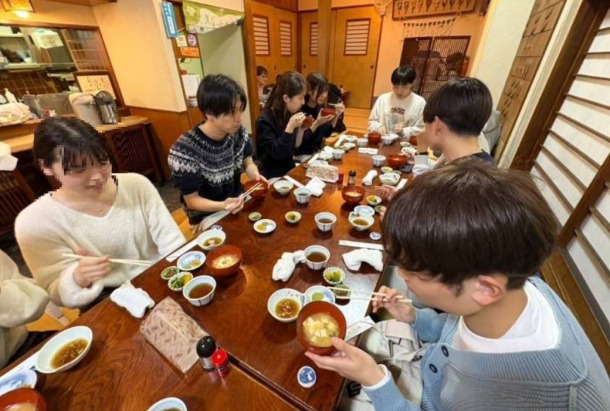
April 2025: A scene from the "Waseda Bishoku Club" welcome party.
I met Taishi Kato (a 3rd-year student in the School of Fundamental Science and Engineering), with whom I co-founded "Sekiyu-Oh," in that student club. Kato loves ramen, and around February 2026, we started working together to open a food truck.
There's only one restaurant serving abura soba near Nishi-Waseda Campus, and it always has a long line, so there aren't any places where you can easily grab abura soba during your lunch break. While there are many abura soba restaurants around Waseda Campus, science and engineering students can't easily get a chance to eat it even if they want to, so I thought there might be a demand for it.
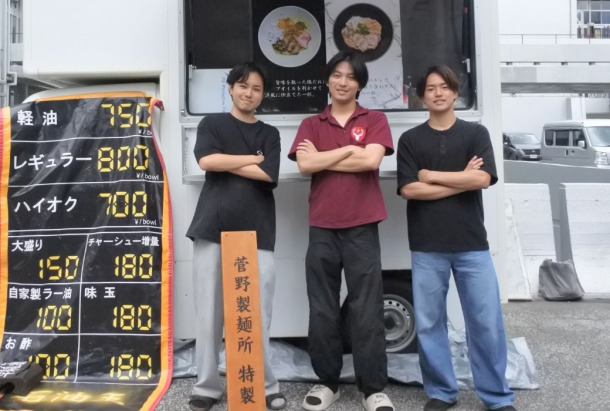
From left to right: Kato, who helped launch the store; Tashiro, the representative; and Fujimura, a part-time employee (2nd year student in the School of Political Science and Economics).
—Were there any difficulties you faced before opening the store?
The most difficult part was setting up the food truck. Initially, we asked the university if we could set up on campus, but they refused. Around March, we changed our search to the area around the university and searched around until we found a parking lot that we wanted to set up in, and we managed to get to the point of having a joint meeting with the real estate agent, the parking lot management company, and the relevant department at the university.
However, the contract and approval process took longer than expected, making it difficult to open a stall again, and I was discouraged once more. I had already rented a food truck for six months, assuming I would be able to open a stall, so I was very anxious about continuing to pay the money without being able to open a stall. In the midst of all this, the staff at the Faculty of Science and Engineering office understood my enthusiasm and allowed me to open a stall at Nishi-Waseda Campus until the end of July. I am truly grateful to all the staff members who granted me permission.
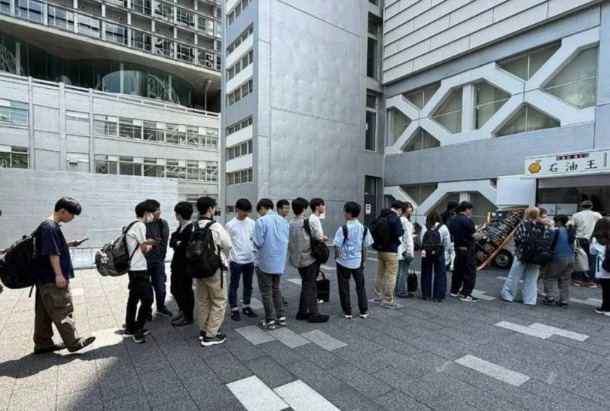
On May 13, 2026, the opening day, a long line formed in front of the food truck. Tashiro said, "I was surprised by the overwhelming response, and I felt that our steady efforts had paid off, and I realized how much science and engineering students had high expectations for abura soba."
—Could you tell us about the concept behind the "Sekiyu-Oh" and the points you've focused on?
Among Waseda University students, there's a unique culture called "refueling," and from that, we thought about creating a food truck modeled after a gas station, and named it "Sekiyu-Oh (oil king) ." While looking around the university area with Kato for a place to set up shop, we came across a gas station and the idea came up to "make the menu include 'regular,' 'diesel,' and 'premium' gasoline," and that's how we got to where we are today.
We are particularly particular about the noodles. Abura soba is often associated with thick noodles, but at "Sekiyu-Oh", we dared to try thin noodles. To bring out the slightly firm, chewy texture, we chose noodles from kannoseimen, which are also used in ramen shops listed in the Michelin Guide. We have special noodles made for "Sekiyu-Oh" delivered daily from deep within Saitama Prefecture. The shipping cost alone is about 5,000 yen, but we are still particular about the noodles. Furthermore, ramen enthusiast Kato experimented with the proportions of the sauce and oil, and the toppings were also chosen with the compatibility with the noodles in mind. After many prototypes, we aimed for a taste that is not too heavy and easy to eat, and we want to deliver a bowl of abura soba that is a little different from the hearty abura soba around Waseda Campus.
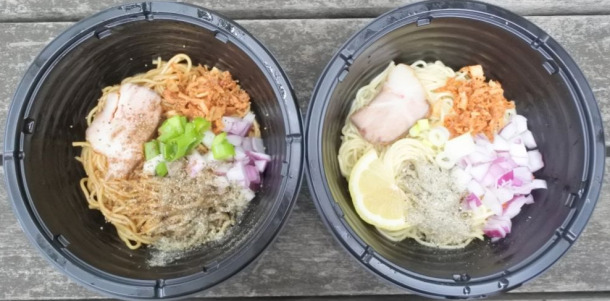
"Regular" 800 yen (left) and "Diesel" 750 yen (right). The regular version is a soy sauce-based broth with seared pork and slow-cooked pork shoulder loin, combined with red onion and garlic chips. The diesel version is a salt-based broth that brings out the umami of dried ingredients, served with anchovies, shredded leeks, and lemon.
—What do you keep in mind when balancing your studies and other activities, and how does it connect to what you're learning at university?
Since we have a shop on campus, we cannot neglect our studies. To ensure that our work does not interfere with the classes of all 15 staff members, including myself, we create a schedule in Excel with everyone's timetables. Even during business hours, we set alarms to ensure that staff members with classes during the third period eat their meals by 1 PM.
In terms of its connection to my studies, the experience I gained in a second-year course called "Career Design" (a subject offered by the School of Fundamental Science and Engineering), where I quantified and graphed cooking and gave a presentation on it, has been very useful. I feel that the perspective of thinking about the balance of umami, saltiness, and sweetness from an engineering standpoint is still relevant to my current approach to creating flavors.
Also, my professor from the research lab came to eat at "Sekiyu-Oh" and said, "It's delicious. Why don't you write a paper on abura soba?" I haven't decided exactly how to research it yet, but I'm interested in research that connects cooking and engineering.
—First of all, why did you choose to attend Waseda University?
One of the reasons I chose Waseda University was because the Department of Expression Engineering in the School of Fundamental Science and Engineering is a department that fuses engineering and art. I think it's appealing because you can study science while also being exposed to humanities fields such as art and expression, allowing you to learn in a way that isn't limited to just one area.
One of the classes where I've truly experienced its appeal is Professor Hirokazu Koreeda 's " Video Production" (a course offered in the School of Fundamental Science and Engineering). In this class, we write and submit scripts, and learn about filmmaking while receiving feedback from the professor. It's really tough having to submit a script almost every week. Sometimes we receive harsh criticism, but I enjoy it because I think it's a learning experience I can't get anywhere else.
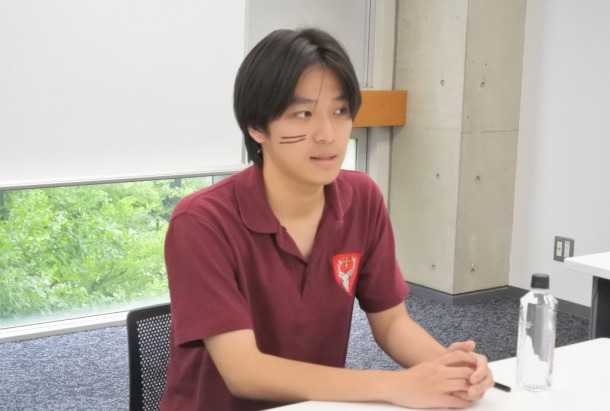
Tashiro, being interviewed, says that he drew two lines on only one cheek as a reminder that he is still only half a professional, following the example of his respected mentor at his part-time job, who has two lines on both cheeks.
-Finally, please tell us your future goals.
First, I want to perfect the new menu item, "High Octane." I'm thinking of a rich and satisfying oil-based ramen with a miso base, pork back fat, and butter on top. And I want to keep the shop open until I graduate. It might be a food truck or something else, but I want "Sekiyu-Oh" to continue to be a place that satisfies the appetites of Waseda University students.
There are several long-established abura soba shops in Waseda. I would be happy if "Sekiyu-Oh" could one day join them, and we could become known as one of the "Five Great Oil Fields." Please come and "refuel" at Nishi-Waseda Campus and enjoy an abura soba experience unlike any other!
No. 932
【Profile】
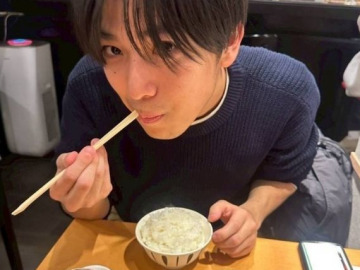
A photo taken at Izumimonten, a famous gyoza restaurant in Gion, Kyoto.
Born in Saitama Prefecture. Graduated from Saitama Prefectural Urawa High School. His hobby is eating out, and he even lines up at popular ramen shops on typhoon days. His recommended Waseda cuisine are "Tempura Takashichi" and "Miso Ramen Chorin".
Instagram: @waseda_sekiyuoh

![[Save version] Map of the four main campuses](https://www.waseda.jp/inst/weekly/assets/uploads/2026/06/110d605cfac40346aad1d2df464a6586-940x705-1-1-610x457.jpg)