"The children gave me the courage to have dreams."
Chika Tenya, 4th year student, School of Law
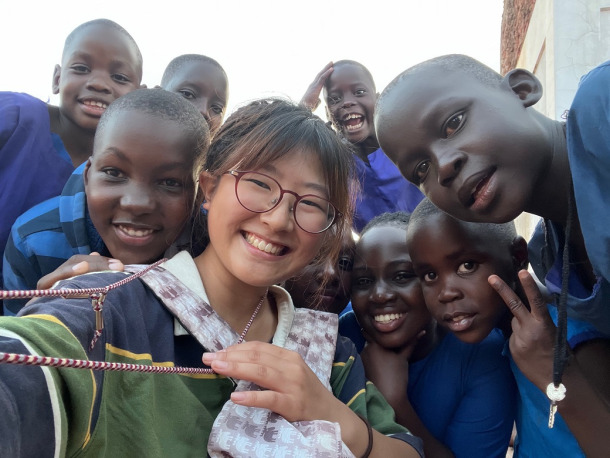
A photo taken with local children on their way home from school when she visited Uganda as a first-grader.
When volunteering in Africa, Tenya encountered in Uganda were energetic children with wonderful smiles who spoke frankly about their dreams. Inspired by her experiences there, Tenya created the picture book "Pearl's Dream," featuring children as the main characters. After crowdfunding, she actually delivered the picture book to the region. We asked her about the background of her activities, the thoughts she put into the picture book, and how her own values have changed.
—Could you tell us what prompted you to visit Uganda, and what were your impressions when you first visited the country?
It all started when I participated in a global volunteer program run by the AIESEC Waseda University Committee (an officially recognized student club) during my first year of university. I was anxious because I had no prior experience traveling abroad, but I had a strong desire to "go to an unknown place," so I chose Uganda as my destination. Also, the Africa I had seen on the news only seemed to show tragic situations, so I wanted to see with my own eyes what life was actually like there. The moment I stepped onto the island, I was enveloped in the smell of red earth and the air filled with swirling sand, and I remember being surprised that "borders really can be crossed," while at the same time feeling excited about the unknown experiences that were about to begin.
During my six weeks in Uganda, I participated in various volunteer activities at the local school, Happy Times Childcare Initiatives, teaching origami and math, conducting sex education classes, and running litter cleanup projects. The children were always smiling and full of energy, the town was filled with music and dance, and it was a warm and vibrant place. Seeing people enjoying their daily lives even in an environment that wasn't exactly materially abundant, my impression of Africa changed dramatically and became much brighter.
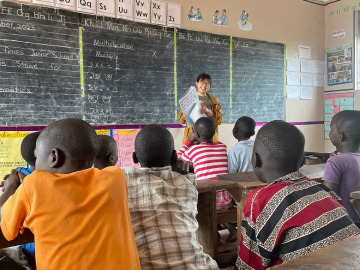
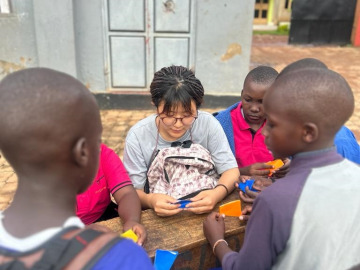
Photo on the left: A scene from a 3rd-4th grade elementary school class.
Photo on the right: Children making origami. They are trying their best to make the most difficult dragon, going through trial and error.
—Why did you create a picture book? And what thoughts did you put into it?
It all started when I met two Japanese university students there and we talked about wanting to create a picture book with children as the main characters. There was a class where the children drew pictures of their future dreams, and we got excited about the idea of preserving those dreams in a picture book. So, the three of us formed a group called Kilabo and decided to create a picture book.
These children are usually full of energy, but there were times when they seemed to feel inferior about their roots, which made me sad. A big reason for this project was that I wanted to leave a tangible message for these Ugandan children that "you are a source of courage for us."
I chose picture books as the medium because I was drawn to their ability to leave a lasting visual impression and their tangible form on paper. Many children and adults in the area cannot read, so I felt that pictures were necessary to convey my message. I also thought that using illustrations instead of photographs would allow me to focus on the children's smiles and expressions without being constrained by negative images of poverty.
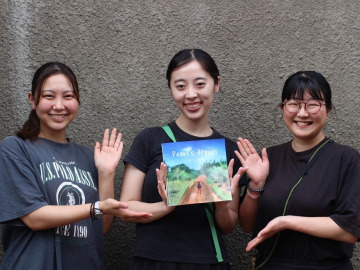
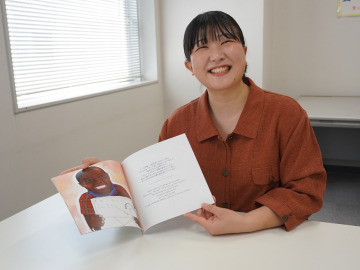
Photo on the left: Kilabo members. Kilabo means "gift" in Luganda, the local language of Uganda, and it is a nickname given to Tenya by the local children.
Photo on the right: Tenya showing us the picture book she created. She couldn't stop talking about the picture book, which was filled with her meticulous attention to detail.
—How did you go about creating the picture book and running the crowdfunding campaign?
I was in charge of the illustrations for the picture book, and the most challenging part was carefully depicting the children's expressions and facial features. I felt that simply drawing Japanese faces and changing the skin tone wouldn't capture their true appearance, so I studied the bone structure, eye shape, and lip features using photographs taken on location as references, and redrew them many times. I also struggled with the story structure, and initially I considered a plot where the protagonist, who can't find their dream, finds it. However, through interacting with the children, I realized that "the children already have dreams," so I opted for a simpler form, depicting their everyday lives as they are, with the topic of dreams naturally leading into the story.
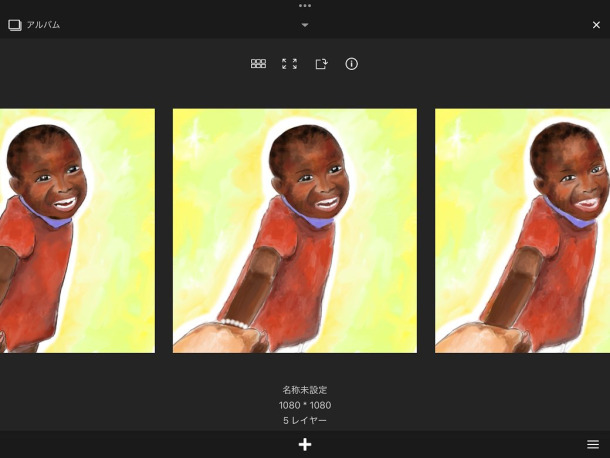
This is a screenshot of the process of creating the face of Pearl, the main character of the picture book. The artist said they struggled to draw a face that looked like the same person as the one they wanted.
In terms of funding, we conducted crowdfunding to raise funds for producing the picture book and delivering it to Uganda. We thought it would also be an opportunity to let people in Japan know about our activities. In the end, we received support of over 800,000 yen from more than 100 people. We were particularly impressed by the comments we received from readers, such as "It reminded me of my childhood" and "It made me want to have dreams too." We realized that our activities are supported by many people, and it was a great encouragement to us. What makes us happiest is that through this activity, we were able to help people in Japan feel closer to Uganda.
—When you actually delivered the picture books to Uganda, what kind of reactions did the children have?
When we delivered the picture books to Uganda in March 2026, the children were overjoyed to see that the characters in the books were wearing the same uniforms as them. I was struck by how they kept turning the pages, saying, "These are our uniforms!" Some even exclaimed, "A gift (Kilabo) has arrived!" I will never forget the sparkle in the children's eyes when they opened the finished book and realized they were the main characters.
Ultimately, the local principal held a school-wide assembly, and we decided to hold a read-aloud session in the library. I was truly moved when dozens of children gathered and listened intently to the picture book. Furthermore, the principal said, "Money may disappear, but books remain as knowledge," and we decided to set aside time for reading books once a week. The library had many books, but they were hardly being used, so I was happy that this gave the children an opportunity to interact with books. I had been working with the desire to "turn my ideas into reality," and I feel that, in the end, my activities have been meaningful for the children and the school.
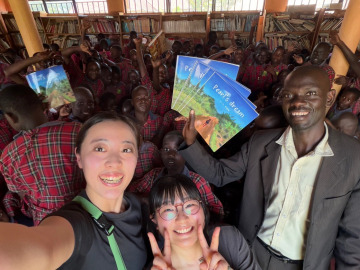
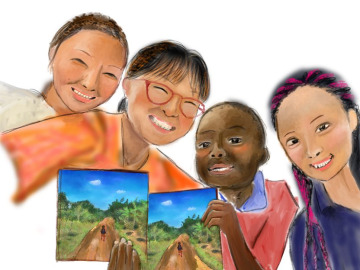
Photo on the left: A scene from a picture book reading session. The person on the right is the local school principal.
Photo on the right: Three Kilabo members and local children are depicted on the back cover of the picture book.
—How have your values changed through your activities?
Living in Uganda made me realize that I can survive anywhere. Experiencing an environment where water wasn't readily available and having to hand-wash clothes made me re-evaluate things I had taken for granted in Japan. Also, before delivering picture books to Uganda, I was looking for a job in Japan, but after returning to Japan, I realized that I wanted to prioritize what I truly wanted to do more than just getting a job with good pay and other conditions.
At the end of the picture book, there's a question: "What is your dream?" Through this book, I rediscovered my own dream: to become a lawyer. In fact, when I was reading the book aloud in Uganda, I declared in front of the entire student body, "I want to be a lawyer." Then one of the students said, "Then I'll become a lawyer too." Hearing that, I felt there was no turning back. Currently, I'm studying hard to get into law school (laughs).
-- Do you have a message for students who want to try something new?
I believe that if you have even the slightest desire to try something, the most important thing is to just jump in. My experience in Uganda and my picture book creation both started out of curiosity—they just seemed interesting. When you actually take action, you'll find encounters and changes in values that you never imagined. I myself declared my dreams to the children of Uganda, and in turn, they gave me the courage to dream. I want to continue to cherish my own dreams and keep challenging myself.
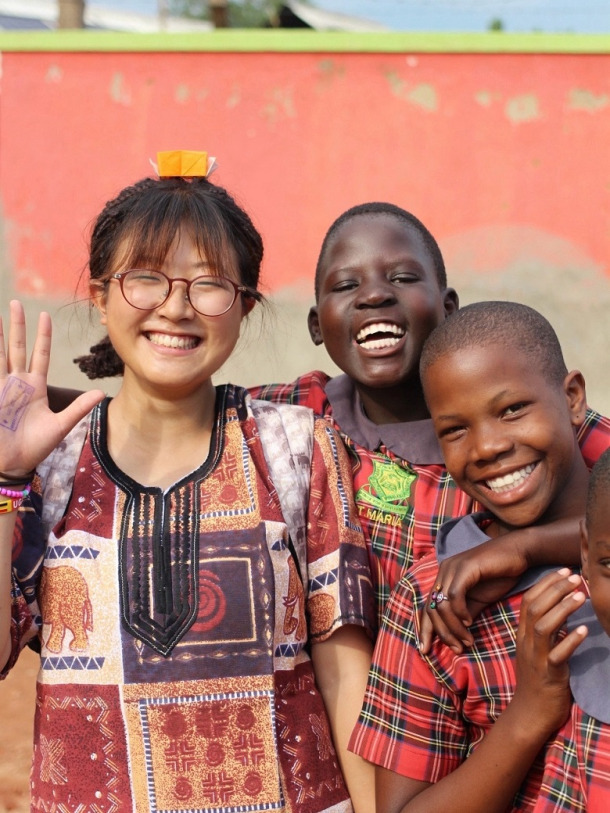
This is one of Tenya's favorite photos, showing her with origami folded by children during school recess on her head. The clothes she's wearing were something she fell in love with and bought locally.
930th
Interview and text by: Waseda Weekly Reporter
Yuichiro Terui, 2nd year student School of Commerce
【profile】
Originally from Nagano Prefecture, she graduated from Nagano High School in Nagano Prefecture. She studied criminal law and other subjects in Professor Yoshihiro Matsubara 's (Faculty of Law) seminar. Her favorite Waseda University Waseda cuisine is "Shin Beijing," which she says is cheap and delicious. Currently, she works at the student-run cafe "Shiru Cafe" and is also a member of the Waseda University Taido Association (an officially recognized student club), where she is diligently practicing.
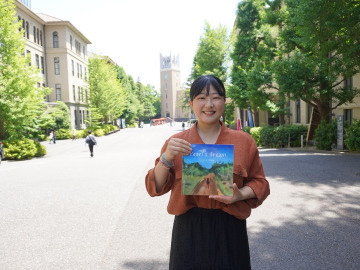
Bringing the picture book Tenya created

![[Save version] Map of the four main campuses](https://www.waseda.jp/inst/weekly/assets/uploads/2026/06/110d605cfac40346aad1d2df464a6586-940x705-1-1-610x457.jpg)