Student Counseling Center, Clinical Psychologist: Kashinoki
Decide specifically what to do and when.
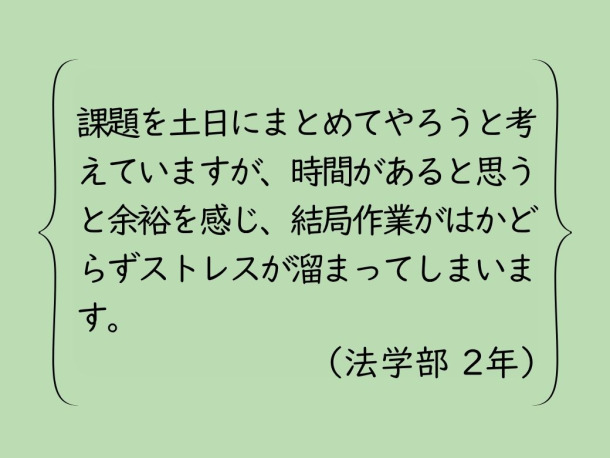
When you have multiple assignments or reports, it's natural to think, "I'll tackle them all on weekends or days off," because it's difficult to find a block of time on class days. However, having plenty of time can make you feel complacent, thinking "it's still okay," and you might end up not getting started on the work, or you might get distracted by watching videos or doing other things. As a result, you might find yourself frantically working on assignments right before the deadline.

This is likely because feeling like you have plenty of time reduces the sense of urgency to "get it done," leading to procrastination. So, what can be done to combat this? Here are two methods.
Create an opportunity to start the work.
Instead of vague plans like "I'll work on my assignments on the weekend," decide specifically what you'll do, where, and when, such as "I'll start working on my report at 9am on Saturday" or "I'll study something at a cafe at 10am after breakfast." It's also a good idea to decide on a completion time if possible. Imagine you're your own personal secretary and schedule your activities accordingly.

When planning your schedule, it's recommended to use a vertical-type schedule book or app that displays the time of day on a vertical axis, as this makes it easier to see when you have free time. If you can't stick to your schedule, there's no need to blame yourself. You can simply decide to do it again at a later date.
Motivation is born from taking action.
This idea is called "Zunin's Law," and it states that the first four minutes of starting something are crucial.
When you start working, your brain becomes more active and you're more likely to concentrate. So, instead of tackling a big task like "finishing a report," try breaking it down into smaller, easier tasks such as "turning on the computer," "creating a file name," "making a bulleted list of ideas," or "opening reference materials." As you do these tasks, your motivation will naturally kick in, and before you know it, you might find yourself concentrating for 30 minutes or even an hour.

When preparing for reports, assignments, or exams, decide specifically what you will do and when, and start with something easy to tackle. Small actions can be the catalyst that helps you successfully manage assignments and exams.
[References]
"I've Stopped My Procrastination Habit!" by Misuzu Nakajima (Daiwa Shobo, 2025)
"Mini Habits" by Stephen Guise, translated by Miwa Taguchi (Diamond, 2017)

![[Save version] Map of the four main campuses](https://www.waseda.jp/inst/weekly/assets/uploads/2026/06/110d605cfac40346aad1d2df464a6586-940x705-1-1-610x457.jpg)