Yuichi Hakamada, Research Associate Waseda University History Museum
In 1905, during the final days of the Qing Dynasty, a sudden boom in students studying in Japan occurred, and Waseda University established an educational institution for students from the Qing Dynasty. Today, Waseda University is one of the leading destinations for international students, but its roots can be said to date back 120 years.
▼Click here to read about the background to the establishment of the Qing Dynasty International Students Department
The Qing Dynasty International Students Department closed in 1910, but in its limited history of just five years, it is estimated that over 2,000 students studied there. In particular, the school welcomed as many as 762 students in the first year. For these students, studying abroad was their first experience. For this reason, rather than the Western powers, they were recommended to study in Japan, which was relatively close in distance and culture and also used Chinese characters. However, they still faced various cultural gaps. One thing that bothered them the most was food.
A pioneer of Chinese cuisine
"Japanese food is extremely simple, with one soup and one dish, and the taste is very bland. Dinner is soup and eggs, and rice served in a small box. When I tried it for the first time,I didn't like it. (※)"
(※) Quoted from "Diary of a Chinese Student Studying in Japan" (1986) translated by Keishu Sanetou and Saburo Sato
This is an impression of the food he had on his first day in Japan, written in his diary by a student named Huang Zunsan (graduated from the Special Preparatory Course of the Qing Dynasty International Students Department in 1908). Compared to Chinese cuisine, which is centered on meat, strongly flavored, and uses a lot of oil, Japanese food is lightly seasoned and focuses on fish and vegetables. Above all, Chinese people were afraid of eating raw fish. Huang spent the next seven years living in Japan, but he seems to have had trouble with food until the very end. It is said that the meals served in boarding houses that catered to students were generally simple, to the point that even Japanese students were put off by them.
As if to escape the unfamiliar Japanese food, international students began to frequent the Chinese restaurants that were beginning to proliferate in Kanda and Jimbocho. In the late Meiji period, Chinese food was just beginning to become known in Japan, but it is said that its popularity began to grow due to the needs of international students. Waseda University must have been well aware of the needs of these international students. At the dormitory for the Qing Dynasty International Students Department, authentic Chinese cuisine was provided for all three meals - breakfast, lunch, and dinner. The menu from that time still remains today.
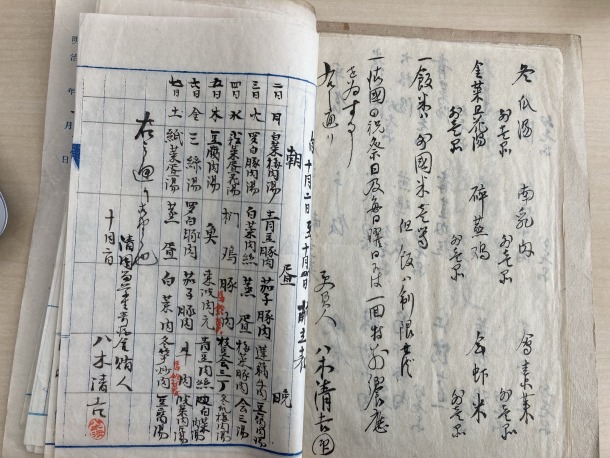
"1905 Menu List for Students Studying in China at the Dormitory" (Collection of the Historical Museum). This is a list of menus served at the dormitory from October 1905 to January of the following year. This document was discovered in the attic of the former Building 3. What was merely a bundle of documents at the time has become a valuable historical document today.
Breakfast is usually soup, and lunch and dinner are usually stir-fried pork, beef, or chicken with two side dishes. On other days, you can also see the names of red braised fish (stewed in soy sauce) and chao koso hua (fried pork kidney). They eat pretty good food. It is also said that special menus were prepared for Chinese holidays (such as the Lunar New Year).
At that time, it must have been difficult to hire a professional chef and obtain ingredients. Nevertheless, Waseda tried to create an environment that was as stress-free as possible for the students. In addition to meals, it is known that recreational activities such as field trips and school trips were frequently planned.
Money and illness
However, such thorough care costs money. Rent in the dormitory, including meals, was 12 yen 50 sen per month. This was equivalent to the starting salary of an elementary school Faculty or police officer at the time. Furthermore, tuition fees for the Qing Dynasty International Students Department were 5 yen for the entrance fee, 36 yen for the preparatory course and 48 yen for the regular course. This compares to the same Waseda's 2 yen entrance fee, 22 yen for the annual tuition fee for the professional department and 2 yen entrance fee, 33 yen for the university department, showing that they were charging a lot more from the international students.
In fact, Chinese students studying abroad at this time were relatively well off financially. Huang, mentioned earlier, wrote in his diary that he had heard that a doctor from a middle-class Japanese family (living with his wife and mother) lived on 24 yen a month, but that he himself, who was given 33 yen a month by the Chinese authorities, was "several times more luxurious." It was only because of these financial circumstances that the students were able to visit Chinese restaurants, which were considered high-end establishments at the time.
However, although they were certainly financially comfortable, they were not living a carefree life. According to Huang's diary, of his monthly expenditure of 28 yen, 5 yen was spent on medical expenses. This was more than one month's tuition fees. Many of the international students suffered from both physical and mental illnesses due to the unfamiliar environment. There seem to be particularly many records of them complaining of mental disorders (nervous breakdown).
For the Qing Dynasty, sending its citizens to study and live in a foreign land was a first for the nation. The first generation of students did not have the systems and organizations to protect international students that exist today, and they did not have many senior compatriots to rely on. Studying abroad has always been difficult for anyone.
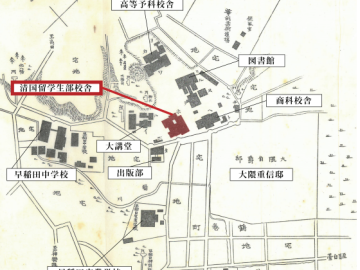
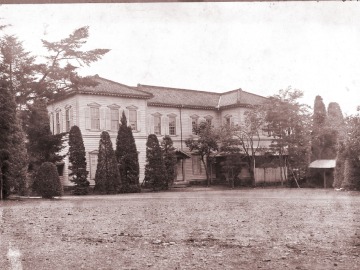
Image on the left: "Waseda University campus map from 1907" (created from Volume 1 of "Waseda University 150-Year History"). The school building of The Qing Dynasty International Students Department was located near the current Building No. 2, and the dormitory was located near the current Building No. 121.
Right: "The Qing Dynasty International Students Department Building." The building used for the school is a wooden Western-style building that has been in use since the founding of Tokyo Senmon Gakko (the predecessor of Waseda University). It was later moved to Higashifushimi and became "Green House It was later demolished due to deterioration, but has now been restored to its new location as the Karuizawa Seminar House.


![[Save version] Map of the four main campuses](https://www.waseda.jp/inst/weekly/assets/uploads/2026/06/110d605cfac40346aad1d2df464a6586-940x705-1-1-610x457.jpg)