Fall Semester 2021 Waseda University Presidential Teaching Award
Subject:Introduction to Political Analysis 01
KOHNO Masaru
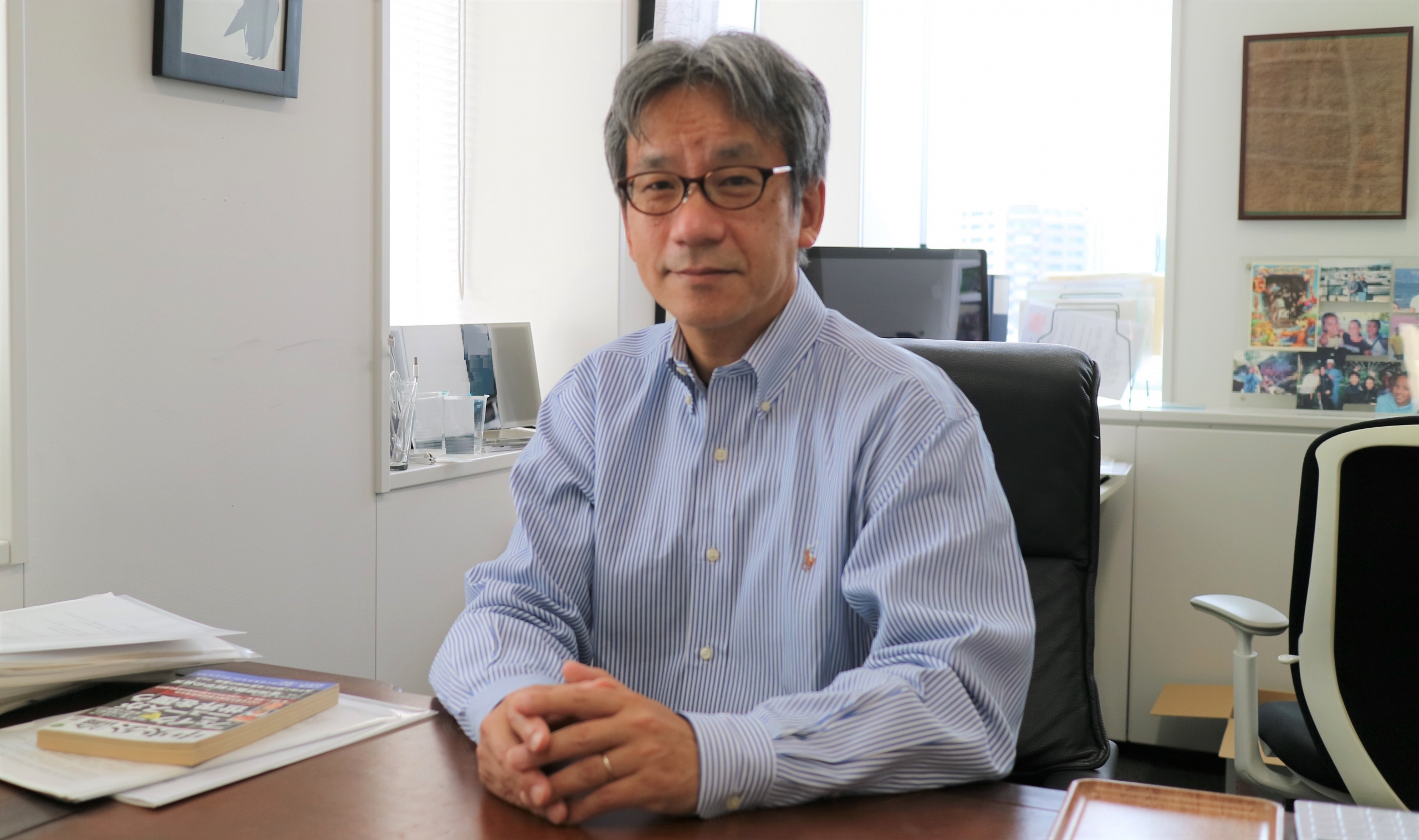 At universities in Canada and the United States, the standard style of introductory courses for first year students is to combine a large-classroom lecture with a small-group discussion session, so as to deepen their understanding of the academic contents. To make this style work in an online environment, Professor Kohno incorporated several measures. He administered, for example, weekly short-tests on the content of the lectures. He also made students mutually evaluate each other’s performance during class discussions. With these techniques, Professor Kohno conducted the class in a way that advanced students’ basic knowledge and understanding.
Have students nominate the best performer to stimulate active discussions
This is one of the mandatory first-year courses in EDESSA, the English Degree Program of the School of Political Science and Economics. It is organized as an introduction to political analysis, providing an overview of the major theories and important empirical findings in political science.
Indeed, Professor Kohno has been regularly teaching a Japanese course titled “Seiji Bunseki Nyumon” parallel to this course with nearly the same content, which he himself had designed many years ago. Professor Kohno was asked to fill in for a faculty member on sabbatical leave, who usually teaches this English program version of it, for which he won the award this time. The North-American style of combining lectures and discussions was also used in the Japanese course. However, because of COVID-19 pandemic, Professor Kohno had to conduct this English course entirely online for AY2021, in consideration of overseas students who could not enter Japan. The biggest challenge was how to motivate students to be actively involved in the discussions in a non-face-to-face setting.
A new scheme Professor Kohno introduced is a system of peer evaluation among students. “Each week, I asked students to send me an email nominating the best performer in discussion session. I had promised that those students with most frequent nominations throughout the semester would be awarded bonus points, which would to be added to their final grade,” explained Professor Kohno. In order to prevent friends from casually nominating each other, Professor Kohno requested students to also explain the reason why they thought that particular student performed the best. “At online sessions, almost all the students had their cameras turned off, so we were always facing a completely black screen, but I think this system worked well in carrying out active discussion sessions, contrary to my initial pessimism,” observed Professor Kohno.
Another measure by which Professor Kohno tried to get students to be active in weekly small-group sessions was to let them know the discussion topics in advance. “The number of times students commented, as well as the content of their comments, are reflected in their grade. Because they are given the topics in advance, some students in fact prepare very well, reading out what they must have written down beforehand. I must also add that these students are first-years, so they are very keen to learn,” said Professor Kohno.
Administering short-tests and motivating students to watch on-demand lectures
During the discussion sessions, students were divided into three groups; two graduate students, together with Professor Kohno, served as discussion leaders. “I don’t think the professors should lead the discussions in small group sessions. There are questions and opinions the students cannot ask or say to the professors directly but they can to the TAs who are closer to them in terms of their age difference. But, for this class, only two TAs were assigned; so I also had to take part as a discussion leader. Ideally, I believe, discussion sessions should be delegated to TAs, and the professors should concentrate on responding to various questions that come up.”
The groups were divided so that Japanese and foreign students were evenly dispersed, and the three discussion leaders rotated between the groups. “I am very grateful to the TAs. Without their great contribution to this class, I probably would not have won this award”, thanked Professor Kohno.
One thing that Professor Kohno took a great care was to avoid turning discussion into a platform for students to display their personal thoughts and convictions or to endorse any partisan/factional propaganda. “I told the students clearly from the very beginning that this is not a class of politics, but this is a class of political science. They were told that, instead of pitting one ideological principle against another, the conversation had to be scientific and evidence-based,” he emphasized.
It is also important to have backup topics for the class discussions in case the discussions appear to become stalled. As Professor Kohno explained, “In addition to the two or three questions that I posted in advance, there are several questions I have in the stock. I’ll pull up one of those topics and present it, asking ‘What do you think about this?’ ‘What do you think about that?’.”
Students were expected to view the on-demand lecture videos prior to attending the weekly discussion sessions. The videos and related materials were uploaded at least 7 days prior to the respective discussion session, and students were regarded as having “attended” the lecture in a given week if they viewed 95% or more of the videos. In consideration of students who were overseas and may have poor Wi-Fi conditions, the videos were broken up into a series of short clips.
At the beginning of the discussion sessions, a short test was administered on Moodle to check students’ understanding of the lecture videos. Students were allowed to consult with the reading materials and their own notes, but were of course forbidden to consult with any other student while taking the test. “Just looking at the Moodle record as to whether the students watched the videos or not, it is impossible to know how seriously the students were paying attention. The short test, even if it is just for five or ten minutes, is so important in motivating students to listen to the lecture and read the material prior to the discussion session,” explained Professor Kohno.
Helping students acquire the ability to choose their own perspective out of the many and various possibilities.
Since this course is for students who have just entered the university, Professor Kohno strove to make it enjoyable and easy to understand. “I tried to use as much familiar examples as possible when explaining difficult concepts and complex models. I believe that a positive experience of taking an interesting course in their early year will make the students even more interested in political science,” he explained.
What Professor Kohno wished to convey to students, not only in this class but in teaching political science generally, is that “there are many different perspectives” to view the same phenomenon. “I always say to the students that there is no right answer in political science and that there are a variety of views. Granting this, what is furthermore important is for the students to develop their own understanding of whether interpretations are drawn logically, whether a particular view is more persuasive than the others, and why they themselves think that particular view is more persuasive than the others. In class I teach a variety of ideas in political science, but I really want the students to be able to judge for themselves which of those ideas are the valid ones,” says Professor Kohno.
In past Japanese versions of the class, students have commented that the class was “shocking,” “I felt like I learned something completely different from what I had learned before,” and “the class laid the foundation for my studies in political science”. Regarding this English class as well, he was happy to hear former students he saw on campus the following year say, “that class was very helpful for me”.
Professor Kohno feels that the cooperation of those around him was a major factor in his winning the award. “The staff members at the department are very helpful. And I think I was lucky and am grateful that I was able to consult closely with the TAs, as I had to do my best as a pinch hitter,” commented Professor Kohno.