WasedaX
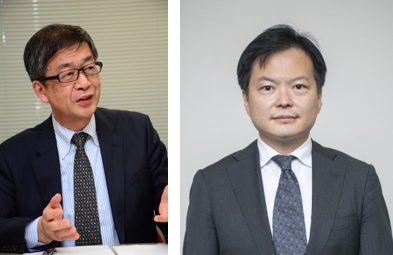
ice President of Academic Affairs and Personnel Affairs Suga and Professor Aoki
(New Course)Property Law in a Globalizing Economy: Diversity or Integration?
Since September 2015, Waseda University has been using edX (founded by Harvard University and MIT in the U.S.), a provider of Massive Open Online Courses (MOOC), to deliver a wide variety of courses to a worldwide audience.
Professor Noriyuki Aoki, Faculty of Law, has been teaching the course “Property Law in a Globalizing Economy: Diversity or Integration?” since March 2022. Vice President Koichi Suga spoke with Prof. Aoki about what he hopes to convey through this course.
Went into comparative civil law for the historical and theoretical discussions
Vice President Suga: How did you come to specialize in comparative civil law, particularly property law, with a focus on American law?
Prof. Aoki: Though I am a graduate of the School of Commerce here at Waseda University, during my undergraduate studies, I came to feel that I wanted to engage in discussions that are based on words, such as history and theory, rather than discussions based on statistics and numbers. Therefore, I went on to graduate school at the Graduate School of Law. I chose to specialize in civil law because I wanted to analyze the structure of industries, markets, and transactions from a legal perspective while taking into account their histories. The Japanese Civil Code was originally based on French law, and was remade in the style of German law. Alas, German law is the main historical and theoretical approach that was actively discussed in earlier times. After, research into French law progressed as well, but the influence of German law remains strong to this day. On the other hand, I became interested in American law because though it has had a significant impact on transcations in Japan, it has remain little studied. This course takes this historical and theoretical approach, comparing Germany, the U.S., and Japan and also examining specific rules.
Vice President Suga: In comparing German, American, and Japanese laws, what are some particular points that you want people to take note?
Prof. Aoki: Since law is a world based on language, the legal system of each country is closely linked to the language of that country. Even for the same civil law rule, the concept of that rule used in English Anglo-American law is often different from that of continental law, the latter which Japan has inherited. Therefore, when discussing in English, we must start contemplating from those conceptual differences. I would like learners to pay attention to those differences, but that is not all. I would like learners to look at the fact that rules are often oriented and operate in the same direction, when we view them on the level of specific transactional phenomena. The rules of civil law, while passed down from ancient Roman law, followed several divergent paths in Western society since the Middle Ages, with each path creating its own concepts. As transactions became more internationalized, these paths were adjusted, and they eventually came to have similar concepts. Still, differences remain due to historical circumstances, as there is some tensions due to the fact that progress has not gone as far as to eliminate those differences. The course incorporates historical backgrounds as the premise of such diversity, and I think it will be enjoyable for learners to see this larger structure.
Learn the differences between Japan, Germany, and the U.S. based on your own country’s way of thinking, and progress to the level where you can enjoy expert talks
Vice President Suga: What would you like to promote about this course?
Prof. Aoki: This course is an intermediate level course for students who have heard about property law at least once, but have never done comparative study at the university level. To make students interested and enjoy comparative study, we focus and examine models of the sale and purchase of real property and movable property, as well as the creation of collateral of these two types of property.
As I mentioned earlier, legal terms are strongly tied up to the legal system of a country. Therefore, it is inherently difficult to explain the operation of rules in English of legal systems other than the Anglo-American legal system. However, if we look at the transactions that we used as models, we can see commonalities that can serve as a basis for comparison. For example, with the sale and purchase of real property, all jurisdictions operate their rules using three concepts: the sales contract, the declaration of intent to transfer ownership, and registration. The specific content of the rules as to the degree to which these requirements must be completed before ownership is transferred varies from jurisdiction to jurisdiction, but there is a common base. In this course, there will be several questions in the form of Core Questions, which are multiple choice Q&A questions on the model cases that take into account this common base. The course will have learners learn how the answer to the same core questions differ when answered using the civil laws of the U.S., Germany, and Japan, and will have learners reflect on the theoretical and historical background of these differences.
The last chapter of each of the four sessions includes interviews with leading U.S. and German experts in their respective fields. This will give learners a chance to listen to the authentic voices of lawyers from different countries concerning the theoretical and historical backgrounds. This is advanced content that even professionals would find challenging to listen to, but the first half of the course is designed to nurture in you the ability to enjoy this kind of content. The exam for credit only covers the material before the interview, I hope this interview will give learners a real taste of comparative law as an added treat.
Using Japan’s strength in objective analysis as a foothold for international discussions.
Vice President Suga: What do you think is the significance of communicating to the world through edx?
Prof. Aoki: Normally, researchers write papers in English, which they publish to the world, but the world of law is completely different. It is normal in any country to write papers in one’s native language and publish them in domestic conferences. When I thought about how to have international discussions in such a very domestic situation, I thought of comparative law as one possiblity.
This course will be conducted in English, but due to the nature of law’s close relationship with language, it is necessary for one to be familiar with Anglo-American law if comparative law is to be discussed in English. In that sense, as a researcher with a background in Anglo-American law, this is a challenging task. It is one of the strengths of Japanese civil law scholarship to be able to objectively analyze the legal systems of each country, including their historical backgrounds. This is due to the historical nature of Japanese civil law scholarship, where comparative legal studies have flourished. In this sense, I believe that it is very valuable that we are able to communicate our studies from Japan, and I hope that this course will serve as a foothold for international discussions.
Vice President Suga: It is not just about communicating in English, but also about getting people to know the significance of studying in Japan, where one can gain a deeper understanding of the cultural differences between countries.
Prof. Aoki: Yes. Waseda University’s Graduate School of Law offers an English-language LL.M. program in Asian Economic Integration and Law. It is a one-year master’s program in comparative law that focuses on the international integration of markets that are oscillating between the global and the local. We accept students not only from East Asia, but also from Europe, North and South America, Southeast Asia, Africa, and all over the world. That, too, is exactly what we are aiming for.
講座概要および登録はこちら
Property Law in a Globalizing Economy: Diversity or Integration? | edX