
- NEWS
- 日本人就労者における24時間行動(睡眠・座位行動・身体活動)と社会人口学的・健康関連要因との関連/ Association of sociodemographic and health-related factors with 24-hour movement behaviors in Japanese adults
日本人就労者における24時間行動(睡眠・座位行動・身体活動)と社会人口学的・健康関連要因との関連/ Association of sociodemographic and health-related factors with 24-hour movement behaviors in Japanese adults
- Posted
- Wed, 25 Nov 2026
概要/Abstract
本研究では、日本人就労者を対象に、社会人口統計学的要因および健康関連要因と、24時間の身体活動構成(睡眠、座位行動、低強度身体活動、中高強度身体活動を含む)との関連性を調査した。20~59歳の日本人成人2,718名を対象としたオンライン調査データを用い、組成データ分析(CoDA)*1を適用した。その結果、性別、年齢層、婚姻状況、学歴、世帯収入、職業活動の種類および飲酒習慣が、日々の身体活動と有意に関連していることが明らかになった。男性、高所得者、肉体労働者、および毎日飲酒する人は、中高強度身体活動の相対的な割合が高かった。逆に、デスクワーカー、未婚者および高学歴者は、座位時間が長く低強度身体活動が少なかった。これらの知見は、日本の労働年齢人口を対象とした健康増進戦略を策定する際、具体的な社会的・職業的状況を考慮することの重要性を浮き彫りにしている。
This study investigated associations between sociodemographic and health-related factors and 24-hour movement behavior compositions (including sleep, sedentary behavior [SB], light physical activity [LPA], and moderate-to-vigorous physical activity [MVPA]) among Japanese working-age adults. Using compositional data analysis (CoDA)*1 on online survey data from 2,718 Japanese adults aged 20–59, we found that sex, age group, marital status, education level, household income, occupational activity type, and alcohol consumption were significantly associated with daily movement profiles. Men, higher-income individuals, manual labourers, and daily drinkers showed higher relative proportions of MVPA. Conversely, desk-based workers, unmarried individuals, and those with higher education showed higher SB and lower LPA. These findings underscore the importance of considering specific social and occupational contexts when developing health promotion strategies for Japan’s working-age population.
これまでの研究で分かっていたこと/Research Background
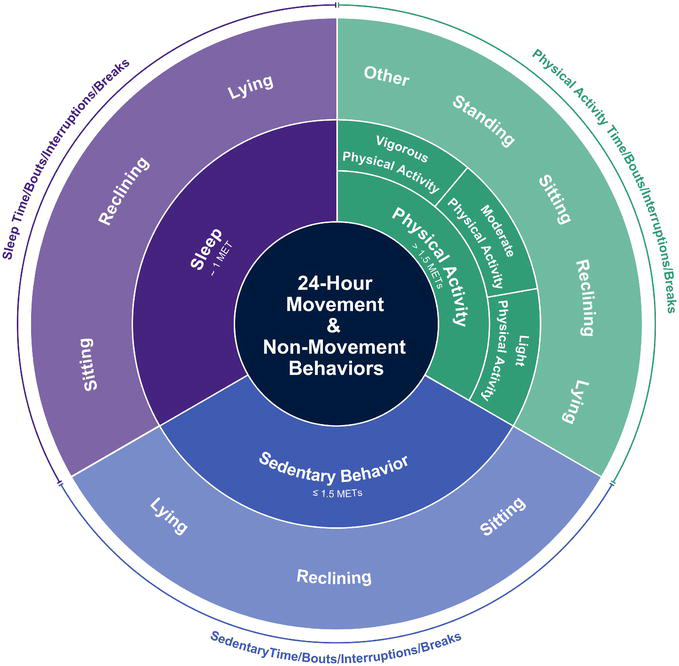
睡眠、座位行動、低強度身体活動、中高強度身体活動に費やされる1日の時間は有限であり、相互に依存しているため、ある行動が増えると、必然的に別の行動は減少することになる。身体活動が健康リスクを低減することは広く認められている一方で、長時間の座位行動や睡眠不足は健康に悪影響を及ぼす。国際的な研究では日々の行動が調査されてきたが、日本には独特な労働文化、長時間労働、伝統的な性役割分担があるため、諸外国の研究結果を直接一般化することは難しい。本研究では、日本において24時間行動パターンが社会人口統計学的要因や健康関連要因によってどのように異なるかを、組成データ解析(CoDA)を用いて初めて検証したものである。
Daily time use across sleep, SB, LPA, and MVPA is finite and mutually dependent, meaning an increase in one behaviour inevitably decreases another. While physical activity is well established as reducing health risks, prolonged SB and poor sleep are detrimental. Although international studies have explored daily behaviors, findings from other countries cannot be directly generalized to Japan because of its distinct occupational culture, long working hours, and traditional gender roles. This study provides the first CoDA-based examination of how 24-hour movement behaviours differ across sociodemographic and health-related factors in Japan.
今回の研究で新たに実現しようとしたこと、明らかになったこと/Findings
全国規模のオンライン調査に組成データ解析を適用した本研究により、男性では中高強度身体活動に費やす時間の相対的な割合が高く、50~59歳の成人はより若い年齢層に比べて相対的な座位行動の割合が高いことが明らかになった。また、職業活動の種類が最も強い要因として浮上した。すなわち、デスクワーカーは座位行動の時間が有意に長く、肉体労働者は中高強度身体活動が中心となる活動パターンを示した。さらに、未婚者や大学院卒の者は、相対的に座位行動の時間が長く、低強度身体活動時間が短いという特徴を有していた。一方、世帯収入や1日あたりの飲酒量が多いことは、相対的な中高強度身体活動の割合が高くなることが分かった。
Using a CoDA approach on a nationwide online survey, this study found that men spent a higher relative proportion of time in MVPA, and adults aged 50–59 exhibited higher relative SB than younger individuals. Occupational activity type emerged as the strongest factor: desk-based workers spent significantly more time in SB, and manual laborers showed profiles dominated by MVPA. Furthermore, unmarried individuals and graduate degree holders demonstrated profiles characterized by higher relative SB and lower LPA, while higher household income and daily alcohol consumption correlated with greater relative MVPA.
そのために新しく開発した手法/Methods developed
1日が24時間しかないという制約に対処するため、本研究では組成データ解析(CoDA)を採用した。CoDAは、各行動を個別に分析するのではなく、時間利用を相対的な割合に変換することで、それらの相互依存関係を評価することが可能である。また、多変量分散分析(MANOVA)モデルおよび逆変換された対数比の差を用いて、有意な行動の相関関係を特定し、群間の差異を定量化した。
To address the constraint of a 24-hour day, this study utilised CoDA. Rather than analysing behaviours in isolation, CoDA converts time-use into relative proportions to evaluate their mutual interdependencies. Multivariate analysis of variance (MANOVA) models and back-transformed log-ratio differences were subsequently used to identify significant behavioural correlates and quantify group differences.
研究の波及効果や社会的影響/Research implications to the society
本研究から得られた知見は、健康づくりにおいて単一の行動の評価にとどまらず、1日を通じた行動に目を向ける必要性を浮き彫りにしている。戦略としては、個人の社会的・職業的環境に合わせて調整されるべきであり、単に一般的な運動の推奨に頼るのではなく、デスクワークに従事する人々や未婚の成人などに対して、座位時間を減らすための実践的な方法を提示すべきである。
These findings highlight the need to move beyond single-behaviour assessments to address whole-day behaviours in health promotion. Strategies should be tailored to individuals’ social and occupational environments, offering practical ways to reduce sedentary time among desk-based workers or unmarried adults rather than relying solely on generalized exercise promotion.
今後の課題/Future issues
本研究は横断研究デザインを採用しているため、諸要因と24時間行動と因果関係を立証することはできない。現在の知見をさらに深め、職場における具体的な対策の有効性を評価するためには、客観的なデバイス(加速度計等)による測定を取り入れ、平日と週末の比較を行う縦断研究デザインの採用や介入研究が今後必要である。
Because this study used a cross-sectional design, it cannot establish causal relationships between correlates and movement behaviors. Future longitudinal and intervention research incorporating objective device-based measures (e.g. accelerometer) and weekday-weekend comparisons is needed to expand the current findings and evaluate specific workplace strategies.
研究者のコメント/Researcher’s Comment
我々の研究結果は、日本における就労者の日々の時間利用パターンが、社会的・職業的背景によって大きく異なることを示唆している。特定の状況、とりわけ性、婚姻状況、職場環境がこうした行動にどのような影響を与えるかを理解することは、対象を明確に絞った公衆衛生上の介入策や行動促進戦略を策定する上で極めて重要である。
Our findings demonstrate that daily time-use patterns among Japanese working-age adults vary significantly according to social and occupational backgrounds. Understanding how specific contexts, particularly sex, marital status, and occupational environments, shape these behaviours is critical for designing targeted public health interventions and behavioral promotion strategies.
用語解説/Terminology
※1 組成データ解析
全体の一部(たとえば、24時間という有限の1日など)を表すデータを分析するために用いられる専門的な統計的枠組みであり、時間利用データや成分比率データの相対的かつ相互に依存する性質を考慮に入れたものである。
※1 Compositional Data Analysis (CoDA)
A specialized statistical framework used to analyze data that represent parts of a whole (such as a finite 24-hour day or materials’ components), accounting for the relative and mutually dependent nature of time-use or component-proportion data.
論文情報/Journal Information
- 雑誌名 / Journal: Journal of Physical Activity and Health
- 論文名 / Title: Sociodemographic and health-related factors associated with 24-hour movement behaviors in Japanese aadults: A cross-sectional study
- 執筆者名・所属機関名 / Authors and Affiliated Organisation: Yu-Tai Liu (Graduate School of Sport Sciences, Waseda University), Ai Shibata (Institute of Health and Sport Sciences, University of Tsukuba), Kaori Ishii (Faculty of Sport Sciences, Waseda University), Sayaka Kurosawa (College of Sport and Wellness, Rikkyo University), Koichiro Oka (Faculty of Sport Sciences, Waseda University)
- First Published Online: July 28, 2026
DOI: https://doi.org/10.1123/jpah.2025-0779
研究助成/Research Grant
Funding: KO was funded by the Ministry of Health, Labour and Welfare Program (https://www.mhlw.go.jp/english/) (Grant Number: JPMH20FA0601 and 22FA1004) and the Japan Society for the Promotion of Science Grants-in-Aid for Scientific Research (https://www.jsps.go.jp/english/e-grants/) (Grant Number: 19H04008, 20H04113, 21K11693, and 21K21233).