
[Event Report] Public Lecture “The Significance and Function of the Equal Pay for Equal Work Principle: A Comparative Study of Japan and France” Sept. 25 (Fri.)

Dates
Add to calendar0925
FRI 2026- Place
- 早稲田キャンパス 8号館313教室
- Time
- 14:00~17:00
- Posted
- Mon, 31 Aug 2026
Public lecture co-hosted by the Institute of Comparative Law, Waseda University
“The Significance and Function of the Equal Pay for Equal Work Principle: A Comparative Study of Japan and France”
【Date and Time】 Friday, September 25, 2026, 14:00 – 17:00
【Venue】 Waseda University, Waseda Campus, Building 8, 3rd Floor, Room 313
【Host】 JSPS KAKENHI Grant-in-Aid for Scientific Research (C) Grant Number 25K04797, Principal Investigator: Yoichi Shimada (Professor Emeritus, Waseda University)
【Lecturers】 Pascal Lokiec (Professeur, Universitéde Paris I (Professor, University of Paris I)), Yoichi Shimada (Professor Emeritus, Waseda University)
【Discussants】 Yuichiro Mizumachi (Professor, Waseda University), Makoto Ishida (Professor Emeritus, Waseda University)
【Moderator】 Hisashi Takeuchi (Professor, Waseda University)
【Audience】 Students, faculty and staff, and the general public are welcome to attend.
【Language】 French and Japanese (interpretation will be provided)
【Number of Participants】 27
【Symposium Overview】
In Japan, “equal pay for equal work” has been introduced as a slogan to drive legal policies aimed at correcting disparities between regular and non-regular workers, and it has achieved a certain level of social recognition. However, when viewed as a legal norm, a consensus on its specific content has not
necessarily been reached, largely because Japan’s wage system is not traditionally based on job content. In contrast, this principle is well-established in French society due to the widespread use of industry-wide collective bargaining agreements. While the elimination of social discrimination and the enforcement of “equal pay for equal work” for workers corresponding to Japan’s non-regular workforce are achieved through legislation, the general principle itself has been established as a legal norm through judicial precedents. As such, significant differences can be observed in the significance and function of this principle between the two nations. This symposium aims to deepen our understanding of the “equal pay for equal work” principle as a legal norm by comparing its significance and function in both Japan and France.
【Time Schedule】
| Time | Program | Speakers / Presenters |
| 14:00 | Opening Remarks | Yoichi Shimada |
| 14:05 | Presentation 1 (1 hour)
“The Genesis and Development of the ‘Equal Pay for Equal Work’ Principle and the Principle of Equal Treatment in French Labor Law” |
Pascal Lokiec
(Prof. University of Paris I) |
| 15:05 | Presentation 2 (1 hour)
“The Significance and Function of the ‘Equal Pay for Equal Work’ Principle in Japanese Labor Law” |
Yoichi Shimada (Professor Emeritus, Waseda University) |
| 16:05 | Break (15 mins) | — |
| 16:20 | Discussion (10 mins each) | Discussants:
・Prof. Yuichiro Mizumachi (Professor, Waseda University)
・Prof. Makoto Ishida (Professor Emeritus, Waseda University) |
| 16:40 | General Discussion | All Participants |
| 16:55 | Summary & Closing Remarks | Yoichi Shimada |
| 17:00 | Closing | — |
Event Report
On September 25 (Fri.) 2026, a public lecture titled “The Significance and Function of the Equal Pay for Equal Work Principle: A Comparative Study of Japan and France” was held at Waseda Campus. This public lecture aimed to clarify the significance and prospects of the equal pay for equal work principle as a legal norm in Japan and France by comparing and analyzing the principle’s formative background, the development of judicial precedents, and recent legislative policies. The event attracted a large audience from both inside and outside the university.
Presentations
Presentation 1: Pascal Lokiec (Professor, University of Paris I) “The Genesis and Development of the ‘Equal Pay for Equal Work’ Principle and the Principle of Equal Treatment in French Labor Law”
In his presentation, Professor Pascal Lokiec gave a lecture on the history of the formation of the equal pay for equal work principle in French law and the current state of its judicial doctrine.
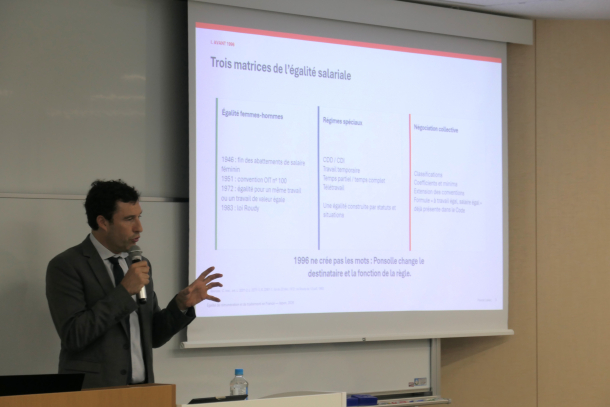
In French labor law, the equal pay for equal work principle had been positioned as a collective right derived from the prohibition of sex discrimination, regulated under special regimes and collective bargaining agreements. A major turning point in its legal history came with the decision of the Social Chamber of the Cour de cassation on October 29, 1996 (the so-called Ponsolle ruling). The Ponsolle ruling expanded the principle from equality between men and women to a general norm of equality, making it a principle that individual workers can invoke directly without relying on collective agreements for its legal basis. The court held that wage disparities without objective justification were unlawful among employees performing the same or equivalent work under the same employer, regardless of the grounds.
Following the Ponsolle ruling, the judicial doctrine extended the reach of the principle to encompass all professional perks—from base salary and bonuses to allowances, fringe benefits, promotion, and career development. Moving beyond the formal classifications of collective agreements, the courts established a multi-stage review method that identifies the specific nature and purpose of each individual benefit and strictly examines whether objective factors, such as experience or qualifications, reasonably justify any disparity.

Prof. Lokiec stated that the substance of the equal pay for equal work principle lies not in mandatory wage standardization, but in a method of control that imposes accountability for objective and reasonable justification on the employer’s wage-setting power. He emphasized that the authority to create disparities has not been eliminated, but has transformed into one that must be explained, justified, and controlled. Looking ahead, he presented the perspective that the principle is shifting from ex post, litigation-based remedies toward an ex ante “logic of prevention” by ensuring wage transparency (EU Directive 2023/970).
Presentation 2: Yoichi Shimada (Professor Emeritus, Waseda University) “The Significance and Function of the ‘Equal Pay for Equal Work’ Principle in Japanese Labor Law”
In his presentation, Professor Yoichi Shimada examined the development of the equal pay for equal work doctrine in Japanese labor law and its potential future evolution into a legal norm.
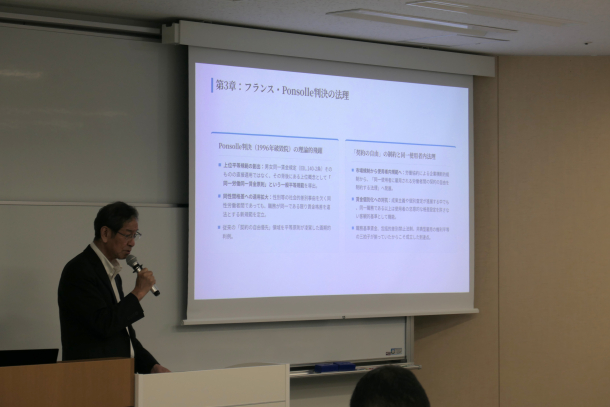
Japanese employment practices have been characterized by a person-based wage system and by treating full-time, permanent employees as a status group. These structural features have posed obstacles to judicial rulings. While job-based wage systems have been introduced in some cases, they have never firmly taken root in Japan. Under the Japanese legal system, without statutory provisions mandating a general norm of equality, he analyzed that the inherent limitation of the system lay in the fact that the judicial precedents were limited to providing only exceptional and ex post remedies against unreasonable disparities in working conditions through public policy violations, as exemplified by the Maruko Alarm case (Nagano District Court Ueda Branch, March 15, 1996) and the Nippon Mail Conveyance case (Osaka District Court, May 22, 2002).
Furthermore, he explained the significance of having established the modular method of review, which examines the objective nature and purpose separately for base salary, bonuses, and various allowances under Article 8 of the Part-Time and Fixed-Term Employment Act. He indicated that it has brought a structural shift that blocks rationalization by vague slogans like “attracting and retaining regular employees” and requires justifying treatment disparities by consistency with each benefit.
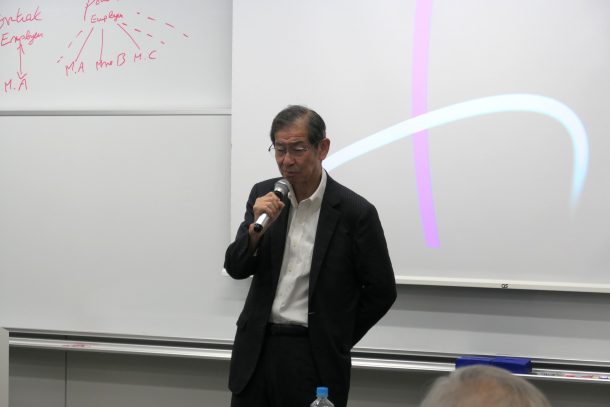
Prof. Shimada concluded his presentation by showing that the equal pay for equal work principle helps break down the status-based wall between regular and non-regular employment by establishing a common axis of “job duties” beyond direct statutory enforcement. Moreover, he expressed the expectation that the principle would mature into a general norm that could be applied to resolve unreasonable disparities not only between non-regular workers but also between regular employees in the future.
Discussion
After the presentations, Professor Emeritus Makoto Ishida (Waseda University) and Professor Yuichiro Mizumachi (Waseda University) commented, asked questions of both speakers, and discussed the topic with them.
1. Comments by Makoto Ishida (Professor Emeritus, Waseda University) and Responses from the Speakers
Professor Emeritus Makoto Ishida highly valued the expansion of French case law from “equal pay” to “equal treatment”. He asked Prof. Lokiec whether the principle has already transformed into “equal work, equal treatment”. Turning to Japanese legal practice, he highlighted the heavy burden of proof borne by employees –as seen in the Nagoya Driving School case (Supreme Court, 1st Petty Bench, July 20, 2023) – and advocated a legislative agenda calling for explicit statutory codification of “equal treatment” and shifting the burden of proof to employers.

Prof. Lokiec affirmed the extension of treatment as a whole (transformation into equal treatment) and highlighted the control of employers’ power (pouvoir) as its theoretical foundation. He explained that as long as employers exercise their power within employment relationships, the principle of equal treatment, imposing objective accountability, is an inevitable consequence extending to overall working conditions.
Prof. Shimada expressed the same concern about the heavy burden of proof on workers and recognized the importance of examining the codification of ‘equal treatment’ and the shift in the burden of proof as a topic for future legislative reform.
2. Comments by Yuichiro Mizumachi (Professor, Waseda University) and Responses from the Speakers
Professor Yuichiro Mizumachi explained that Japan and France share a judicial framework that reviews substance based on the nature and purpose of the treatment. Then, pointing to the Tohoku Eizo case (Sendai High Court, September 11, 2025), he indicated that the equal pay for equal work principle is becoming increasingly generalized in Japan as well. He also stated that, as a doctrine unique to Japan in the absence of industry-wide collective agreements, the principle of “balanced treatment” is significant because it provides proportional treatment according to different working conditions. Then, he asked about the possibility of proportional remedies in French labor law and the extent to which the principle has taken root in Japanese corporate practice.
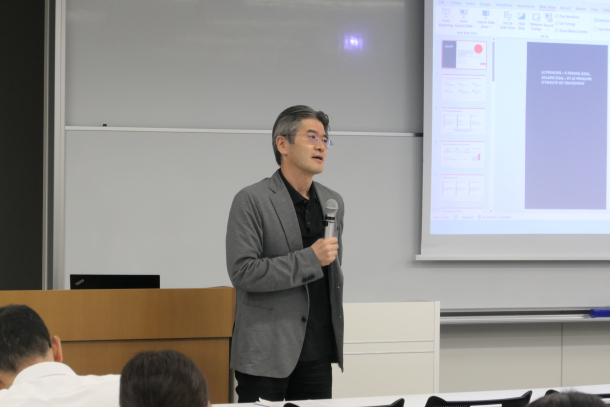
Prof. Lokiec responded that it is precisely in Japanese labor relations—where industry-wide collective agreements are remarkably few—that the importance of this principle as an individual right becomes even more critical. He explained that French labor law has no explicit concept of “balanced treatment,” but substantive adjustments are made through accountability.
Prof. Shimada emphasized that judicial interpretation alone has limits, and that it is essential to create a framework to confirm the purpose and nature of the corporate treatment system through communication between social partners and to implement equal and balanced treatment autonomously.
By comparing legal frameworks and judicial doctrines in Japan and France, this symposium proved to be a highly insightful occasion that clarified the prospects and the role that the principle of equal pay for equal work should play in Japanese labor law.
(Text: Haruka Nomura, ICL Research Assistant)
Link to Japanese page