Going Abroad – Once a Distant Dream, Now a Reality
Mon, Nov 2, 2026-
Tags
Going Abroad – Once a Distant Dream, Now a Reality
Budding Researchers Stepping Out into the World – How the Overseas Research Travel Grant Program Opens the Door to New Endeavors
Experiences abroad broaden one’s research perspective and personal potential
“Going abroad” – While these words have an allure for many students, they can also seem like a somewhat unattainable goal.
Graduate students in the fields of science and engineering in particular have very little time and money to spare as they spend their days juggling research and creative projects. However, even if it is just for a short-term stay, going abroad can be beneficial not only from a research perspective, but also for shifting one’s word-view and way of thinking.
To encourage its students to take on such challenges, Waseda University established the Overseas Research Travel Grant Program for Upper-level Undergraduate and Graduate Students, which offers partial financial support for travel and accommodation costs to graduate students engaged in research abroad, such as through study programs, fieldwork, and presentations at international conferences.
For Kako Sugaya, a master’s student in architecture at Waseda, a 10-day trip to Adelaide, Australia, offered a valuable opportunity to build on her research and reshape the way she sees the world.
When studying abroad felt out of reach
Though Sugaya is now actively engaged in research overseas, before university, studying abroad never felt like a realistic option. She wasn’t particularly confident in her English, and she couldn’t fully picture herself studying in another country. If anything, it felt like something meant for other people.
Her feelings began to change once she started getting more involved in her studies at Waseda. At the Keigo Kobayashi Lab, she came into contact with international students from a variety of backgrounds and engaged in discussion and collaboration with them on a daily basis. She also saw many of her senior lab members depart on their own journeys overseas. Within this environment, the choice to study abroad slowly started to feel less like something that required a special impetus, and more like a natural next step that she, too, could take.
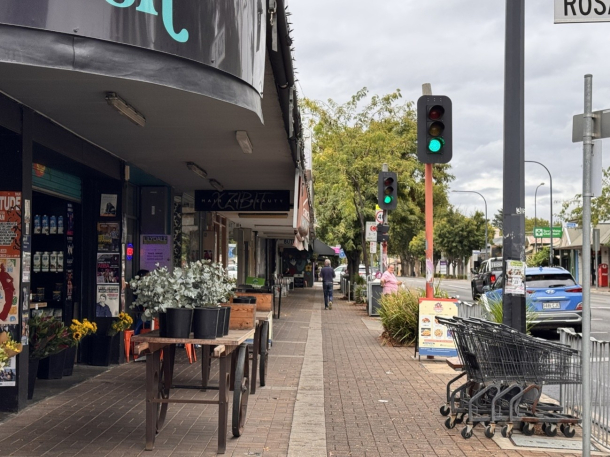
Supermarket carts neatly lined up on the sidewalk, turning the outside space into part of the store
Finding her research theme – “Who does space belong to?”
Sugaya’s interest in architecture goes beyond the design of buildings themselves. She is also deeply interested in the ways in which people use space – how they engage with it and at times make it their own.
This approach to architecture was inspired by undergraduate fieldwork she conducted in Ho Chi Minh City, Vietnam. In contrast to Japanese apartment complexes, where the shared hallways are kept free from clutter, the hallways in Vietnamese apartment complexes served as extensions of the residents’ living spaces. They were filled with furniture and other belongings and at times would even become the site where cooking was performed. The separation between “inside” and “outside” was thus blurred, and the relationship between the personal and the shared was similarly in constant flux.
“I realized that not just the insides of buildings, but also the richness of outside spaces can have an effect on how people interact with each other,” reflects Sugaya.
After this experience, she broadened her interests from the architecture of individual buildings to urban environments and public spaces.
Going abroad as a fieldwork for “reading” a city
Sugaya was given the chance to dig even deeper into these ideas on her recent trip to take part in a workshop in Adelaide, Australia.
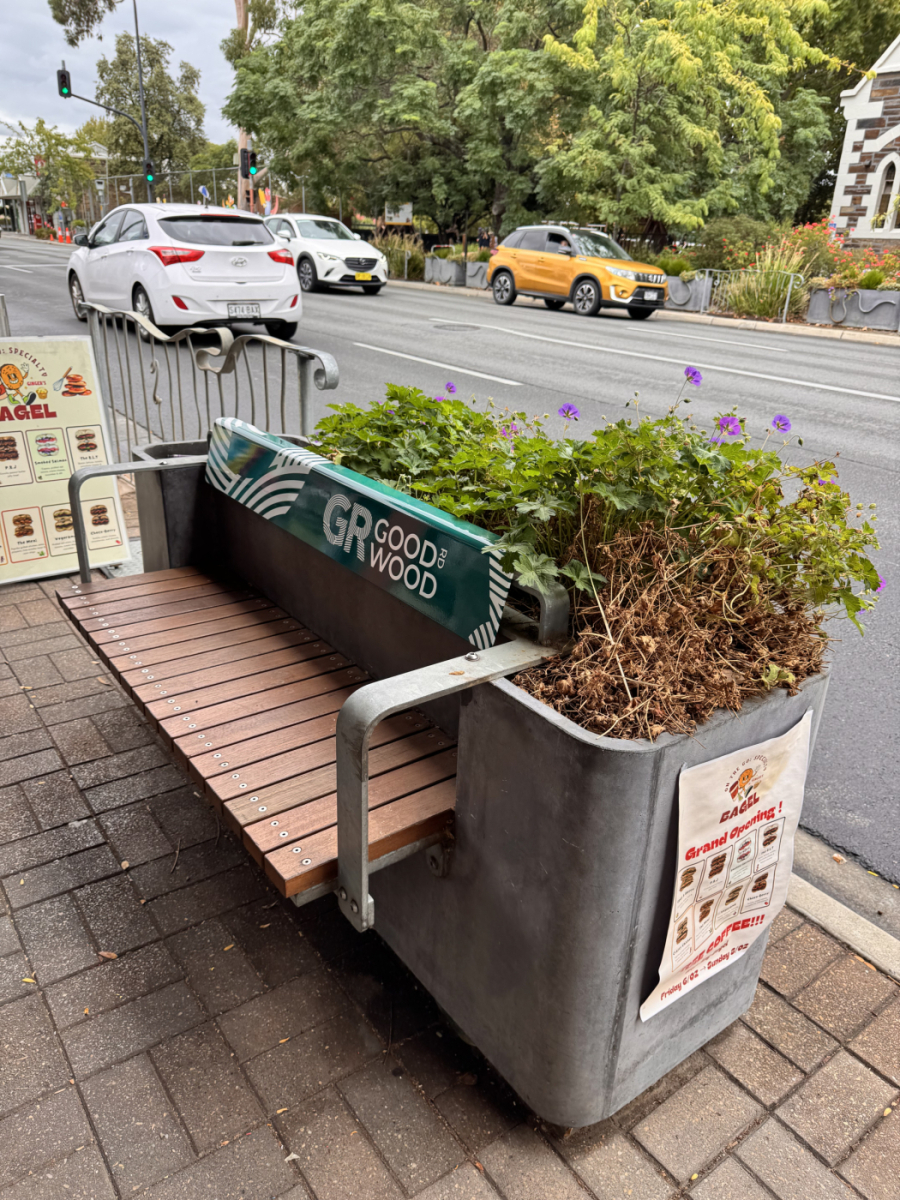
Rather than being assigned a theme from the start, the concept of the workshop was for participants to observe the local area and come up with their own research questions. Once in Adelaide, Sugaya took notice of the street furniture – benches and planted vegetation – that could be found around the city. While such street furniture was a common sight in commercial districts, its presence became scarce as soon as you entered into a residential area. Sugaya began to wonder why the spaces were divided in this way, and if there could be a way to connect them.
“I was struck by how, even within the same city, you could have areas with such different atmospheres just a few steps away from each other.”
The process of walking around a local environment, making observations, and assigning meaning from one’s own perspective in this way is not merely a way of obtaining knowledge, but also a means of sharpening one’s questioning mind as a researcher.
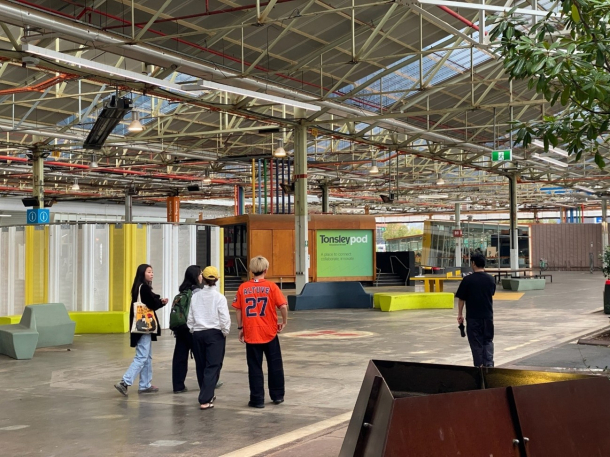
A visit to Tonsley Innovation District, an example of adaptive reuse
Broadening one’s horizons means asking more questions
Spending time abroad can change not only one’s research, but also one’s inner self. Sugaya reflects on the different atmospheres in Japan and abroad.
“When you’re in Japan, you often feel pressure to fit in or to do things a certain way. But that idea isn’t as present overseas.”
Coming into contact with different values causes one to rethink one’s presuppositions. However, this change doesn’t necessarily provide answers.
“Learning that there were so many possibilities actually left me more uncertain,” admits Sugaya.
Still, this uncertainty itself is a sign that her worldview has expanded.
“Because I have seen more of the world, I think I am able to see other ways of thinking and other paths I could take.”
Whether in research or in life, the ability to keep asking questions is an important strength.
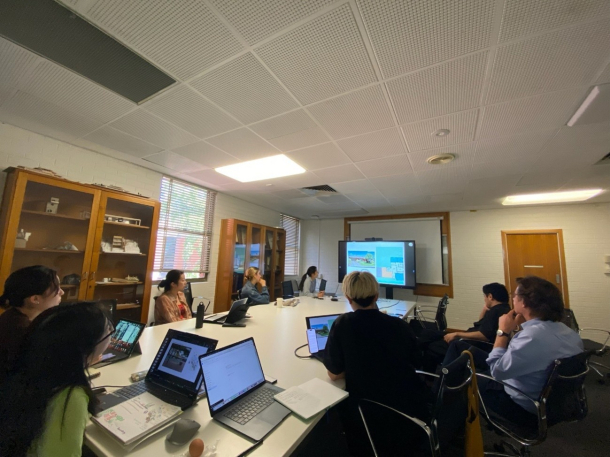
Participants presenting on their respective themes
The push that made her decide to go abroad
There are several logistical hurdles to being able to making such experiences a reality. Architecture students have to devote a vast amount of time to their projects and assignments, and making enough money to sustain oneself through part-time work is no simple task either.
“For a student, it’s hard to make even a little bit of money,” says Sugaya.
Her trip to Adelaide was supported by the Overseas Research Travel Grant Program for Upper-level Undergraduate and Graduate Students.
“Once I knew I could count on this support, the choice to make the trip was easy.”
More than just offering financial assistance, the grant program lowered the mental barrier Sugaya faced in deciding to take the plunge.
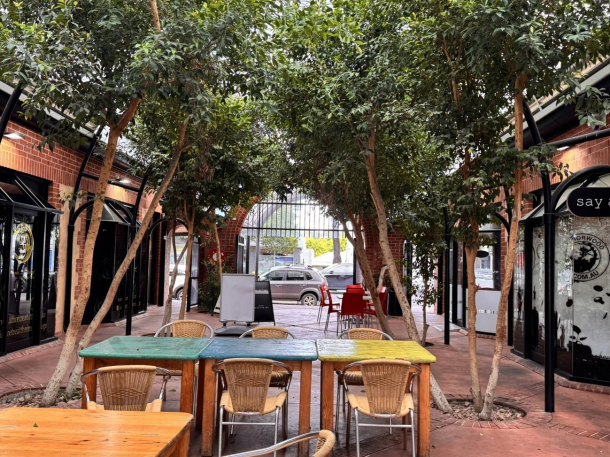
A public-use courtyard shared by the shops on either side
The deep impact even a short stay can have
Studying abroad is often associated with long-term commitments and high costs. However, after seeing how her own research questions become more concrete through observations and discussions held overseas, Sugaya came to know first-hand how impactful even a short-term program can be.
“Even if it’s not for a long-term stay, I think the important thing is just to get out there,” she states.
What’s more, her experience went beyond simply gaining knowledge and achieving results – it also changed her on a personal level.
“Coming into contact with new values also helped me gain confidence in myself.”
Even if it is just for a short time, being on the ground offers a remarkable depth of learning, one that carries forward into the next steps of one’s research and the choices that follow.
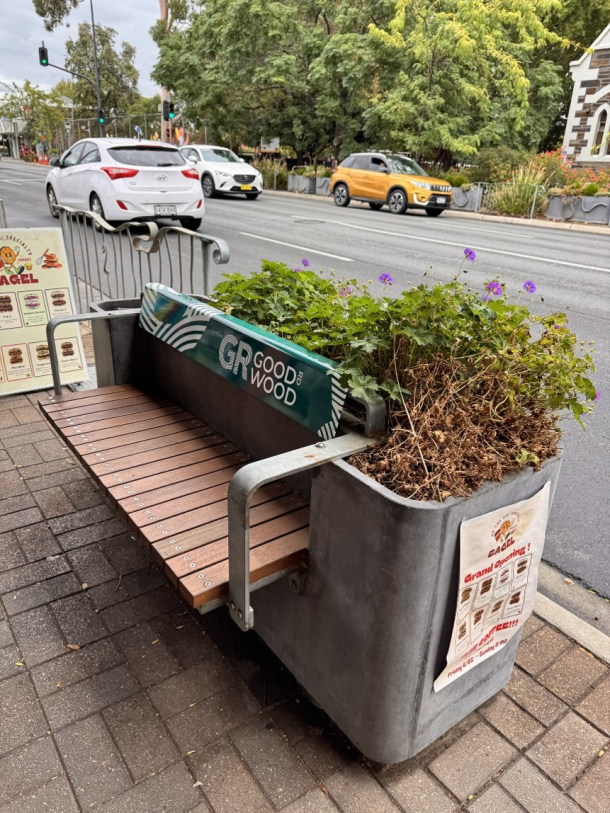
Street furniture combining a bench and a flower bed
Support that broadens a researcher’s possibilities
Sugaya’s experience is not a special case. Like many students, she faced constraints of time, money, and circumstance, yet she still chose to take that first step. And that step led to more than just a travel experience. Deepening her research questions, broadening her horizons, and gaining flexibility in future choices – the accumulation of all the above will give her an edge as she enters the professional world.
Even modest support can influence a researcher’s path and broaden the way they think, ultimately leading to the creation of new knowledge and contributions to society. A small push can open the door to new possibilities, and this program serves as a reliable starting point.
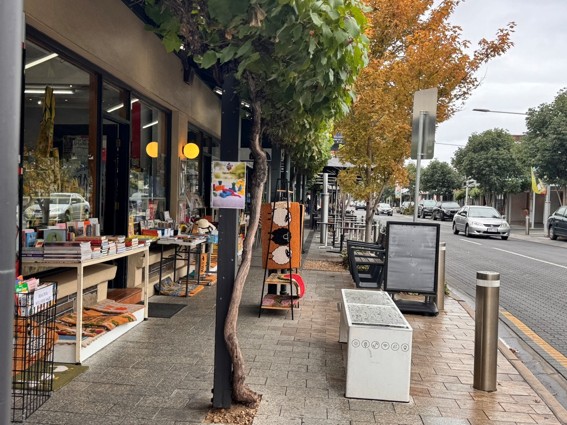
Books, goods, and posters from a local bookstore spilling out onto the sidewalk
About the Overseas Research Travel Grant Program for Upper-level Undergraduate and Graduate Students
This program supports Waseda’s upper-level undergraduate and graduate students in pursuing hands-on opportunities abroad, such as conducting research at overseas universities and research institutions or giving presentations at international conferences. By covering part of the travel and accommodation costs for students with a defined research plan, the program broadens access to international learning and research. Over time, these efforts lay the foundation for developing the next generation of talent and creating value for society.
Profile
Kako Sugaya
Master’s student in the Department of Architecture, Graduate School of Creative Science and Engineering, Waseda University, and a member of the Keigo Kobayashi Lab. Interested in how people engage with public spaces and cities, she conducts research that looks at architecture and the city as interconnected. As an undergraduate, she carried out fieldwork on shared spaces in apartment complexes in Ho Chi Minh City, Vietnam. She has also taken part in study abroad programs and workshops in countries including Spain and Australia.