![[Podcast Column] How Territorial Disputes Take Shape in Society](https://www.waseda.jp/top/en/assets/uploads/2026/07/2026.6.29-territorial-disputes-screenshot-for-podcast-column-3.jpg)
[Podcast Column] How Territorial Disputes Take Shape in Society
Wed, Jul 8, 2026-
Tags
This podcast column presents the third episode of Season 2 of Waseda University’s English-language podcast “Rigorous Research, Real Impact.” Professor Alexander Bukh (Graduate School of Asia-Pacific Studies) serves as the guest in the episode titled “Social Construction of Territorial Disputes in Northeast Asia.”
In the excerpt below, Professor Bukh leverages his research to introduce the concept of territorial disputes as “socially constructed,” explaining how the meanings attached to political issues emerge through social processes within societies. Using the example of a Rolex watch, he illustrates how shared interpretations, such as associating objects with status or wealth, develop and become widely accepted, even though they are not inherent to the object itself.
All eight episodes of Season 2 of Waseda University’s English podcast “Rigorous Research, Real Impact” are currently streaming for free on Spotify, Amazon Music, Apple Podcasts, and YouTube.
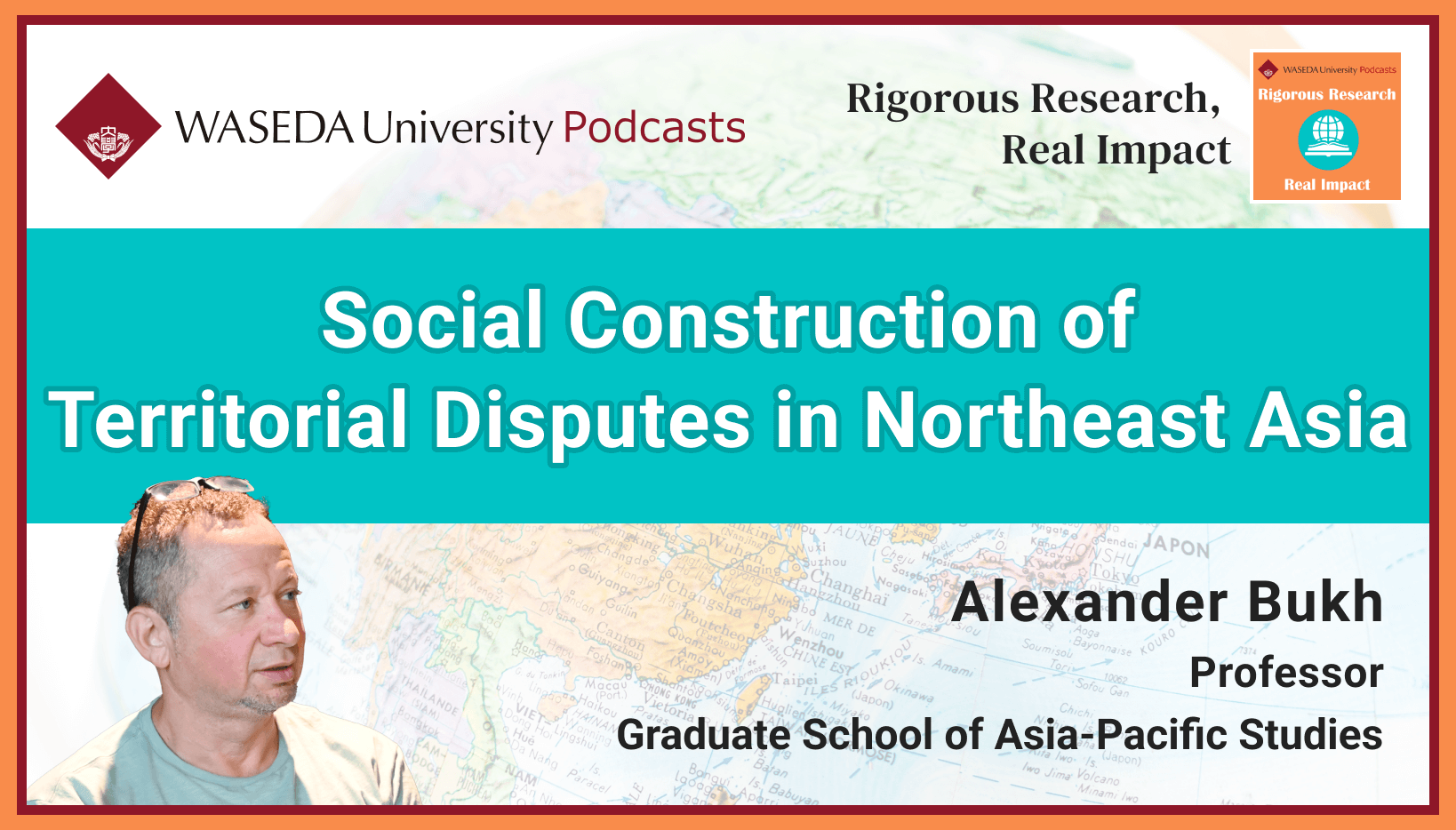
You can read the full transcript by clicking the above episode banner.
Question: Your book These Islands Are Ours introduces the idea of territorial disputes as socially constructed. Could you briefly explain what this means and how such disputes become embedded in national identity and collective memory, for example in cases like Dokdo/Takeshima?
Professor Bukh (1:47):
First, I think we should briefly talk about what it means to be socially constructed. This is a concept that comes from sociology but has been embraced by other social sciences like international relations, the discipline I belong to, but also political science, history, economics, and many other disciplines, as well. So, what does it mean to be socially constructed? The meaning is rather simple: it means that the various meanings associated with certain material objects or issues emerge in a specific social process. So, different processes that take place inside societies ascribe certain meanings to these objects, issues, or events, and these meanings become shared by others—by most members of the society or by the whole society.
Professor Bukh (2:37):
A good example would be something like a Rolex watch. When we see somebody with a Rolex, I mean, it’s just a watch, basically a machine to show time. But when we see somebody with a Rolex, we associate this person maybe with success, wealth, or maybe showing off. So, these meanings will be shared by most members of a society, and we take this for granted. Everybody, I think, in the modern society, you know, will share this understanding when they see somebody with a Rolex. But this meaning ascribed to a Rolex watch, it emerges within, inside, specific social processes, and then it’s disseminated inside the society.
Professor Bukh (3:13):
So this is what we mean by social construction: meanings associated again, with certain objects, issues, things, they emerge inside social processes. And this is what I mean by the social construction of territorial disputes. Because in the case of territorial disputes in Asia, Northeast Asia, including Dokdo/Takeshima that you mentioned, the roots of territorial disputes, they go back to, well, the defeat of Japan, the San Francisco Peace Treaty, the way this treaty has been written. But the meanings associated with these territories, these disputed territories, they emerged inside or as a result of specific social processes that took place in various countries involved.

About the Guest:
Professor Alexander Bukh
Professor Alexander Bukh teaches in the Graduate School of Asia-Pacific Studies. He has a PhD in International Relations from the London School of Economics (LSE) and has previously taught at LSE, Tsukuba University, and the Victoria University of Wellington. Professor Bukh specializes in international relations, international relations of Northeast Asia, and Japan-Korea and Japan-Russia relations. He is a member of the International Studies Association (ISA), the Association for Asian Studies (AAS), and the Association for Borderland Studies.