![[Podcast Column] Building Peace from the Ground Up](https://www.waseda.jp/top/en/assets/uploads/2026/07/2026.6.29-ground-screenshot-for-podcast-column-5.jpg)
[Podcast Column] Building Peace from the Ground Up
Thu, Jul 23, 2026-
Tags
In this podcast column, we explore and excerpt of the fifth episode of Season 2 of Waseda University’s English-language podcast “Rigorous Research, Real Impact.” Associate Professor Megumi Kagawa (Faculty of Social Sciences) appears as the featured guest in an episode on conflict analysis and peacebuilding, focusing on how peace is built from the ground up in post-conflict societies.
Building on her research on local peace initiatives, particularly in the Bangsamoro peace process in the Southern Philippines, Assoc. Prof. Kagawa examines how national peace agreements interact with existing community-led efforts. In the excerpt below, she explains the challenges local communities face when national agreements are implemented and introduces the concept of “hybrid peacebuilding” as a framework for understanding how different systems of governance and authority interact in peace processes.
All eight episodes of Season 2 of Waseda University’s English podcast “Rigorous Research, Real Impact” are currently streaming for free on Spotify, Amazon Music, Apple Podcasts, and YouTube.
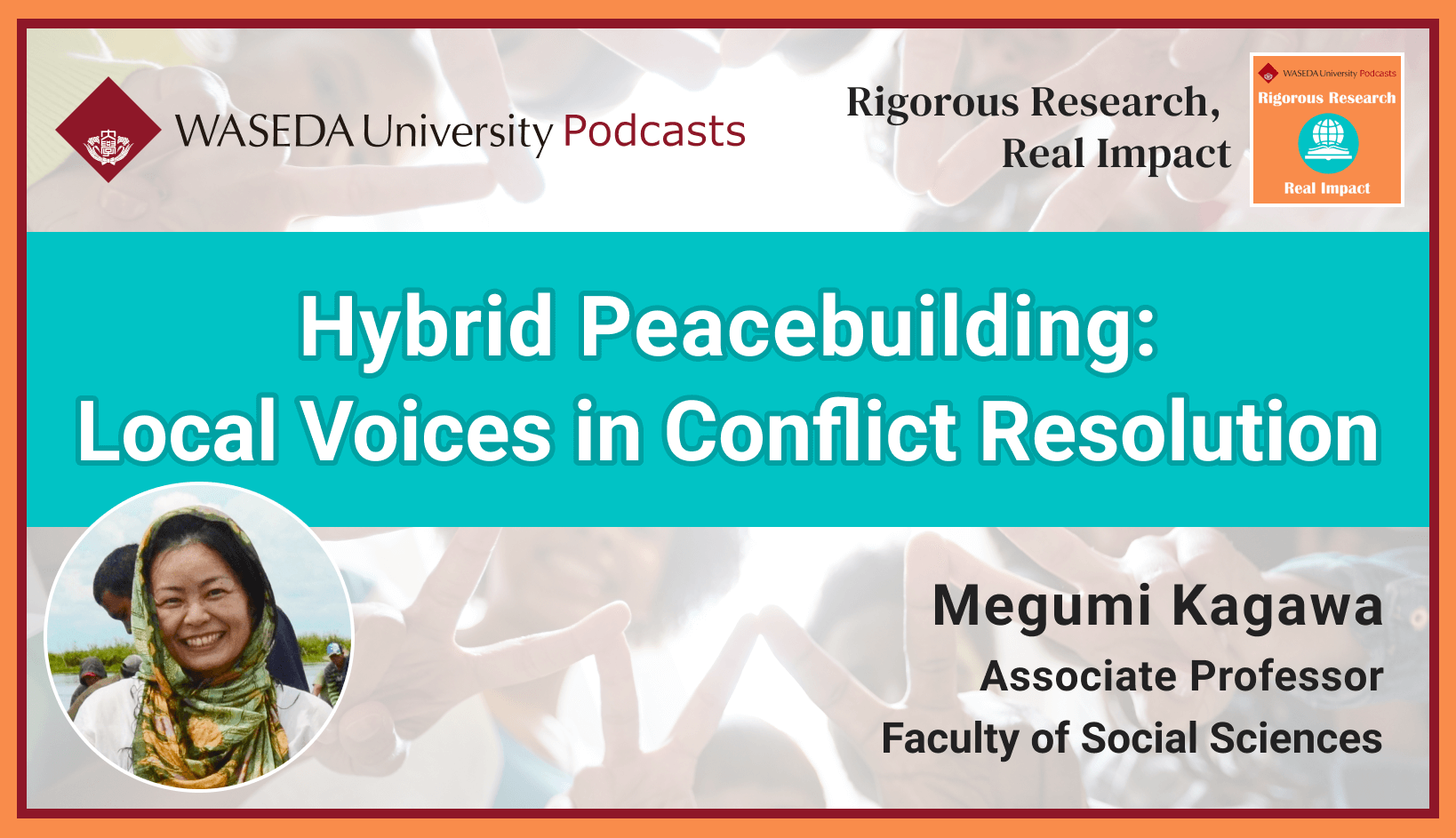
You can read the full transcript by clicking the above episode banner.
Question: Your research on “Uneven Peace Infiltration” examines how national peace agreements affect local, community-led peace initiatives. Could you explain the challenges these communities face and introduce the concept of “hybrid peacebuilding”?
Professor Kagawa (1:40):
Okay, let’s start from there, what that means, “hybrid peacebuilding.” Because “hybrid” means starting and mixing with one and another one. And then one thing is about liberal peacebuilding, which is institutional building, like in other words, state-building. And then another one is a local customary governance, so how local community tries to govern themselves and then try to hybridize. Because if you are imposing an international norm of liberal peacebuilding, they might defend. So that’s why we’re trying to mix it and then hybrid the peacebuilding. And then also in reality, even if they sign a peace agreement, it might not be implemented soon. So, we’re trying to find a way of how to implement it.
And also it could be the elite-led peacebuilding. So, for ground people, if they have a different kind of social hierarchy, it’s difficult to go down–all the peace dividend on the ground. So, we’re trying to find out how we can try to give them a space to live.
That’s why my research is a local peacebuilding, because the local community is the space for people to live. So that’s how people make a life and then how they build peace. And that’s the space of the first and the last peacebuilding. So, people started to build the peace from on the ground, and it might break from the local level, not from the top level. So that’s why it’s very important to research and work for maintaining the peace and starting the peace and encouraging the peace. Local peacebuilding is very important, so that’s why I’m looking at the ground-up situation.
And then also the legal rationale source to gain power sometimes can be abused. Culturally, it might be a different way they interpreted institutional law. So that’s why we’re trying to look for the more soft power to govern themselves. War divided the people into different communities, so we have to bridge communities. So, all the communities are divided, so we try to find a way to bridge them to each other.
My definition of hybrid peacebuilding is not only the mixing with the institutional or liberal peacebuilding and then the local governance system, but also mixing with the rebel governance, because the rebel is the one who are in the peace process and also, they are the one with the power in transition time. So that’s why I mean “hybrid”–it means a three-way mix.
About the Guest:
Associate Professor Megumi Kagawa
Megumi Kagawa is an associate professor in the Faculty of Social Sciences at Waseda University. Her research fields include international relations and conflict analysis & resolution, with a particular interest in peacebulding. She is a member of The Japan Association of International Relations, The American Political Science Association, Conflict Research Society, and the International Studies Association.