The theme for the 2026 "Lectures by Experts" series is "Food." We will explore food from the perspectives of multiple experts. Our guest for the third installment is Professor Ayu Washizu (Faculty of Social Sciences), who specializes in "Environmental Input-Output Analysis." Professor Washizu applies economic analytical methods to environmental issues and has recently been researching sustainable community development centered on "food" and "agriculture." We asked her how "food" is connected to our society and environment.
What is the relationship between our diet and CO₂ emissions?
Analyzing the three main causes of CO₂ emissions from our consumption habits using an environmental household budget based on input-output analysis reveals them to be food expenses, utility costs, and transportation costs. Understanding how much CO₂ emissions are involved in our daily food consumption is a starting point for considering the transition to a sustainable society.
INDEX
▼ Applying "input-output analysis" to the assessment of environmental problems
▼The "Kyo Lemon Project" demonstrates a positive cycle between "food" and "community development"
▼ Reducing CO₂ emissions from food production is key to community development.
▼ Food can be a starting point for thinking about the transition to a sustainable society.
Applying "input-output analysis" to the assessment of environmental problems
What kind of research field is your area of expertise, "environmental input-output analysis"?
Input-output analysis is a method for analyzing the ripple effects that the production activities of one industry have on other industries. For example, if automobile production increases, demand spreads not only to automobile manufacturers but also to various other industries such as steel, glass, logistics, advertising, and dealerships. Input-output analysis is a way to grasp these "connections between industries" numerically. Originally an analytical method in economics, it was used during the period of rapid economic growth to create economic plans such as "how much electricity and steel infrastructure is needed to develop the automobile industry."
It was in the 1990s that this began to be applied to environmental analysis. Following the 1992 United Nations Conference on Environment and Development (Rio Summit), CO₂ emissions became a global issue, and "life cycle assessment (LCA)," which evaluates the environmental impact of the entire process of manufacturing a product, attracted attention. For example, how much CO₂ is emitted when manufacturing one car? By using input-output analysis to calculate this, it is possible to estimate CO₂ emissions, including indirect emissions that occur along the supply chain (*1).
*1 The entire process from sourcing raw materials to manufacturing, logistics, sales, and finally delivering products and services to consumers.
My background is in economics, and I have been conducting research on applying input-output analysis to Life Cycle Assessment (LCA). Input-output analysis is an excellent tool for understanding the relationship between "food" and "environment." The food industry, agriculture, and distribution are closely interconnected, and by calculating CO₂ emissions within this network, it becomes possible to evaluate the sustainability of our daily food consumption.
The "Kyo Lemon Project" demonstrates a virtuous cycle of "food" and "community development."
Could you tell me specifically about the research topic you've been focusing on recently?
I am currently, together with Professor Kenichi Akao (Faculty of Social Sciences), under a grant from the Ministry of the Environment's Comprehensive Environmental Research Promotion Fund, working on a research project titled Building a Methodology for Transitioning to a Sustainable Society Centered on Local Communities: Towards the Developmental Expansion of Regional Circular and Symbiotic Ecosystem Projects. Current local communities face various challenges, including an aging population, limited access to shopping, and abandoned farmland. Therefore, The Ministry of the Environment is promoting the creation of a bottom-up "regional circular economy" that involves local people and businesses. This is an approach that aims to improve the environment, economy, and society in an integrated manner by utilizing local resources. The topics that tend to generate the most discussion are "food" and "agriculture.".
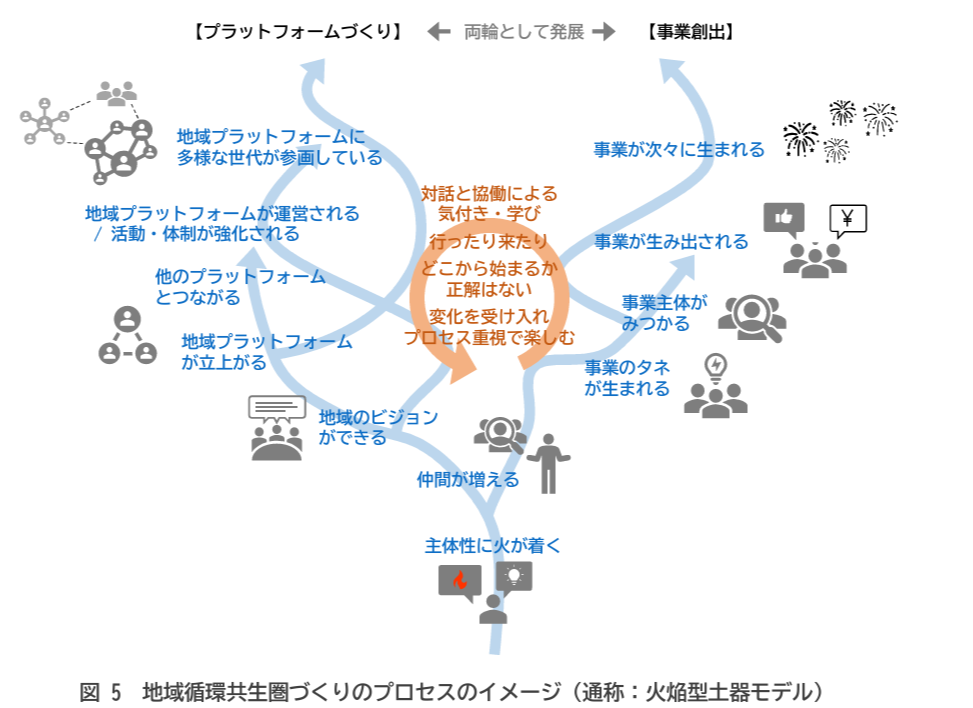
From "Guidelines for Creating Regional Circular and Symbiotic Ecosystems: Local Communities Take the Lead! Environmentally Friendly Community Development Through Everyone's Participation" (Ministry of the Environment) (Click to enlarge)
One example that I'm paying attention to as a model for a regional circular economy is the "Kyoto Lemon Project," a collaborative effort between local businesses and farmers in Kyoto. Kyoto is facing challenges such as an increase in abandoned farmland and overtourism due to inbound tourism. This project aims to solve both problems simultaneously by leveraging the demand from foreign tourists.
Lemons are normally grown in warmer regions, but in Kyoto, the cold winters force them to be harvested while still green and before they are fully ripe. This green lemon was then turned into an advantage, and branded as "Kyo Lemon." Crucial to this project is Japan Juice Co., Ltd., which handles fruit juice processing. The company collects various fruits from farmers across Japan who are facing challenges, and efficiently produces a wide variety of products by systematically operating three production lines: juicing, peel processing, and extract extraction.
Furthermore, Takara Shuzo Co., Ltd., a global company based in Kyoto, is producing a craft chu-hai (a type of Japanese alcoholic beverage) using this Kyoto lemon. Leveraging economies of scale (*2), which are the strengths of large corporations, they are branding a local ingredient. While a typical chu-hai costs around 200 yen per bottle, the Kyo Lemon Chu-hai costs around 400 yen and is selling well in souvenir shops frequented by tourists. This project is packed with sustainable elements that address local issues, such as utilizing abandoned farmland, revitalizing the region, minimizing food waste, and promoting Japanese culture to the world.
*2 Expanding production scale reduces the cost per product, improving profit margins and competitiveness.
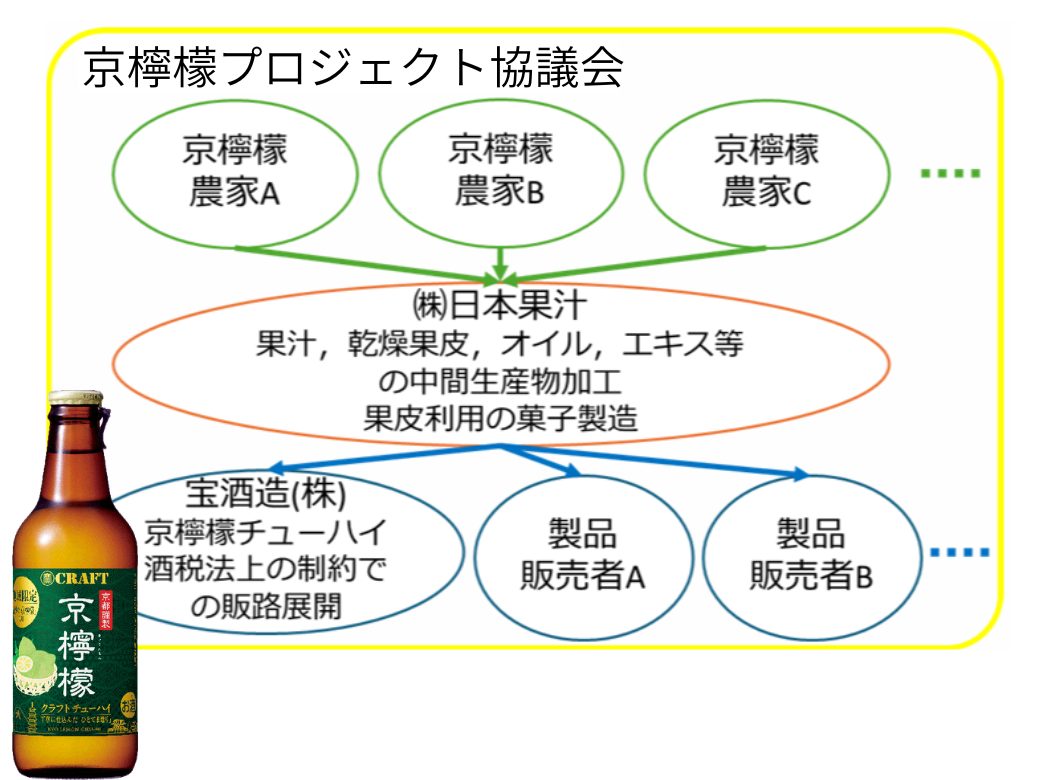
The structure of the "Kyo Lemon Project Council" (from materials created by Professor Washizu) and "Takara CRAFT" <Kyoto Lemon>, a craft chu-hai (Japanese alcoholic beverage) made with Kyo lemons (click to enlarge).
Reducing CO₂ emissions from food production hinges on community development.
First of all, what made you interested in "community building"?
My starting point was research on "environmental household accounts" using input-output analysis. In the 1990s, "sustainable production," which involves reviewing the process of making products, attracted attention, and efficiency improvements in production sites advanced significantly. "Smartification" using ICT greatly contributed to efficiency improvements and energy conservation in production sites. However, in the 2000s, it began to be pointed out that "while the environmental burden from production has improved, the environmental burden from consumption has not been reviewed." So, I used input-output analysis to investigate the CO₂ emissions of consumers.
An environmental household budget using input-output analysis can analyze not only CO₂ emissions from electricity, gas, water, and gasoline used in the home, but also CO₂ emissions from the production of common consumer goods such as clothing and food. It turns out that the three main causes of CO₂ emissions from our consumption are food expenses, utility costs, and transportation costs. While utility and transportation costs are decreasing due to the use of energy-saving equipment and renewable energy, CO₂ emissions from food expenses show no signs of decreasing. I was once struck by a question from a middle school student: "How much sacrifice do I have to make to become an environmentally friendly consumer?" Aiming for eco-friendly consumption inevitably involves "sacrifice," which is why progress is so slow.
So, I researched "smartification," or in other words, the efficiency of management. For example, information on products sold at the register of a family restaurant is instantly reflected in the factory's production and logistics plans. Systems are actually being implemented that reduce environmental impact naturally through the power of ICT, without requiring human sacrifice. However, that alone is not enough to solve the problem. So, what I ultimately arrived at was "community building" that restructures the entire supply chain of "food" and "agriculture."
Food can be a starting point for thinking about the transition to a sustainable society.
What does food mean to you, an expert in environmental input-output analysis?
I believe that food is the most familiar theme, encompassing all environmental, economic, and social challenges. Starting with input-output analysis, I progressed through environmental household accounting and smartification to research on community development. I believe that community development centered on the supply chain of food and agriculture, such as the "Kyoto Lemon Project," holds clues to realizing a sustainable society.
In short, "food" is a starting point for thinking about sustainability transition (the transition to a sustainable society). I would like you to take a moment to trace where the food you casually eat comes from and how much environmental impact it has. For example, just thinking about how much CO₂ emissions are involved in your shopping on a particular day can change the way you see the world.
Finally, do you have a message for Waseda University students?
Currently, the government is working to mandate that companies disclose sustainability information in their securities reports and other documents. This will lead to companies that actively invest in reducing the environmental impact of their products and services being highly valued, resulting in increased corporate value. When you are job hunting, be sure to look at the sustainability information published by each company and check how they are making a significant contribution to building a sustainable society.
Sustainability transition is a challenge that is truly ongoing. As a first step in making environmental issues "personal," please start by looking at the food right in front of you. And I hope that during your student years, you will learn about environmental issues from multiple perspectives and become someone who can contribute to the realization of a sustainable society.
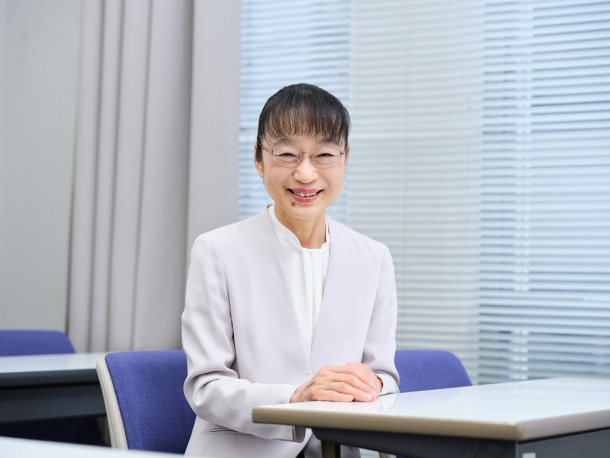
Ayu Washizu
Faculty of Social Sciences Professor. She graduated from the Faculty of Economics at Keio University. Completed the master's program at the Graduate School of Economics of the same university and graduated from the doctoral program at the same graduate school after completing coursework in the Graduate School of Economics. PhD (Business). After working at Tokai University College of Arts and Sciences as an Assistant Professor and Waseda University School of Social Sciences as an Assistant Professor, she holds her current position. Her areas of expertise are econometrics (inter-industry linkage theory) and environmental economics. Advanced Collaborative Research Organization for Smart Society (ACROSS) (ACROSS) Institute for Economic Analysis of Next-generation Science and Technology Director.
Courses taught: "Industrial Structure Theory," "Introduction to Economics 1 [Microeconomics] B," "Carbon Neutrality and Society (for undergraduate students)"
Interview and text: Kenichi Marumo
Photography: Seiji Ishigaki

![[Save version] Map of the four main campuses](https://www.waseda.jp/inst/weekly/assets/uploads/2026/06/110d605cfac40346aad1d2df464a6586-940x705-1-1-610x457.jpg)