VR Headsets May Make Dry Eye Less Likely: World’s First Time-Course Observation During a VR Session
Wed, Nov 12, 2025-
Tags
VR Headsets May Make Dry Eye Less Likely: World’s First Time-Course Observation During a VR Session
Researchers examined the effects of VR headset use on tear film dynamics
Virtual reality (VR) use is often linked to reduced blinking, raising concerns about dry eye. This study examined the ocular surface during a 30-minute VR gaming session using a compact imaging system to observe the tear film in real time. Over the session, the tear film’s lipid-layer interference grade increased, indicating thickening of the lipid layer. Under these experimental conditions, this change may be associated with a lower likelihood of dry eye during VR use.
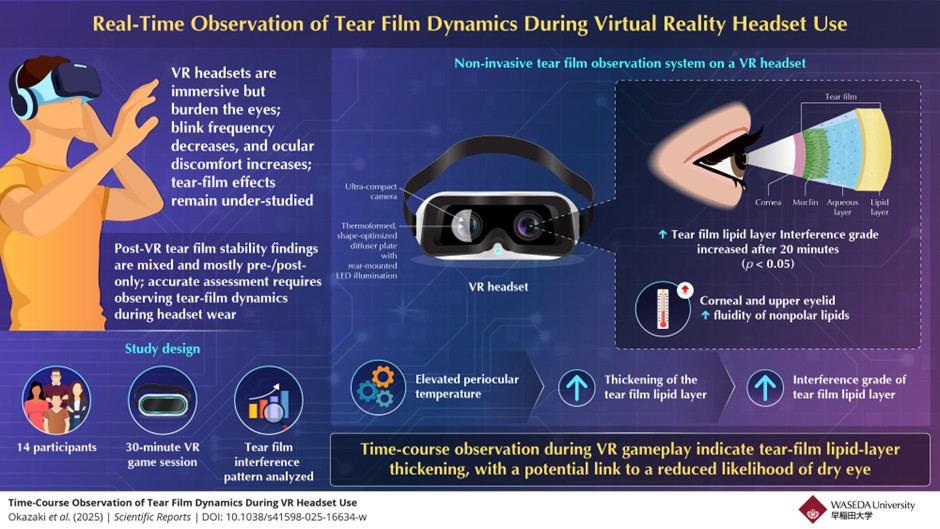
Title: Time-course observation of tear film dynamics during VR headset use
Caption: VR headset use may increase lipid layer thickness, potentially helping to prevent dry eye disease.
Credit: Yoshiro Okazaki from Waseda University, Japan
License type: Original content
Usage restrictions: Cannot be reused without permission.
Virtual reality (VR) gaming has gained significant attention in recent years, with an increasing number of users integrating VR and immersive headsets into their daily lives. These devices provide highly immersive visuals, creating a strong sense of presence and disconnection from the real world. However, concerns have been raised about the effects of prolonged VR use—especially at short viewing distances—on eye health and its potential link to dry eye disease, an ocular condition characterized by tear film instability.
The tear film is a dynamic, multilayered system composed of lipid and aqueous layers that work together to protect and lubricate the eye. Excessive exposure to visual display systems can disrupt this balance, causing tear film instability, leading to discomfort in the eye. While previous studies have examined tear film stability before and after VR headset use, real-time changes in tear film behavior during VR headset use have remained unexplored.
To address this issue, Associate Professor Yoshiro Okazaki from Waseda University, Japan, and Visiting Professor Dr. Norihiko Yokoi from the Kyoto Prefectural University of Medicine, Japan, designed a novel method using VR headsets with an ultra-compact camera for real-time observation of tear film dynamics. Their article, published in Volume 15 of Scientific Reports on September 26, 2025, offers the first real-time data on how tear film dynamics change over the duration of a VR session. “In a digital world where many people worry about eye comfort, we were motivated by the lack of real-time data on what happens to the tear film during VR use,” says Okazaki.
The researchers designed a VR headset with an integrated ultra-compact camera system that allowed noninvasive observation of the tear film during a VR session. 14 healthy participants played a VR game for 30 minutes while the built-in camera monitored changes in their tear film lipid layer interference pattern at baseline and every five minutes during brief pauses.
As the gameplay progressed, researchers noted a significant increase in the interference grade of the tear film lipid layer, consistent with its thickening. Additionally, the corneal and upper eyelid temperatures increased significantly after the VR session. These findings suggest that the periocular warming inside the headset may have led to the thickening of the tear film lipid layer. A previous study has demonstrated that an increase in lipid-layer thickness, induced by elevated temperature, is associated with enhanced tear film stability. Therefore, it is essential that the present study elucidates whether similar stabilization of the tear film occurs under the experimental conditions employed.
According to Okazaki, “While not intended as a health claim, our findings provide insights into how the thermal environment inside VR headsets may influence tear film behavior.” He further notes, “This is useful not just for the users but also for the headset designers who are involved in developing future VR systems.”
However, the study’s observations were limited to healthy participants, leaving open questions about whether similar results would be seen in individuals with dry eye disease or meibomian gland dysfunction. The study also did not include a non-headset control group. Okazaki notes that they plan to expand the research to include clinical populations and appropriate controls.
For now, these findings provide valuable early insights for both VR users and developers. While the study does not address treatment or preventive strategies, the results may inform future headset design and usage considerations related to eye comfort and health.
Reference
|
Title of original paper: |
Time-course observation of tear film dynamics during VR headset use |
|
Journal: |
Scientific Reports |
|
DOI: |
About Dr. Yoshiro Okazaki from Waseda University
Dr. Yoshiro Okazaki is an Associate Professor in the Faculty of Human Sciences at Waseda University, Japan. He earned his Doctorate in Engineering from the University of Tokyo. He has published multiple peer-reviewed papers on medical systems and device development. His research primarily focuses on healthcare technology. His research interests span biomedical engineering, affordable medical devices, point-of-care devices, e-health, endoscopes, and ophthalmic devices.
Funding information
This work was supported by JSPS KAKENHI Grant Number 22K20513.