Researchers Breaking New Ground: Professor Chie Nakamura
Thu, Nov 19, 2026-
Tags
Uncovering Universal Mechanisms of Language Comprehension through the Study of Bilingual Cognition

Associate Professor Chie Nakamura, Faculty of International Research and Education
Associate Professor Chie Nakamura specializes in psycholinguistics. Her research examines sentence processing, the mechanism humans use when acquiring and comprehending a first or second language.
“The ability to understand meaning while reading or listening may appear natural, yet it remains a profoundly mysterious phenomenon. My research seeks to uncover the cognitive mechanisms underlying everyday language comprehension. I focus particularly on bilingual cognition, including why children can acquire complex language systems, why foreign-language acquisition is difficult for adults, and how language and thought interact during comprehension.”
Research involving English-Japanese bilinguals offers an effective way to investigate these questions. The selected project uses Waseda University’s School of International Liberal Studies as its research setting.
“Bilingual research is centered mainly in Europe and the United States. With similar language pairs such as English and Spanish or English and French, it can be difficult to determine whether an observed cognitive process results from similarities between the languages or from processing distinctive to bilinguals. Studying typologically different languages such as English and Japanese is particularly valuable, although recruiting participants is difficult. We will make full use of the School of International Liberal Studies, where many bilingual speakers gather, to analyze how information is shared and processed across languages.”
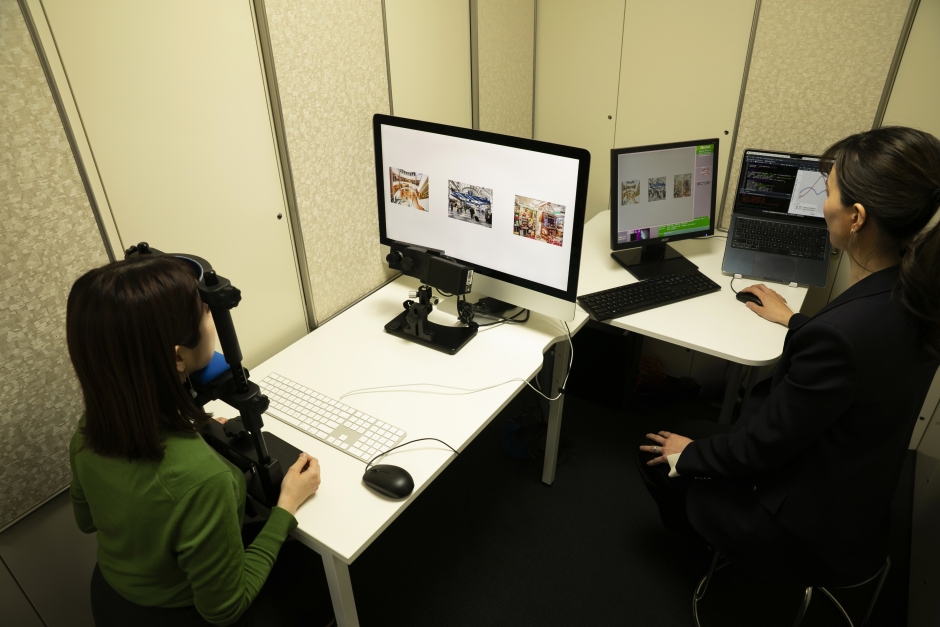
Professor Nakamura’s Research Equipment
Associate Professor Nakamura uses several approaches, including syntactically ambiguous sentences.
“Consider the question, ‘Where did Lizzie tell someone that she was going to catch butterflies?’ It is ambiguous whether ‘where’ asks about the place where she would catch butterflies or where she made the statement. Ambiguity exists in both English and Japanese, but word order and the distance between ‘where’ and the element it modifies differ. Examining how bilinguals process such sentences can reveal whether interpretation depends simply on distance or on language-specific syntactic representations. Comparisons among bilinguals, monolinguals, native English speakers, and native Japanese speakers should help reveal sentence-comprehension processes shared across human language.”
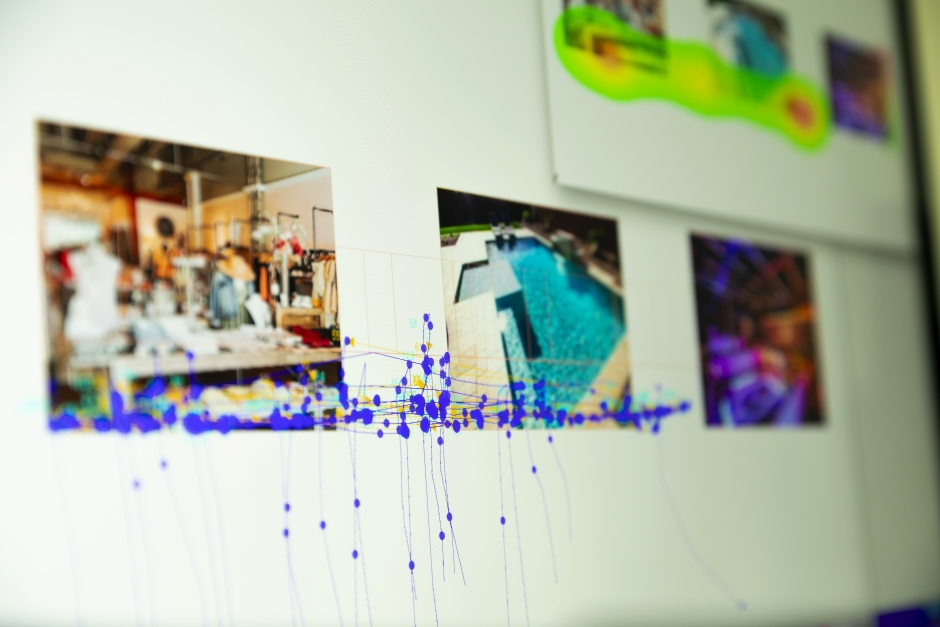
Eye-tracking analysis screen. When viewing images while recognizing ambiguous sentences, it is possible to observe the brain’s processing over time, such as excluding irrelevant images, repeatedly examining images that cause hesitation, and focusing attention on images judged to be correct.
The experiments use eye tracking and electroencephalography (EEG). Mapping eye movements while participants view a sentence and related images allows real-time analysis of sentence comprehension. EEG captures neural responses when meaning or structure differs from expectations and shows how comprehension unfolds over time.
“Ultimately, I hope to abstract sentence-comprehension and learning mechanisms from experimental data and construct a mathematical model capable of explaining them comprehensively. Identifying processes shared by humans could yield methods for language education and learning systems and contribute to improved language understanding in artificial intelligence.”
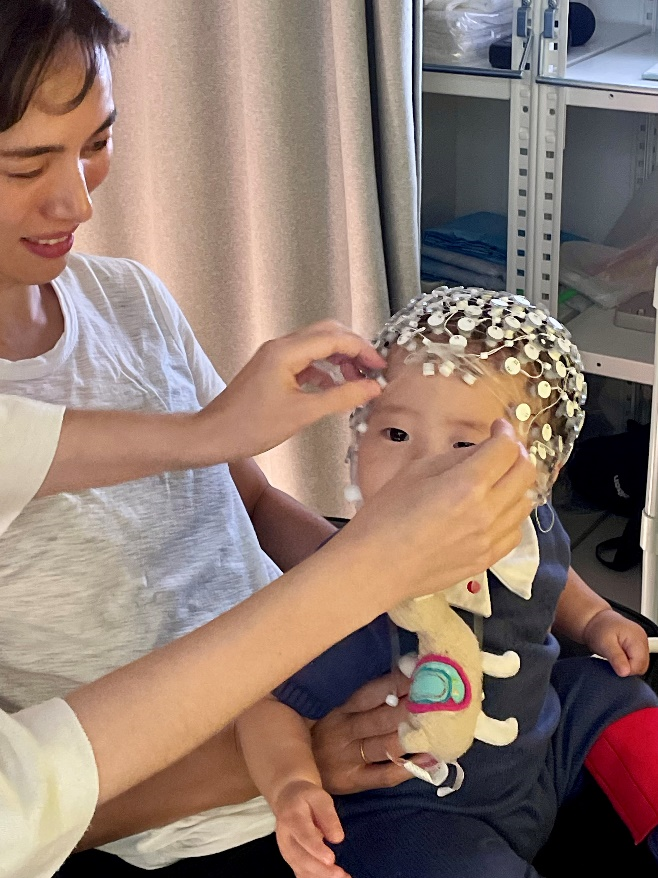
Measuring brainwaves. It is possible to capture the detailed processing of how the brain comprehends sentences in a very fine temporal resolution on the order of milliseconds.
“To increase both the quantity and quality of data, it would be ideal to conduct eye tracking and EEG recording simultaneously. Through the PI Advancement Program, I hope to create an integrated environment and use the funding to expand equipment, hire assistants, and organize workshops, substantially improving research precision.”
A Tailor-Made Support Program Designed around the Needs of PIs
Established in 2022, the PI Advancement Program provides tailor-made support because the needs of researchers pursuing original work differ. In principle, it is open to researchers within 15 years of receiving their doctoral degree. Selected researchers receive research promotion funding and advice on expanding research networks and planning international collaborations. University Research Administrators* in the Research Strategy Section of Waseda University’s Research Innovation Center also provide hands-on support for securing major external funding and promoting industry-academia collaboration.
What kinds of achievements will the four selected researchers cultivate in the years ahead? We look forward to following their progress.
*University Research Administrator: A professional who works with researchers and administrative staff to acquire research resources, plan and manage research, and facilitate the use of research outcomes, supporting more active research and stronger R&D management.