Rising Researchers Demonstrating Their Originality: Professor Yasuaki Shinohara
Wed, Nov 18, 2026-
Tags
Unraveling the Mechanisms of Speech Perception through Cognitive Neuroscience

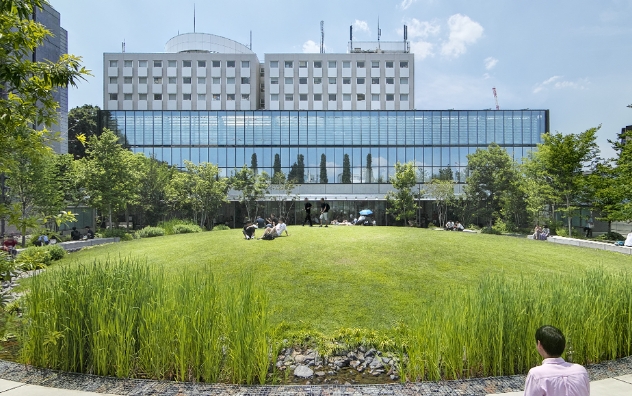
Associate Professor Yasuaki Shinohara, Faculty of Commerce. Photo location: Nishi-Waseda Campus.
Associate Professor Yasuaki Shinohara of the Faculty of Commerce has approached phonetics through the study of how humans produce and perceive speech sounds, analyzing the mechanisms of speech production and perception from an acoustic perspective.
“Recently, I have become particularly interested in phonemes, such as consonants and vowels, and the allophones that occur within a phoneme. For example, the /t/ in the word ‘butter’ is pronounced differently in British and American English, [t] in the former and [ɾ] in the latter. These are called allophones. Although they are phonetically different sounds, why are they perceived as the same phoneme /t/? I aim to elucidate the neural processing mechanisms behind this.”
The theme selected for the PI Advancement Program is “Neural Processing of Speech Sounds: Analyzing Phoneme Recognition through Event-Related Potentials.” The project investigates, from the perspective of cognitive neuroscience, how the brain processes phoneme recognition and the perception of allophones.
“Our broad objective is to analyze, through neural responses, the processes by which humans perceive, discriminate, and recognize speech sounds. Under the PI Advancement Program, we will first compare the electroencephalographic responses of British English and American English speakers. A particularly important challenge is analyzing neural responses to allophones.”
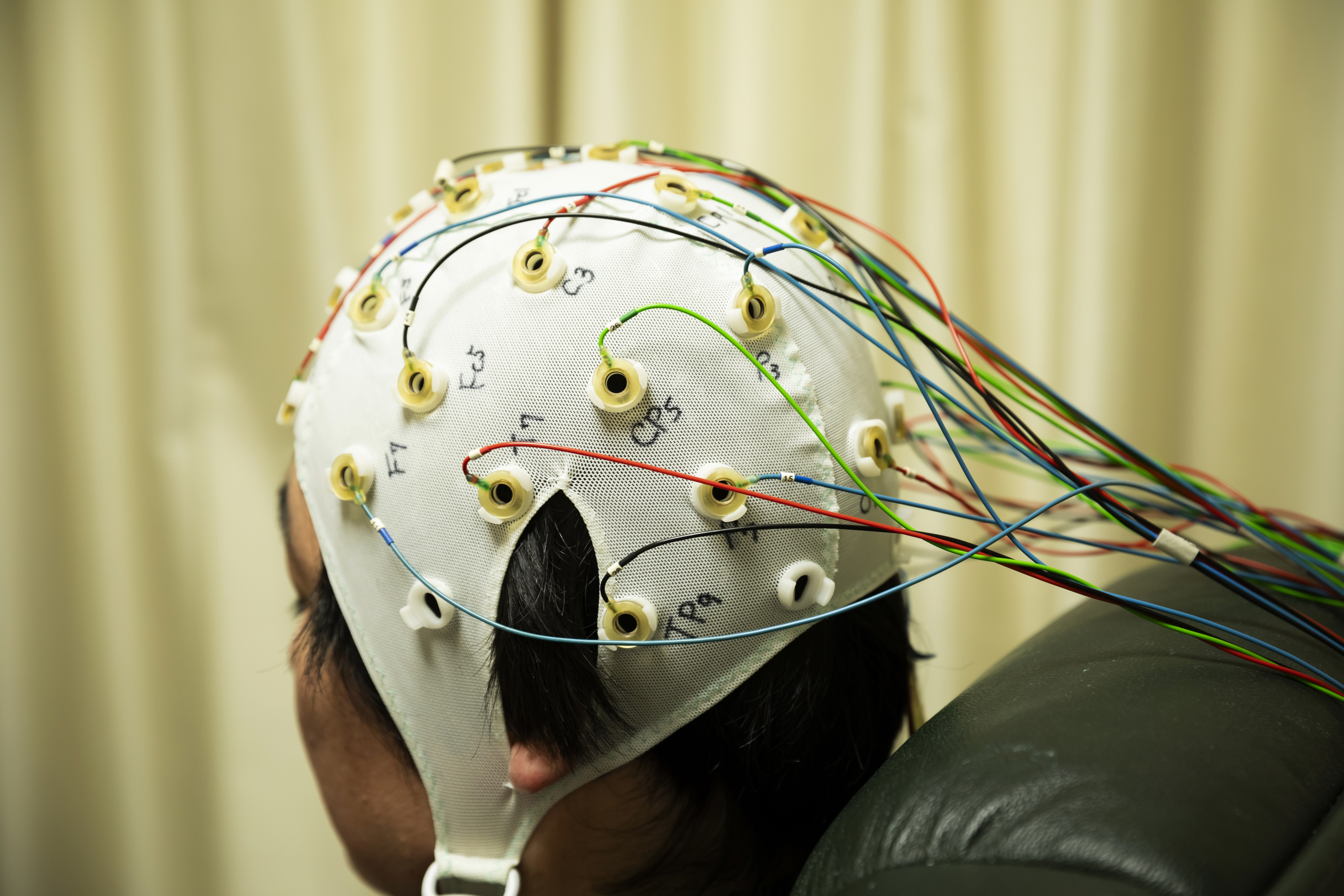
Electroencephalography (EEG) equipment. Accurate data collection also requires facilities such as a sound-attenuated room.
With current methods, EEG responses to distinct phonemes can be measured. Allophones, by contrast, occur within the same phoneme and do not constitute independent phonological categories. Based on Associate Professor Shinohara’s view that “the brain is simply processing speech sounds statistically,” allophones that do not form independent categories should nevertheless produce changes in EEG responses similar to those elicited by phonemes.
“After birth, as humans develop, they perceive and discriminate countless speech sounds and gradually establish phonemic categories. This is a relatively simple process based on how frequently speech sounds are heard, which explains why neural responses to phonemes differ according to the native-language environment. If so, we should also be able to detect neural responses to allophones in the same way as to phonemes. We will test this hypothesis through measurement experiments.”
The analysis focuses on an event-related potential (ERP) component known as mismatch negativity (MMN). MMN reflects responses related both to auditory discrimination of acoustic differences and to phonological discrimination between phonemes. One of the project’s distinctive features is that these responses are measured separately to clarify the process of phoneme recognition. Collecting and analyzing MMN data requires resources including EEG equipment, a sound-attenuated room, and research personnel.
“We will use the PI Advancement Program’s research promotion funding to expand our equipment, enhance the laboratory environment, and secure personnel. By establishing the necessary research environment and hiring a postdoctoral researcher who can share responsibility for data collection, analysis, and the supervision of research assistants, we should be able to increase our research output. In phonetics, publication in leading international journals is especially important, but Japan still lags behind Europe and the United States. I hope to create a virtuous cycle that includes researcher development and, ultimately, establish Waseda University as a major center for phonetics.”
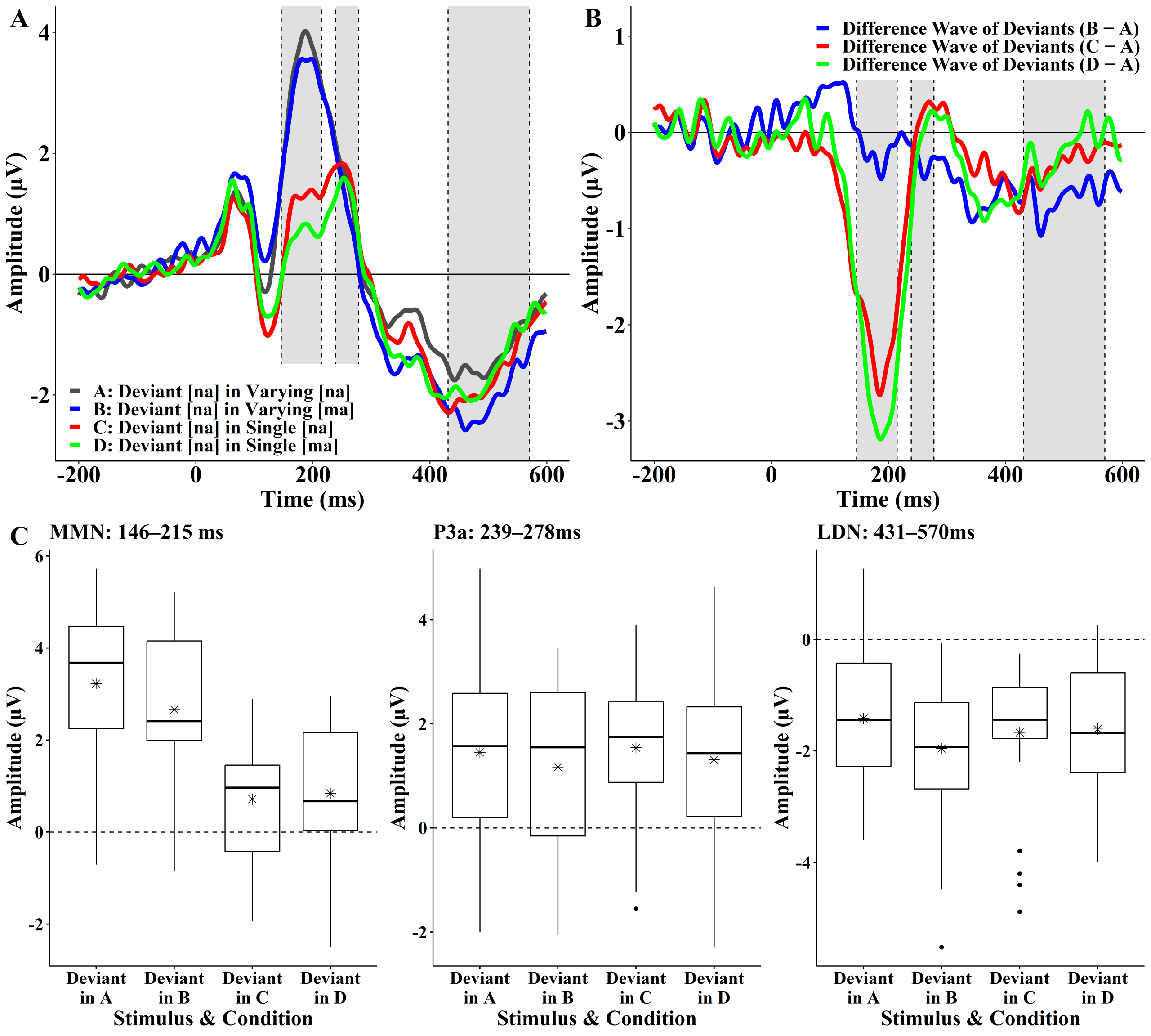
Analysis of mismatch negativity (MMN) (Shinohara & Shafer, 2026, Fig. 4) Shinohara, Y., & Shafer, V. L. (2026). Neural indices of phonological and acoustic–phonetic perception. Brain and Language, 273, 105685. https://doi.org/10.1016/j.bandl.2025.105685
The research also has potential applications that could benefit society. One is identifying the stage of perception at which difficulties arise. For example, if factors contributing to cognitive decline in older adults can be identified by examining relationships between neural responses and lifestyle habits, the findings could support efforts to improve health across society.
“Speech-perception ability varies greatly from one older adult to another. If these differences are related to cognitive ability, analyzing the relationship between EEG responses and lifestyle habits may reveal factors that help people maintain higher cognitive function. This could contribute to addressing challenges in an aging society, including enabling more people to remain active in the workforce for longer.”
Associate Professor Shinohara is also exploring educational applications. In a separate collaborative project, EEG responses to phonemes and allophones are being used to investigate the stage of speech perception at which children with autism spectrum disorder experience difficulties, with the longer-term aim of contributing to earlier identification of developmental disorders.
“Applications in education and clinical settings require the collection of very large datasets. If my research methods can be established and EEG data can be converted into reliable indices, we should be able to identify a wide range of difficulties in perceptual processing. To that end, my first goal is to clarify the relationships among EEG responses, speech perception, and cognitive ability over the next ten years.”
A Tailor-Made Support Program Designed around the Needs of PIs
The PI Advancement Program, under which three early-career researchers were selected this year, was established by Waseda University in 2022. Because the research pursued by PIs is inherently original, the type of support they require also differs from one researcher to another. The program’s defining feature is its tailor-made approach, providing support appropriate to the individual needs of each PI.
In principle, the program is open to researchers within 15 years of receiving their doctoral degree. Selected researchers receive research promotion funding intended for purposes such as improving their research environment, allowing it to generate synergies with other research funds. They can also receive advice from a team of advisors on topics including expanding domestic and international research networks and planning and proposing international collaborative research. In addition, University Research Administrators (URAs) in the Research Strategy Section of Waseda University’s Research Innovation Center provide hands-on support for securing major external research funding and promoting industry-academia collaboration, among other activities.
What kinds of achievements will the three selected researchers cultivate in the years ahead? We look forward to following their progress.