
Optical Skyrmions Can Control the Motion of Magnetic Skyrmions
Tue, Oct 13, 2026-
Tags
Optical Skyrmions Can Control the Motion of Magnetic Skyrmions
Researchers explore how topological patterns in light affect the motion of magnetic nanostructures, leading to many potential applications
Magnetic skyrmions (MSks) are nanoscale patterns of magnetization that can be created and moved around in magnetic materials. Despite being promising information carriers for future memory and computing technologies, precise control of their motion remains challenging. Now, researchers from Japan used micromagnetic simulations to investigate how MSks interact with optical skyrmions, their light-based counterparts. Their findings provide a new framework for controlling MSks with light, potentially connecting photonics and magnetism with promising applications.
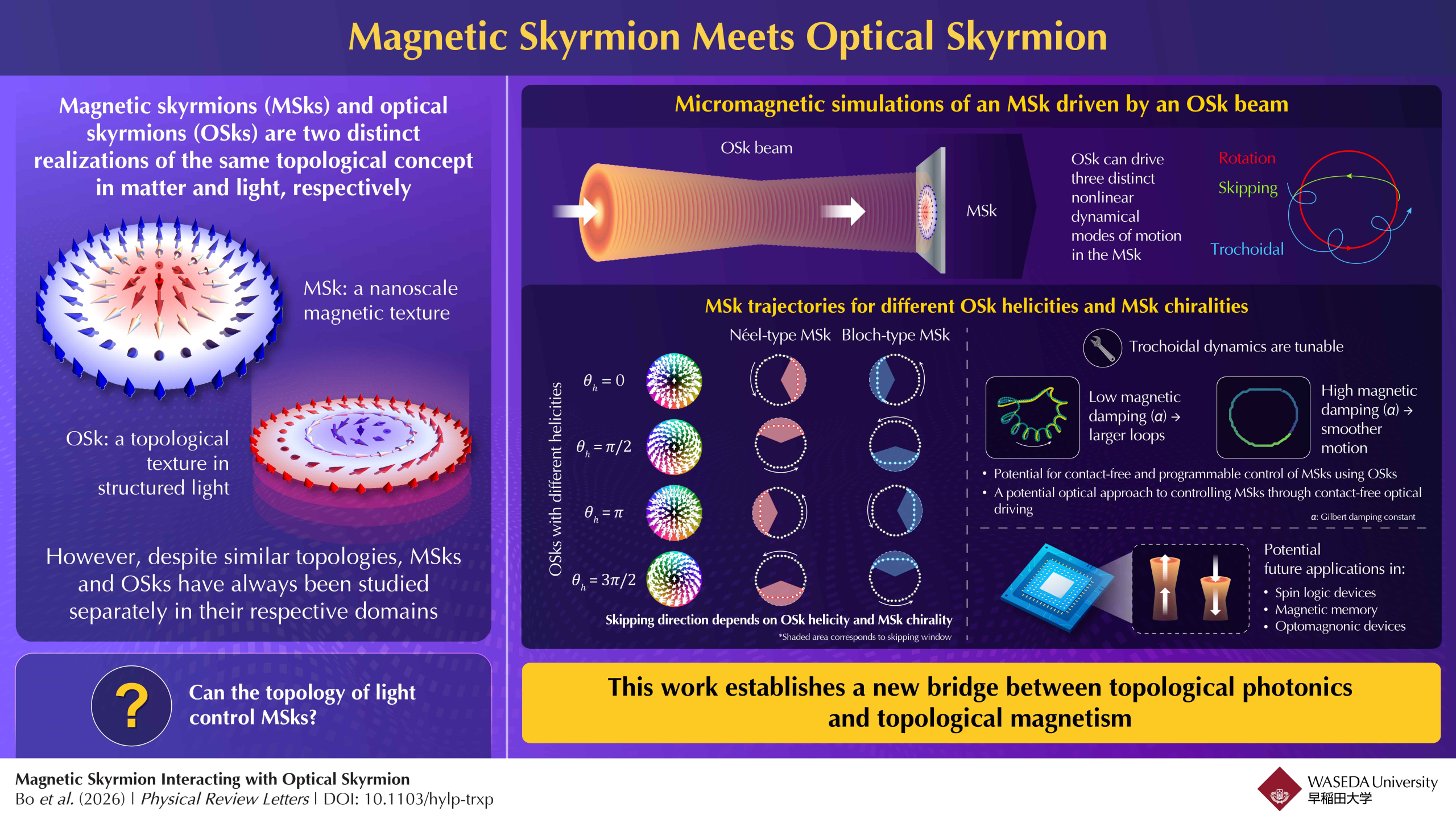
Image title: How optical skyrmions can be used to control magnetic skyrmions
Image caption: The phase and polarization structure of an optical skyrmion can be translated into the motion of a magnetic skyrmion, offering a potential route toward contact-free and programmable control of magnetic nanostructures in emerging technologies for processing and storage of information such as hybrid photonic spintronic or optomagnonic devices
Image credit: Dr. Lan Bo and Prof. Masahito Mochizuki from Waseda University, Japan
License type: Original content
Usage restrictions: Cannot be reused without permission
Magnetic skyrmions (MSks) are swirling patterns of magnetization that form inside certain magnetic materials. They can behave like actual particles in many ways, exhibiting a stable internal structure and distinct boundaries. Because they are extremely small and can be pushed around with relatively little energy, MSks are regarded as promising information carriers in emerging technologies, including low-power memories and logic circuits. However, a major goal in the field has been to find practical ways to control their motion with high precision.
Interestingly, MSks have a counterpart in light called optical skyrmions (OSks). These are structured polarization textures of electromagnetic fields that share the same underlying topological description as MSks. Despite their common topology, the two have been largely studied separately in their respective fields of magnetism and photonics. This raises a fundamental question: Can the topology of light control the dynamics of a MSk?
A research team led by Professor Masahito Mochizuki in the Department of Applied Physics at Waseda University, Japan, and Dr. Lan Bo, a Japan Society for the Promotion of Science (JSPS) postdoctoral fellow at Waseda University, attempted to fill the knowledge gap using micromagnetic simulations. Their study, co-authored by Dr. Xichao Zhang, a former research Associate Professor at Waseda University, was published online in Physical Review Letters journal on September 14, 2026.
Explaining the motivation behind their pioneering study, Dr. Bo explains, “The inspiration for this study came from a simple question: What happens when two different forms of topology, one in matter and one in light, meet? What fascinated us is that MSks and OSks are physically very different, that is, one exists in a magnetic material and the other in an electromagnetic field, but they are described by essentially the same topological concept.” He adds, “We therefore asked whether the topology and internal structure of light could directly control the dynamics of a topological magnetic texture.”
In their study, the team demonstrated the novel interaction between two forms of similar topologies: MSk and OSk. They explored how an OSk beam affects the motion of a single MSk on a thin magnetic layer. The beam was created using two types of structured light known as Laguerre-Gaussian modes, whose phase and polarization properties combined give rise to a skyrmion polarization pattern. The researchers then simulated how this generated optical field may drive the motion of the MSk using equations describing the light’s effect on magnetization and the internal dynamics of the magnetic material.
By analyzing the simulation results, the team identified three distinct types of motion in the MSk. The first type was a rotational motion around a fixed orbit, with its radius defined by the intensity gradient of the light. The second type corresponded to localized deviations from this orbit, which the researchers called ‘skipping.’ The third type was a looping trajectory known as trochoidal motion.
The researchers showed that each of these behaviors could be traced back to different properties of the incident light field. Most notably, the direction of the skipping motion was controlled by the swirling direction or ‘helicity’ of the vector field in the OSk, as well as the chirality or handedness of the MSk.
Simply put, the results suggest that changes in the intensity, phase, and polarization structure of the optical field can be used to precisely alter the trajectory of a MSk. “Our findings establish a new bridge between topological photonics and topological magnetism, opening a route toward contact-free and programmable control of MSks,” explains Prof. Mochizuki.
“For example, the induced rotational motion could potentially provide a basis for optically trapping and manipulation of MSks, analogous to optical tweezers, while the helicity-controlled skipping motion could enable selective trajectory steering and conversion of optical information into magnetic motion. The trochoidal motion may also provide an optically tunable oscillator-like response,” Dr. Bo further elaborates.
This interaction between information encoded in the structure of light and magnetic motion could provide a foundation for future optomagnonics (controlling magnetic properties using light) and spintronic (process and store data using electron charge and spin) technologies. Prof. Mochizuki concludes: “Future information technologies require faster, smaller, and more energy-efficient ways to store and process information, and MSks are attractive candidates for such technologies. By showing how the trajectory of a MSk could be optically controlled, our work reveals a new principle for connecting photonic information processing with spintronic information storage and computation.”
Title of original paper: Magnetic Skyrmion Interacting with Optical Skyrmion
Journal: Physical Review Letters
Authors: Lan Bo1, Jian Chen2, Xichao Zhang1,3,4,5, Yan Zhou6, Chengwei Qiu7, and Masahito Mochizuki1
Affiliations:
1Department of Applied Physics, Waseda University, Japan
2School of Optical-Electrical and Computer Engineering, University of Shanghai for Science and Technology, China
3Department of Electronic and Computer Engineering, The Hong Kong University of Science and Technology, China
4Department of Physics, The Hong Kong University of Science and Technology, China
5IAS Center for Quantum Matter, The Hong Kong University of Science and Technology, China
6School of Science and Engineering, The Chinese University of Hong Kong, China
7Department of Electrical and Computer Engineering, National University of Singapore, Singapore
DOI: 10.1103/hylp-trxp
About Professor Masahito Mochizuki
Dr. Masahito Mochizuki is a Professor at Waseda University, Japan. He received his Ph.D. from the University of Tokyo in 2003. His area of expertise is theoretical condensed-matter physics, and his research interests include strongly correlated electron systems, multiferroics, spintronics, topological magnetism, and photoinduced nonequilibrium phenomena. He is a member of the Physical Society of Japan, the Japan Society of Applied Physics, and the Magnetics Society of Japan.
About Dr. Lan Bo
Dr. Lan Bo is a Japan Society for the Promotion of Science (JSPS) Postdoctoral Fellow at Waseda University in Japan. He received his Ph.D. in Materials Science and Engineering from Northeastern University, China, in 2024, after conducting joint doctoral research at Waseda University. His research focuses on spintronics and topological magnetism, with particular emphasis on magnetic skyrmions, topological spin textures, and their nonlinear dynamics. He has published 22 peer-reviewed papers, including first-author works in Physical Review Letters, Communications Physics, Physical Review Research, Physical Review B, and Applied Physics Letters. He was selected as a 2026 IOP Trusted Reviewer and is a member of the IEEE.
About Associate Professor Xichao Zhang
Dr. Xichao Zhang was an Associate professor at Waseda University in Japan. He received his Ph.D. from Shinshu University in 2018. His research centers on the dynamics and functionalization of interacting topological quasiparticles on artificially structured magnetic surfaces and interfaces. He pursues interdisciplinary research at the interface of magnetism, soft matter, active matter, and fluid science, which may contribute to the design and development of unconventional applications, including artificial intelligence. He is a recipient of the Waseda Research Award, and he is a senior member of the IEEE. He joined Hong Kong University of Science and Technology as a scientist in 2026.